Teesta sees 'attempt to suppress freedom'

[email protected] (CD Network | Photos by Suresh)
January 30, 2016

sdm 1

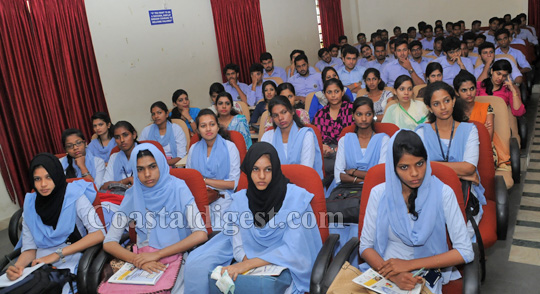
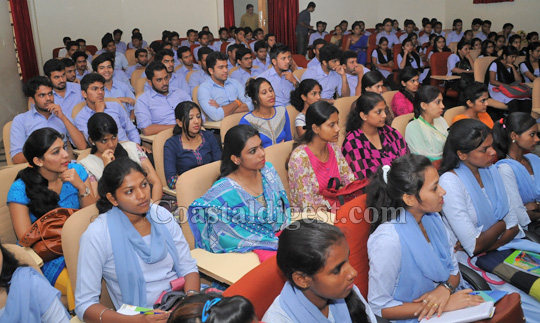
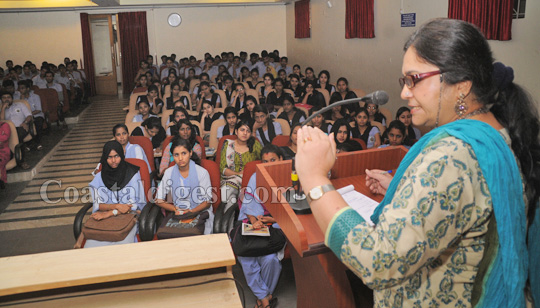
Mangaluru, Jan 29: Human rights activist Teesta Setalvad said human rights would be protected when youth develop a power to raise voice against injustice in the society.

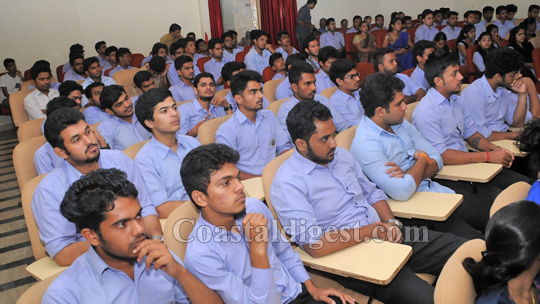
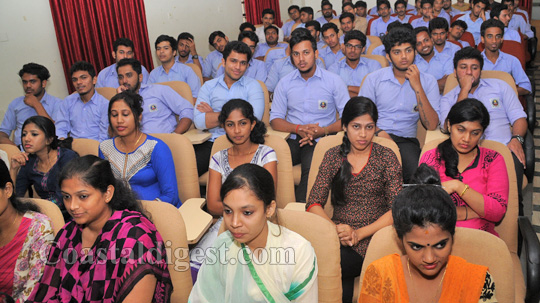
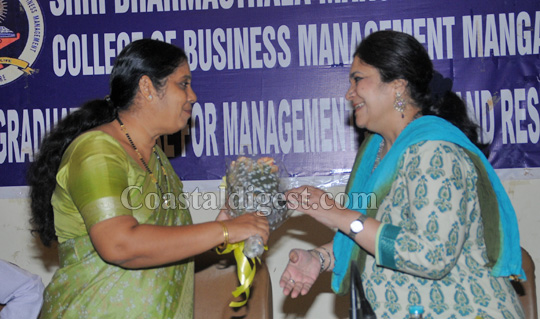
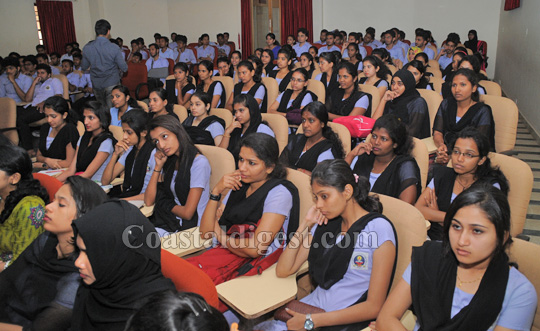
At an interaction with the students organised by the SDM College of Management, in association with Centre for Integrated Learning and Campus Career Academy here on Friday, she said the youth should question the society if they feel it is wrong.

“The Constitution has guaranteed freedom of speech and expression, but an attempt is being made to suppress this right. The suicide of research scholar Rohith Vemula has clearly highlighted inequality in education sector. The youth should bring about changes in education system and thereby try to open the eyes of the government. In spite of the UK being a capitalist country, the country has given stress on public education system. In India, the preference is given for the private educational institutions.”

Answering to a question posed by a student on choice of food, she said that the diversity in food habits is a part of the plurality of cultures and the right to consume food is guaranteed by the Constitution. It is left to the individual to decide what food he wants to consume and not to consume.”

Expressing concern over immoral rowdyism (moral policing) that is rampant in Mangaluru, she said it is a part of violation of human rights wherein a sense of insecurity is created in the minds of youth.

Stating that elections are in the hands of money and corporate forces, she said that the textbooks do not have lessons on social movements in the country.

“Even after 70 years of independence, we are till in colonial mindset and the discrimination between male and female children has failed go away from our mindset. About 35 per cent of the people are still reeling under poverty,” she felt.
sdm 3

sdm 4

sdm 5

sdm 6

sdm 7

sdm 8

Comments

Zahoor Ahmed
 - 
Saturday, 30 Jan 2016

After 70 years we got Sangh mindset HRD Minister.Next we move to Colonial to manuvada.

Add new comment

  • Coastaldigest.com reserves the right to delete or block any comments.
  • Coastaldigset.com is not responsible for its readers’ comments.
  • Comments that are abusive, incendiary or irrelevant are strictly prohibited.
  • Please use a genuine email ID and provide your name to avoid reject.
News Network
June 22,2020

Bengaluru, Jun 22: Senior Congress leader BK Hariprasad and BJP’s MTB Nagaraj, one of the defectors who helped the saffron party come to power in Karnataka, were unanimously elected to the Legislative Council along with five others on Monday. 

All seven were declared as “duly elected” by Legislative Assembly Secretary MK Vishalakshi, the returning officer for the biennial election to the Legislative Council. 

Hariprasad and Naseer Ahmed of the Congress, Nagaraj, R Shankar, Prathap Simha Nayak and Sunil Vallyapur of the BJP and Govinda Raju of the JD(S) are now MLCs. 

While Ahmed was an incumbent who will get another term, the six others will replace Jayamma, MC Venugopal, NS Bore Raju, HM Revanna and TA Sharavana and DU Mallikarjuna whose term ends June 30. 

While an election was scheduled June 29, it was not necessary as only seven candidates were in the fray for the seven seats on Monday, which was the last date for withdrawal of nominations. The nominations of A Yadavanahalli PC Krishnegowda and Mandikkal Nagaraja were rejected. 

With their rejection as MLCs, Nagaraj and Shankar - who jumped ship to the BJP last year - will now look to become ministers in Chief Minister BS Yediyurappa’s Cabinet. Both Nagaraj and Shankar were ministers when they resigned and defected from the Congress-JD(S) coalition. While Nagaraj lost the December 2019 bypolls, Shankar did not contest. 

Nagaraj, Shankar and Vallyapure were Yediyurappa’s picks for the Council, whereas Nayak is said to have been backed by BJP state president Nalin Kumar Kateel. 

There were many aspirants in the Congress for the Council berths, but Hariprasad and Ahmed were picked, given their experience. Hariprasad is widely believed to counter Siddaramaiah, who leads the party in the Assembly. 

Raju of the JD(S) runs a poultry business in Kolar and the choice of a fresh face is seen as the party leadership steering clear of any trouble as there were many asking for the ticket. 

Comments

Add new comment

  • Coastaldigest.com reserves the right to delete or block any comments.
  • Coastaldigset.com is not responsible for its readers’ comments.
  • Comments that are abusive, incendiary or irrelevant are strictly prohibited.
  • Please use a genuine email ID and provide your name to avoid reject.
News Network
May 1,2020

Bengaluru, May 1: As Mumbai link surfacing in some COVID-19 cases in Mandya district in Karnataka, JDS leader and former chief minister H D Kumaraswamy on Friday blamed the district administration for the situation, accusing it of not quarantining 7,000 labourers who 'returned' from the Maharashtra capital.

"The information we have is that there are about 16,000 labourers from Mandya were working in Mumbai of which 7,000 people reached the district. None of them was quarantined properly," Kumaraswamy told reporters in Bengaluru.

He claimed the district, a stronghold of JDS, was staring at a major spurt in cases due to the careless attitude of the district administration. "Government should initiate action against those who are responsible for the laxity," he said.

However, he did not specify when the 7,000 workers returned to Mandya. When asked about Kumaraswamy's claim, officials said they have to verify it. Of the eight cases reported from Mandya on Friday, three had a travel history to Mumbai, a major COVID-19 hotspot in the country, officials said.

A Health Department official said four of the fresh cases were contacts of a patient who tested positive on April 8 and admitted to a hospital. After weeks of coming in contact with him, the four were confirmed for COVID-19, an official said. The Three people with travel history to Mumbai had, in fact, brought the body of a man who died of a heart attack there on April 24, the official added.

Comments

Add new comment

  • Coastaldigest.com reserves the right to delete or block any comments.
  • Coastaldigset.com is not responsible for its readers’ comments.
  • Comments that are abusive, incendiary or irrelevant are strictly prohibited.
  • Please use a genuine email ID and provide your name to avoid reject.
News Network
June 26,2020

Bengaluru, Jun 26: The National Restaurant Association of India (NRAI) on Thursday came up with a Standard Operating Procedure (SOP) for restaurants whereby among other physical distancing norms, it has suggested a 2-metre gap between tables.

Formulated in partnership with Releski, a Bengaluru based skill-tech company, the SoP suggests that in case of back-to-back seating, people sitting with their backs towards each other will have their seats divided by 'Plexiglass' divider raised up to 2 meters from the ground.

"In a typical restaurant, the improvised seating plan should have a minimum distance of 2 metres between tables. The distance of 2 metres (6 feet) between tables should measure from one edge of the table to the other table's edge," it said.

In case of loose or free seating such as in banquet style or food court style seating, a minimum 2 meters of distance should be maintained between tables.

The guidelines noted that, to encourage physical distancing, restaurants have to sacrifice their seating capacity, to promote health and safety, and also to gain trust from their patrons.

"In order to perform this, divide your restaurants under different sectors. Pull out your restaurant's floor plan and colour code different sections red and yellow. Red sections are potential areas where maximum footfall or traffic is observed. Yellow sections are areas where the footfalls are average," it said.

All the red sections are encircled or bordered by placing barricades or Q manager and will open at specific points to access the yellow section and all the opening points will have hand sanitisers and sprays, and every guest who walks from red zones to yellow zones will sanitise himself/herself to reduce the chances of contamination.

For air conditioning, the guidelines of CPWD shall be followed which inter alia emphasises that the temperature setting of all air conditioning devices should be in the range of 24-30 degree Celsius, relative humidity should be in the range of 40- 65 per cent, intake of fresh air should be as much as possible and cross ventilation should be adequate, the guidelines suggested.

The industry body has also suggested appointment of a COVID-free Ambassador who would operate as the Chief Health Officer within the restaurant team, preferably from the management team in each shift.

The ambassador's would put the new daily work routines into practice, to monitor compliance with good practice and to lead the preventative measures, adapt to health & safety recommendations and requirements of the restaurant and oversee the implementation of the norms.

Anurag Katriar, President of NRAI and CEO & Executive Director of deGustibus Hospitality, said: "Every restaurant cutting across formats is facing the harsh reality of subdued to shut business volumes in the present and the uncertainty of business environment in the future. One thing is certain that hygiene and safety will be a key differentiator in the post-pandemic restaurant operations."

Comments

Add new comment

  • Coastaldigest.com reserves the right to delete or block any comments.
  • Coastaldigset.com is not responsible for its readers’ comments.
  • Comments that are abusive, incendiary or irrelevant are strictly prohibited.
  • Please use a genuine email ID and provide your name to avoid reject.