Temple desecration: Internet services suspended in Jammu

June 17, 2016

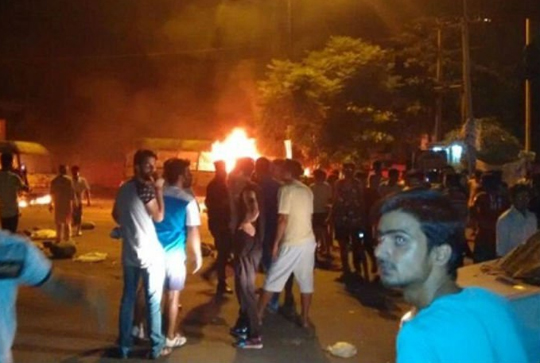
Jammu, Jun 17: Authorities today decided to suspend all Internet services across Jammu region to stop spread of rumours on social networking sites following the desecration of a temple here last evening.

desecration

All mobile and broadband-based Internet services have been suspended, a district official said.

"To stop rumour mongering on social networking sites in the wake of the desecration of Shiv temple in Nanak Nagar area, the authorities decided to temporarily suspend all Internet services including mobile and landline Internet services," the official said.

One more temple was allegedly desecrated in Jammu yesterday, leading to tension briefly in parts of the city.

"A man entered a temple in the Nanak Nagar area and tried to vandalise it. The man has been identified and arrested," Deputy Commissioner of Jammu Simrandeep Singh had said.

A large number of people came onto the roads after news spread. Shopkeepers in the area downed their shutters and held a protest demanding action against the accused.

"Though some people held protest in the area, the situation is normal and under control. Adequate police personnel have been deployed to foil any untoward incident in the area," Singh said.

The incident took place even as normalcy had returned to Jammu following alleged desecration of a temple in another area Roopnagar on Tuesday by a man who was described by police as "mentally disturbed". The city had witnessed violence and arson over that incident.

Comments

naren kotian
 - 
Friday, 17 Jun 2016

arming hindus like jews in judea and samaria ( israel) should happen in Jammu ... enough is enough ... shoot at sight and coordinate with army and finish the followers of rotten stuff ... pundits and hindus only areas must be created in valley .

Add new comment

  • Coastaldigest.com reserves the right to delete or block any comments.
  • Coastaldigset.com is not responsible for its readers’ comments.
  • Comments that are abusive, incendiary or irrelevant are strictly prohibited.
  • Please use a genuine email ID and provide your name to avoid reject.
News Network
April 20,2020

New Delhi, Apr 20: The Centre on Monday said that India's COVID-19 doubling rate has improved to 7.5 days from 3.4 days before the lockdown was enforced to check the spread of the coronavirus.

"India's doubling rate before the lockdown was 3.4 days. It has now improved to 7.5 days. As per data on April 19, in 18 States, the rate is better than the national average," said Lav Agarwal, Joint Secretary, Union Health and Family Welfare Ministry, at a daily briefing here.

"The number of districts where no case has been reported in the last 14 days has increased to 59 in 23 States and UTs. Goa is now COVID-19 free," he said.

India's total number of coronavirus positive cases has risen to 17,656 including 14,255 active cases, 2,842 cured/discharged/migrated and 559 deaths, according to the Ministry of Health and Family Welfare.

"Mahe in Puducherry, Kodagu in Karnataka and Pauri Garhwal in Uttarakhand have not reported any COVID-19 case in last 28 days," said Agarwal.

Let us take a look at the top developments of the day regarding the COVID-19 situation in the country:

1. There are 23 active COVID-19 cases in Himachal Pradesh. 11 patients have recovered, four migrated out of the State and one person succumbed to the disease. A total of 2,902 people have been tested for COVID-19 so far, said Himachal Pradesh Health Department.

2. The number of COVID-19 cases has risen to 408 in Karnataka including 16 deaths and 112 discharges, according to the state Health Department. 18 new cases have been reported in the last 24 hours.

3. "14 new COVID-19 cases reported, all from Kashmir. The total number of cases now stands at 368, Jammu-55 and Kashmir-313," said Rohit Kansal, Principal Secretary, Planning, Union Territory of Jammu and Kashmir administration.

4. According to Punya Salila Srivastava, Joint Secretary, Ministry of Home Affairs, the Ministry wrote to Kerala government yesterday, expressing concerns over modified guidelines regarding lockdown. "Kerala has allowed some activities that violate the Ministry's instructions issued under the Disaster Management Act," she said.

5. Five more police personnel from Chandni Mahal police station have tested positive for COVID-19. Till now eight personnel from the police station have tested positive for the virus, according to the Delhi Police.

6. Total 57 new COVID19 cases and two deaths have been reported today. Cumulative positive cases now stand at 1,535, and toll at 25, said Rajasthan's Health Department.

7. Indian Council of Medical Research (ICMR) has said that RTPCR kits are US FDA approved and have good standards and these should be stored under 20-degree temperature for better result.

8. "A total of 283 more COVID-19 cases have been reported in Maharashtra, taking cumulative positive cases in the State to 4,483, as of 11 am today. Of the 283 new cases, Mumbai has recorded 187," said Rajesh Tope, Maharashtra Health Minister.

9. One new COVID-19 positive case was reported today in Bokaro, taking the total number of cases in the State to 42, said Nitin Madan Kulkarni, Jharkhand's Health Secretary.
10. According to Punjab's Health Department, only one person has been tested positive for COVID-19 in the State today. The person is a contact of the COVID-19 patient.

11. "There is only one red zone district in Chhattisgarh. For the last 72 hours, no COVID-19 positive patient has been found even in that red zone district. I am hoping that whole of Chhattisgarh will be green zone soon," said Chief Minister Bhupesh Baghel.

12. Six new COVID-19 cases were reported in Kerala, all from Kannur, of which 5 have foreign travel history. Total cases in the State at 408, including 114 active cases, said Kerala Chief Minister Pinarayi Vijayan.

Meanwhile, the Centre has constituted six Inter-Ministerial Central Teams (IMCTs), two each for West Bengal and Maharashtra and one each for Madhya Pradesh and Rajasthan to make an on-spot assessment of the situation and issue necessary directions to the state authorities for their redressal and submit a report to the Central government in the larger interest of the general public.

Comments

Add new comment

  • Coastaldigest.com reserves the right to delete or block any comments.
  • Coastaldigset.com is not responsible for its readers’ comments.
  • Comments that are abusive, incendiary or irrelevant are strictly prohibited.
  • Please use a genuine email ID and provide your name to avoid reject.
Agencies
June 21,2020

New Delhi, June 21: Diesel prices rise to record high after 60 paise hike in rates, petrol up 35 paise; rates up by Rs 8.88 and Rs 7.97 in 15 days.

Petrol price in Delhi was hiked to Rs 79.23 per litre from Rs 78.88, while diesel rates were increased to Rs 78.27 a litre from Rs 77.67, according to a price notification of state oil marketing companies. 

In Bengaluru, petrol will be costlier by 37 paise at Rs 81.81 per litre, while diesel will cost 57 paise more per litre at Rs 74.43.

Rates have been increased across the country and vary from state to state depending on the incidence of local sales tax or VAT.

The 15th daily increase in rates since oil companies on June 7 restarted revising prices in line with costs after ending an 82-day hiatus in rate revision, has taken diesel prices to a new high. The petrol price too is at a two-year high.

Over 63 per cent of the retail selling price of diesel is taxes. Out of the total tax incidence of Rs 49.43 per litre, Rs 31.83 is by way of central excise and Rs 17.60 is VAT. 

Petrol in Mumbai costs Rs 86.04 per litre and diesel is priced at Rs 76.69.

Prior to the current rally, the peak diesel rates had touched was on October 16, 2018 when prices had climbed to Rs 75.69 per litre in Delhi. The highest-ever petrol price was on October 4, 2018 when rates soared to Rs 84 a litre in Delhi.

When rates had peaked in October 2018, the government had cut excise duty on petrol and diesel by Rs 1.50 per litre each. State-owned oil companies were asked to absorb another Re 1 a litre to help cut retail rates by Rs 2.50 a litre.

Oil companies had quickly recouped the Re 1 and the government in July 2019 raised excise duty by Rs 2 a litre.

The government on March 14 hiked excise duty on petrol and diesel by Rs 3 per litre each and then again on May 5 by a record Rs 10 per litre in case of petrol and Rs 13 on diesel. The two hikes gave the government Rs 2 lakh crore in additional tax revenues.

Oil PSUs Indian Oil Corp (IOC), Bharat Petroleum Corp Ltd (BPCL) and Hindustan Petroleum Corp Ltd (HPCL), instead of passing on the excise duty hikes to customers, adjusted them against the fall in the retail rates that was warranted because of a decline in international oil prices to two-decade lows.

International oil prices have since rebounded and oil firms are now adjusting retail rates in line with them.

In 15 days of hike, petrol price has gone up by Rs 7.97 per litre and diesel by Rs 8.88 a litre.

Comments

Add new comment

  • Coastaldigest.com reserves the right to delete or block any comments.
  • Coastaldigset.com is not responsible for its readers’ comments.
  • Comments that are abusive, incendiary or irrelevant are strictly prohibited.
  • Please use a genuine email ID and provide your name to avoid reject.
Agencies
January 20,2020

New Delhi, Jan 20: The BJP has got a brand new President in the form of JP Nadda. At around 2.30 pm, the announcement was made, bringing an end to the Amit Shah era in BJP. The party's Working President Jagat Prakash Nadda won unopposed, sparking celebrations outside the BJP headquarters here on Monday. 

Amit Shah himself was among the people who proposed Nadda's name along with Nitin Gadkari and Rajnath Singh. Soon after his annointment, BJP election returning officer Radha Mohan Singh told the media, "I announce JP Nadda as the new BJP President." Shah was also seen hugging Nadda.

The nomination process for the post of the BJP President began at 10 am and went on till 12.30 pm. For the next hour, the filed nomination paper, which was just one, was examined. Party members waitied till 2.30 pm for the candidate to withdraw if he wished to. It was after this that Nadda was declared as the man who would step into the shoes of Amit Shah.

Many in the BJP believe that although Nadda is the BJP chief now, Shah would still make all macro-level decisions like pre poll alliances or top organisational appointments. Nadda would be in charge of monitoring the day-to-day needs of the organisation. BJP sources say that Amit Shah himself wanted an arrangement like this one and personally wanted Nadda to take over. as he helped Shah formulate legislations like Triple Talaq and Citizenship Amendment Act.

The party constitution mandates completion of election of at least 50 per cent of state Presidents for the election of national President to happen. In the last few days, the BJP has completed the election of a slew of state Presidents like in West Bengal, Nagaland among others.

The process of election of the national BJP President is quite elaborate and has been described in detail in the party constitution, which says that the national president shall be elected by an electoral college, comprising members of the national council and the state councils.

"Any 20 members of the electoral college of a state can jointly propose the name of a person, who has been an active member for four terms and has 15 years of membership, for the post of national president. Such joint proposal should come from not less than five states where elections have been completed for the national council. The consent of the candidate is necessary," it says.

Who is JP Nadda?

Jagat Prakash Nadda, 59, who has his roots in the Rashtriya Swayamsevak Sangh (RSS) and its affiliates, was appointed the Bharatiya Janata Party (BJP) national President on Monday, replacing his 'mentor' and Union Home Minister Amit Shah.

Former environment, health and law minister from Himachal Pradesh, which has just four of the Lok Sabha's 543 seats, Nadda has tried to carve out his own space in national politics with his low profile and astute organisational skills, believe his party leaders.

He rose through the ranks from the Akhil Bharatiya Vidyarthi Parishad (ABVP), the student wing of the RSS, from where he has managed to build inroads from university to the state politics.

Nadda has been active on the national political scene since 2010 when he was picked by then BJP chief Nitin Gadkari to join his new team. He was made the party's national general secretary.

Born on December 2, 1960, Nadda did his graduation from Patna and holds a post-graduate degree in political science and Bachelor of Legislative Law (LL.B) from Himachal Pradesh University in Shimla.

Starting his political career as a student leader of the ABVP in 1978, Nadda had also worked both with Gadkari and Shah even in the party's youth wing -- the Bharatiya Yuva Morcha -- from 1991 to 1994.

His wife Mallika Nadda, who teaches history at the Himachal Pradesh University and is currently posted in university's campus in Delhi, was an ABVP activist too, and its national general secretary from 1988 to 1999.

In the previous BJP government (2007-12) in the state, Nadda was forced to resign as Forest Minister in 2010 owing to differences between him and then chief minister Prem Kumar Dhumal.

He was elected to the Rajya Sabha in 2012.

Nadda won his first Assembly election from Bilaspur (Sadar) in Himachal in 1993. In 1998, he again won from that seat and became the state Health Minister.

He lost the Assembly elections in 2003, but again won in 2007 and was appointed the Forest Minister in the Himachal Pradesh.

Nadda, as a forest minister, was the brain behind opening forest police stations to check forest crimes, launching community-driven plantation, setting up forest ponds and the massive plantation of deodars to boost the depleting green cover of the 'Queen of Hills', as Shimla was fondly called by the British.

A close confidant of Prime Minister Narendra Modi, Nadda was among those who were mentioned as likely aspirants to the BJP top post after Rajnath Singh was inducted into the Central government as the Home Minister in 2014.

Later, Nadda was inducted into the union cabinet in its first expansion in 2014 as the Health Minister.

Hailing Nadda's appointment, Chief Minister Jai Ram Thakur told IANS it is a proud moment that a leader belonging to a small state in the national politics is today the leader of the country's biggest national party.

His father N.L. Nadda, who was a Vice-Chancellor of the Ranchi University, resides in Bilaspur town.


Comments

Add new comment

  • Coastaldigest.com reserves the right to delete or block any comments.
  • Coastaldigset.com is not responsible for its readers’ comments.
  • Comments that are abusive, incendiary or irrelevant are strictly prohibited.
  • Please use a genuine email ID and provide your name to avoid reject.