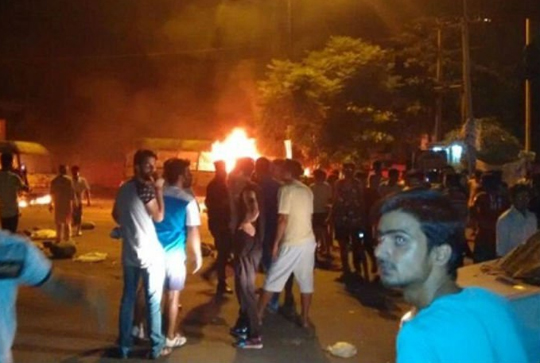
Temple desecration: Internet services suspended in Jammu

June 17, 2016

Jammu, Jun 17: Authorities today decided to suspend all Internet services across Jammu region to stop spread of rumours on social networking sites following the desecration of a temple here last evening.

desecration

All mobile and broadband-based Internet services have been suspended, a district official said.

"To stop rumour mongering on social networking sites in the wake of the desecration of Shiv temple in Nanak Nagar area, the authorities decided to temporarily suspend all Internet services including mobile and landline Internet services," the official said.

One more temple was allegedly desecrated in Jammu yesterday, leading to tension briefly in parts of the city.

"A man entered a temple in the Nanak Nagar area and tried to vandalise it. The man has been identified and arrested," Deputy Commissioner of Jammu Simrandeep Singh had said.

A large number of people came onto the roads after news spread. Shopkeepers in the area downed their shutters and held a protest demanding action against the accused.

"Though some people held protest in the area, the situation is normal and under control. Adequate police personnel have been deployed to foil any untoward incident in the area," Singh said.

The incident took place even as normalcy had returned to Jammu following alleged desecration of a temple in another area Roopnagar on Tuesday by a man who was described by police as "mentally disturbed". The city had witnessed violence and arson over that incident.

Comments

naren kotian
 - 
Friday, 17 Jun 2016

arming hindus like jews in judea and samaria ( israel) should happen in Jammu ... enough is enough ... shoot at sight and coordinate with army and finish the followers of rotten stuff ... pundits and hindus only areas must be created in valley .

Add new comment

  • Coastaldigest.com reserves the right to delete or block any comments.
  • Coastaldigset.com is not responsible for its readers’ comments.
  • Comments that are abusive, incendiary or irrelevant are strictly prohibited.
  • Please use a genuine email ID and provide your name to avoid reject.
Agencies
April 23,2020

New Delhi, Apr 23: The nationwide lockdown in India which started about a month ago has impacted nearly 40 million internal migrants, the World Bank has said.

The lockdown in India has impacted the livelihoods of a large proportion of the country's nearly 40 million internal migrants. Around 50,000 60,000 moved from urban centers to rural areas of origin in the span of a few days, the bank said in a report released on Wednesday.

According to the report -- 'COVID-19 Crisis Through a Migration Lens' -- the magnitude of internal migration is about two-and-a-half times that of international migration.

Lockdowns, loss of employment, and social distancing prompted a chaotic and painful process of mass return for internal migrants in India and many countries in Latin America, it said.

Thus, the COVID-19 containment measures might have contributed to spreading the epidemic, the report said.

Governments need to address the challenges facing internal migrants by including them in health services and cash transfer and other social programmes, and protecting them from discrimination, it said.

World Bank said that coronavirus crisis has affected both international and internal migration in the South Asia region.

As the early phases of the crisis unfolded, many international migrants, especially from the Gulf countries, returned to countries such as India, Pakistan, and Bangladesh until travel restrictions halted these flows.

Some migrants had to be evacuated by governments, such as those of China and Iran, it said.

Before the coronavirus crisis, migrant outflows from the region were robust, the report said.

The number of recorded, primarily low-skilled emigrants from India and Pakistan rose in 2019 relative to the prior year but is expected to decline in 2020 due to the pandemic and oil price declines impacting the Gulf countries.

In India, the number of low-skilled emigrants seeking mandatory clearance for emigration rose slightly by eight percent to 368,048 in 2019.

In Pakistan, the number of emigrants jumped 63 per cent to 6,25,203 in 2019, largely due to a doubling of emigration to Saudi Arabia, it said.

According to the bank, migration flows are likely to fall, but the stock of international migrants may not decrease immediately, since migrants cannot return to their countries due to travel bans and disruption to transportation services.

In 2019, there were around 272 million international migrants.

The rate of voluntary return migration is likely to fall, except in the case of a few cross-border migration corridors in the South (such as Venezuela-Colombia, Nepal-India, Zimbabwe South Africa, Myanmar-Thailand), it said.

Migrant workers tend to be vulnerable to the loss of employment and wages during an economic crisis in their host country, more so than native-born workers.

Lockdowns in labour camps and dormitories can also increase the risk of contagion among migrant workers.

Many migrants have been stranded due to the suspension of transport services. Some host countries have granted visa extensions and temporary amnesty to migrant workers, and some have suspended the involuntary return of migrants, it said.

Observing that government policy responses to the COVID-19 crisis have largely excluded migrants and their families back home, the World Bank said there is a strong case for including migrants in the near-term health strategies of all countries, given the externalities associated with the health status of an entire population in the face of a highly contagious pandemic.

The Bank said governments would do well to consider short, medium and long-term interventions to support stranded migrants, remittance infrastructure, loss of subsistence income for families back home, and access to health, housing, education, and jobs for migrant workers in host/transit countries and their families back home.

The pandemic has also highlighted the global shortage of health professionals and an urgent need for global cooperation and long-term investments in medical training, it said.


Comments

Add new comment

  • Coastaldigest.com reserves the right to delete or block any comments.
  • Coastaldigset.com is not responsible for its readers’ comments.
  • Comments that are abusive, incendiary or irrelevant are strictly prohibited.
  • Please use a genuine email ID and provide your name to avoid reject.
Agencies
February 29,2020

New Delhi, Feb 29: Former RBI governor Raghuram Rajan has said slowdown in growth is due to the current government focussing more on meeting its political and social agenda rather than paying attention to the economy.

India can still reverse its slowing economic growth by paying attention to key issues, he said. "It's a sad story, I think most recently, it is politics," Rajan said in response to a question on what was stopping India's growth which remains below potential.

In an interview to Bloomberg TV, Rajan said unfortunately the current government after a massive election win has "focussed more on fulfilling its political and social agenda rather than paying attention to the economic growth".

"Unfortunately, this drift has continued a pace of slowing growth, which was precipitated initially by some actions the government took such as the demonetisation and a poorly rolled out Goods and Services Tax (GST) reform," Rajan said.

India's GDP growth hit nearly 7-year low of 4.7 per cent in the December quarter, as per official data released on Friday.

The GDP growth for the quarter is the lowest since January-March of 2012-13.

In the interview, which was telecast before the official numbers were released, Rajan said India has not paid sufficient attention to cleaning up the financial sector and unfortunately, that is leading to the slowing growth.

"These are things that they can change if attention is paid to them and appropriate actions are taken," Rajan, Professor of Finance at University of Chicago Booth School of Business, said.

On being asked about the spread of the coronavirus globally and its impact, he said there will certainly be some legacy issues in terms of business rethinking in the global supply chain.

"If it is disrupted anywhere, the entire supply chain is held ransom and companies are going to start rethinking that should we actually have these really spread out global supply chain or to bring them back closer home and how much diversification should we have. Should we have multiple production sites across the world rather than have it focussed primarily in Asia," he said.

Comments

Add new comment

  • Coastaldigest.com reserves the right to delete or block any comments.
  • Coastaldigset.com is not responsible for its readers’ comments.
  • Comments that are abusive, incendiary or irrelevant are strictly prohibited.
  • Please use a genuine email ID and provide your name to avoid reject.
News Network
June 16,2020

New Delhi, Jun 16: Delhi Health Minister Satyendar Jain on Tuesday said that he has been hospitalised after suffering from high-grade fever and a sudden drop in his oxygen level.

He tweeted to inform that he was admitted to the Rajiv Gandhi Super Speciality Hospital (RGSSH) here, a dedicated COVID-19 facility under the Delhi government.

"Due to high-grade fever and a sudden drop of my oxygen levels last night I have been admitted to RGSSH. Will keep everyone updated," Jain tweeted.

Comments

Add new comment

  • Coastaldigest.com reserves the right to delete or block any comments.
  • Coastaldigset.com is not responsible for its readers’ comments.
  • Comments that are abusive, incendiary or irrelevant are strictly prohibited.
  • Please use a genuine email ID and provide your name to avoid reject.