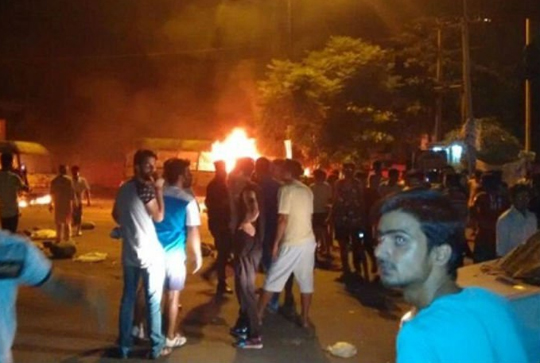
Temple desecration: Internet services suspended in Jammu

June 17, 2016

Jammu, Jun 17: Authorities today decided to suspend all Internet services across Jammu region to stop spread of rumours on social networking sites following the desecration of a temple here last evening.

desecration

All mobile and broadband-based Internet services have been suspended, a district official said.

"To stop rumour mongering on social networking sites in the wake of the desecration of Shiv temple in Nanak Nagar area, the authorities decided to temporarily suspend all Internet services including mobile and landline Internet services," the official said.

One more temple was allegedly desecrated in Jammu yesterday, leading to tension briefly in parts of the city.

"A man entered a temple in the Nanak Nagar area and tried to vandalise it. The man has been identified and arrested," Deputy Commissioner of Jammu Simrandeep Singh had said.

A large number of people came onto the roads after news spread. Shopkeepers in the area downed their shutters and held a protest demanding action against the accused.

"Though some people held protest in the area, the situation is normal and under control. Adequate police personnel have been deployed to foil any untoward incident in the area," Singh said.

The incident took place even as normalcy had returned to Jammu following alleged desecration of a temple in another area Roopnagar on Tuesday by a man who was described by police as "mentally disturbed". The city had witnessed violence and arson over that incident.

Comments

naren kotian
 - 
Friday, 17 Jun 2016

arming hindus like jews in judea and samaria ( israel) should happen in Jammu ... enough is enough ... shoot at sight and coordinate with army and finish the followers of rotten stuff ... pundits and hindus only areas must be created in valley .

Add new comment

  • Coastaldigest.com reserves the right to delete or block any comments.
  • Coastaldigset.com is not responsible for its readers’ comments.
  • Comments that are abusive, incendiary or irrelevant are strictly prohibited.
  • Please use a genuine email ID and provide your name to avoid reject.
News Network
March 2,2020

New Delhi, Mar 2: As communal violence spiked in north-east Delhi earlier this week, Hindu, Muslim and Sikh residents of a colony came together and stood guard against frenzied mobs which ran riot in nearby areas vandalising homes, shops and torching cars.

They have not let their guard down even as the situation is limping back to normalcy following four days of violence that has claimed at least 42 lives and left over 200 injured.

The B-Block colony in Yamuna Vihar has a Hindu-dominated Bahjanpura on one side and Muslim populated Ghonda on the other.

People from all faiths in the locality sit outside their homes at night and deal with any suspected outsider, Arib, a dentist in his 30s, said.

"It is the sloganeering by mobs that causes panic in the dead of night. Such slogans are from both sides and we hear groups of people moving forward towards our area.

"This is where we let the Muslim locals deal with Muslim groups and Hindu residents deal with Hindu groups coming from outside," he said.

Businessmen, doctors and people working at government offices stuck together as violence reached its crest on Monday and Tuesday, and have been guarding the locality round the clock.

Earlier, the locals had claimed inadequate police deployment in the area, but were satisfied as patrolling by security personnel increased in the last two days.

Charanjeet Singh, a Sikh who owns a transport firm, said residents have ensured that not too many people gather to guard the colony at night. It has been decided not use sticks or rods, an idea which seems to have worked in maintaining peace, he said.

"I was 10 years old when we came to this locality from Uttar Pradesh's Meerut in 1982. There were riots in 1984 and tension in 2002, but even then our area remained peaceful. We have always been united and that is the way we have helped each other," Singh, who is now in his 50s, told PTI.

Faisal, a businessman in his 30s, said after two days of major violence, there was palpable tension in the area. "Nobody could sleep in the neighbourhood even on Wednesday and Thursday when the situation was brought under control," he said.

Faisal said around 4 am on Wednesday, three to four miscreants had torched a car, but were chased away by vigilant residents. They raised an alarm and others gathered, saving other vehicles parked nearby from being damaged, he added.

On the idea of not keeping sticks while guarding B-Block, Singh said, "Violence begets violence, crowd begets crowd. We thought if somebody would see sticks or rods in our hands from a distance and large crowds standing guard, it is likely they would want to come prepared. This could fuel violence."

"Now, if there is some young man returning late in the night, we identify if he belongs to our area. If not, we normally inform him about the situation and guide him to his destination, if required," he added.

Seventy-year-old V K Sharma said people in his colony never had any trouble with each other, as he blamed "outside elements" for the violence in north-east Delhi.

"Some people have some problem with symbols. If they find a particular religion's symbol on a shop, home or a car, they vandalise it.

"This is on both sides, Hindus as well as Muslims. But not all people in all religion are like that. There are good people who outnumber these handful people involved in violence," he said.

The violence happened for two days but it would take months for fear to subside, Sharma said, as he took out his two granddaughters, aged nine and two, out for ice cream.

"I cannot reduce the tension outside my home, but at least I can make these kids feel good by reducing their craving for ice cream,” he added.

Colony resident Shiv Kumar, a property consultant, and Wasim, a government official, said they too were members of this voluntary guards' team of the colony which stays up at night to fend off miscreants.


Comments

Add new comment

  • Coastaldigest.com reserves the right to delete or block any comments.
  • Coastaldigset.com is not responsible for its readers’ comments.
  • Comments that are abusive, incendiary or irrelevant are strictly prohibited.
  • Please use a genuine email ID and provide your name to avoid reject.
News Network
June 6,2020

Thiruvananthapuram, Jun 6: The Sabarimala Temple in Kerala is set to reopen from June 14 for devotees for monthly pooja and festival.

The temple will be open for the five-day monthly rituals in the Malayalam month of Midhunom that begins on June 15. From June 19-28 is the Sabarimala festival

A virtual queue system has been put in place in which 200 people will be allowed to register within an hour, Devasom Minister Kadakampally Surendran said.

To avoid crowding, only 50 devotees will be allowed to be present in front of the temple.

Before entering the premises, people will be scanned in Pampa and Sannidhanam. As a precautionary measure, people have been asked to wear mask and sanitation would be carried out at regular intervals.

Notably, no accommodation will be provided to the devotees in Sabarimala.

According to the Devasom Minister the administration has made two slots for the temple visit-- 4 am to 1 pm and 4 pm to 11 pm.

Also, the vehicles will only be allowed till Pampa. People coming from other states are required to register at government COVID Jagrata pass registration portal. Moreover, Appam and Arvana will be provided only through online booking.

Also, the devotees coming from other states will have to upload Indian Council of Medical Research (ICMR) labs certificate as a proof that they have not been infected with the lethal infection.

Also for the Guruvayoor Temple, the district collector, police and temple administration will hold a meeting to decide on the re-opening of the Temple. Here too devotees have to get themselves registered online.

In a single day, 600 people would be allowed to offer prayers at this shrine. Each hour, 150 people will be allowed to enter the premises.

Also, the time slot will be provided to people. In one batch 50 people will be allowed for 15 minutes inside the premises

Not only that, but marriages can also again be solemnised with divine blessings at the Guruvayoor temple. The administration will allow only 60 marriages in a day.

Weddings were stopped at the temple, due to the COVID-19 lockdown that was in place since March 24.

A marriage group should not have more than 10 people, including the bride and the groom and it is mandatory for the group to abide by the social distancing norm.

Comments

Add new comment

  • Coastaldigest.com reserves the right to delete or block any comments.
  • Coastaldigset.com is not responsible for its readers’ comments.
  • Comments that are abusive, incendiary or irrelevant are strictly prohibited.
  • Please use a genuine email ID and provide your name to avoid reject.
News Network
January 12,2020

New Delhi, Jan 12: As many as 109 children were sexually abused every day in India in 2018, according to the data by the National Crime Records Bureau, which showed a 22 per cent jump in such cases from the previous year.

According to the recently released NCRB data, 32,608 cases were reported in 2017 while 39,827 cases were reported in 2018 under the Protection of Children from Sexual Offences Act (POCSO).

POCSO Act, 2012 is a comprehensive law to provide for the protection of children from offences of sexual assault, sexual harassment and pornography. It requires special treatment of cases relating to child sexual abuse such as setting-up of special courts, special prosecutors, and support persons for child victims.

As many as 21,605 child rapes were recorded in 2018 which included 21,401 rapes of girls and 204 of boys, the data showed.

The highest number of child rapes were recorded in Maharashtra at 2,832 followed by Uttar Pradesh at 2023 and Tamil Nadu at 1457, the data showed.

Overall crimes against children has increased steeply over six times in the decade over 2008-2018, from 22,500 cases recorded in 2008 to 1,41,764 cases in 2018, according to the NCRB data from 2008 and 2018.

In 2017, 1,29,032 cases of crime against children were recorded.

Priti Mahara, Director of Policy Research and Advocacy at CRY – Child Rights and You (CRY) said, that while on the one hand, the increasing numbers of crimes against children are extremely alarming, it also suggests an increasing trend in reporting which is a positive sign as it reflects people's faith in the system.

"It also provides a direction in which government interventions must be made and evidence needs to be created. While some major efforts have been taken to ensure child protection, a lot more is needed to see expected results on the ground," Mahara said.

In percentage terms, major crime against children during 2018 were kidnapping and abduction which accounted for 44.2 per cent followed by cases under POCSO, which accounted for 34.7 per cent, the data showed.

A total of 67,134 children (19,784 male,47,191 female and 159 transgender) were reported missing in 2018. During the year 2018, a total of 71,176 children (22,239 male, 48,787 female and 150 transgender) were traced, the NCRB data said.

As many as 781 cases of use of child for pornography or storing child pornography material was also recorded in 2018, more than double that of  2017 when 331 such cases were recorded, the data showed.

The state-wise segregation of crimes against children reveals Uttar Pradesh, Madhya Pradesh, Maharashtra, Delhi and Bihar accounted for 51 per cent of all crimes in the country, the data said.

While Uttar Pradesh tops the list with 19,936 recorded crimes against children (14 per cent of total crimes), Madhya Pradesh and Maharashtra are the close second and third with 18,992 and 18,892 crimes registered respectively.

The report also showed that cases of sexual harassment in shelter homes against women and children reportedly increased by 30 per cent, from 544 cases recorded in 2017 to 707 cases in 2018.

Mahara suggested that financial investments must be adequately increased with a focus on prevention of crimes against children and the identification of vulnerable children and families.

"Strengthening community-level child protection system is also a key to prevention. While there is growing evidence of the precarious lives that children in India are leading, it is essential that this evidence is used to effectively inform policy and programme initiatives," she said.

As many as 501 incidences were also recorded under The Prohibition of Child Marriage Act, a 26 per cent jump from 2017 when 395 cases were reported under the Act.

Comments

Add new comment

  • Coastaldigest.com reserves the right to delete or block any comments.
  • Coastaldigset.com is not responsible for its readers’ comments.
  • Comments that are abusive, incendiary or irrelevant are strictly prohibited.
  • Please use a genuine email ID and provide your name to avoid reject.