Tempo overloaded with cattle causes accident, 32 cows seized

[email protected] (CD Network, Photos by Suresh Vamanjoor)
July 12, 2014

Bejai Cow siezed1

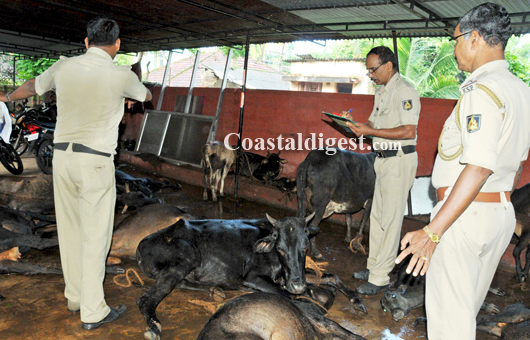
Mangalore, Jul 12: More than 30 cows were seized in Mangalore after a 407 tempo, in which they were being transported, hit into an auto rickshaw, a car and an electric pole.

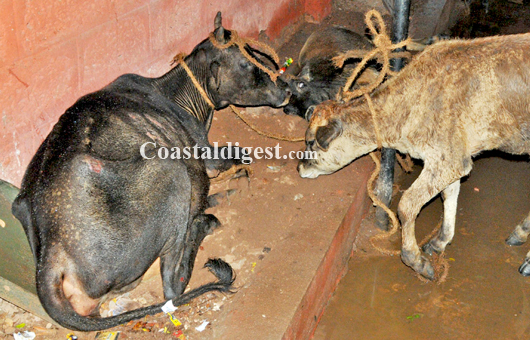
Police seized the tempo and 32 cattle which were tied up in cruel manner, eyewitnesses said. The animals were bruised due to overcrowding and had suffered serious injuries. They hardly had enough space to sit or stand freely, sources said.

They said that tempo driver lost control and hit the rickshaw near KSRTC bus stand in the city. While he was trying to speed away from the spot, he again rammed into a Ford Figo and an electric pole.

Though locals tried to catch hold of the culprits they managed to flee from the spot.

Unconfirmed sources said some of the cows died while being transported.

A case has been registered at Barke police station.

Bejai Cow siezed2

Bejai Cow siezed3

Bejai Cow siezed4

Bejai Cow siezed5

Bejai Cow siezed6

Ford Figo

Comments

Wilda
 - 
Saturday, 12 Mar 2016

I've been surfing online more than 4 hours today, yet I never found any interesting
article like yours. It is pretty worth enough for me. Personally, if all
website owners and bloggers made good content as you did, the
net will be a lot more useful than ever before.

Here is my weblog: sklep mayoral: http://www.changshengruikang.com/comment/html/?5895.html&page=

Add new comment

  • Coastaldigest.com reserves the right to delete or block any comments.
  • Coastaldigset.com is not responsible for its readers’ comments.
  • Comments that are abusive, incendiary or irrelevant are strictly prohibited.
  • Please use a genuine email ID and provide your name to avoid reject.
coastaldigest.com web desk
January 3,2020

Mangaluru, Jan 3: S Cube Art Gallery has successfully concluded its prestigious assignment from Airports Authority of India (AAI) to beautify Mangaluru Airport with artistic works. AAI had invited tenders for various jobs to be executed in the airport premises. S Cube Art Gallery had made a competitive bid which was subsequently followed up with presentation before selection panel and award of contract. S Cube Art Gallery bagged the contract for six works in two sectors out of the total four sectors for which the tender had been called.

The themes presented by S Cube Art Gallery showcase the Tulu culture and heritage of the people of Coastal Karnataka. The six themes selected are:

1. ‘Human Hand Flying Paper Plane’ – fibre glass and steel sculpture work installed in the circle in the outer precincts of the airport. This is a larger than life sculpture signifying the dreams and aspirations of the air travelers. Artist: Harish Kodialbail, Mangalore

2. ‘Kambala’ – fibre glass sculpture installed at the exit area of the airport. This sculpture is meant to introduce ‘Kambala’, the iconic folk sport of the region to the visitors and tourists. Artist: Harish Kodialbail, Mangalore

3. ‘Fisherman with Boat’ - fibre glass and steel sculpture installed at the entrance to departures lounge of the airport. It symbolizes the fishing culture of the coastal region depicting the soaring aspirations, life of courage and adventure as well as the daily struggles of the fisher folk. Artist: Harish Kodialbail, Mangalore

4. ‘Tiger Dance’ - fibre glass and steel sculpture installed at the arrivals lounge of the airport. This work depicts the world famous ‘Mangalore Pilivesha’ showing tiger dancers in various typical postures to the visiting tourists. Artist: Harish Kodialbail, Mangalore

5. ‘Folk Art Forms’ – six individual terracotta sculptures with Tulunadu cultural themes installed alongside the domestic and international corridors of the airport. Artist: Venki Palimaru, Udupi

6. ‘Jain Miniature Paintings’ – Jain miniature paintings (18x6 feet) – Two works of acrylic on canvas displayed on the wall on either sides of the exit area. The work was conceived after referring to authentic traditional Jain paintings in Moodbidri Jain Mutt and Shravanabelagola Mutt. Artist: Reshma S. Shetty, Mangalore

The total value of the contract was Rs. 56 lakhs. The work was completed over a period of six months and concluded in the month of July, 2019.  S Cube Art Gallery is grateful to the Airports Authority of India for giving the opportunity to participate in this project and showcase the artistic talents of the region.

Comments

Add new comment

  • Coastaldigest.com reserves the right to delete or block any comments.
  • Coastaldigset.com is not responsible for its readers’ comments.
  • Comments that are abusive, incendiary or irrelevant are strictly prohibited.
  • Please use a genuine email ID and provide your name to avoid reject.
Agencies
July 5,2020

The deadly coronavirus that entered India while there was still nip in the air has beaten rising mercury, humid conditions, unique Indian genome and has entered monsoon season with more potency as fresh cases are only breaking all records in the country.

India recorded a single-day spike of record 24,850 new coronavirus cases on Sunday, taking its total tally to 6.73 lakh corona-positive cases.

Top Indian microbiologists were hopeful in March that after the 21-day lockdown, as summer approaches, the rise in temperature would play an important role in preventing the drastic spread of COVID-19 virus in India.

Several virologists hinted that by June this year, the impact of COVID-19 would be less than what it appeared in March-April.

The claims have fallen flat as the virus is mutating fast, becoming more potent than ever.

According to experts, the novel coronavirus is a new virus whose seasonality and response to hot humid weather was never fully understood.

"The theory was based on the fact that high temperatures can kill the virus as in sterilisation techniques used in healthcare. But these are controlled environment conditions. There are many other factors besides temperature, humidity which influence the transmission rate among humans," Dr Anu Gupta, Head, Microbiologist and Infection Control, Fortis Escorts Heart Institute, told IANS.

There is no built-up immunity to COVID-19 in humans.

"Also, asymptomatic people might be passing it to many others unknowingly. New viruses tend not to follow the seasonal trend in their first year," Gupta emphasized.

Globally, as several countries are now experiencing hot weather, the World Health Organization (WHO) reported a record hike in the number of coronavirus cases, with the total rising by 2,12,326 in 24 hours in the highest single-day increase since COVID-19 broke out.

So far over 11 million people worldwide have tested positive for the disease which has led to over 5,25,000 deaths, according to data from Johns Hopkins University. The US remained the worst-hit country with over 28 lakh cases, followed by Brazil with 15.8 lakh.

According to Sandeep Nayar, Senior Consultant and HOD, Respiratory Medicine, Allergy & Sleep Disorders, BLK Super Speciality Hospital in New Delhi, whether temperature plays a role in COVID-19 infection is highly debated.

One school of thought said in the tropical regions of South Asia, the virus might not thrive longer.

"On the other hand, another school of thought has found that novel Coronavirus can survive in a hot and humid environment and tropical climate does not make a difference to the virus. According to them, this is what distinguishes the novel coronavirus from other common viruses, which usually wane in hot weather," stressed Nayar.

Not much has been studied in the past and no definite treatment or vaccine is available to date.

"Every day, new properties and manifestation of the disease come up. As of now, the only way to prevent this monster is by taking appropriate precautions. Hand hygiene, social distancing, cough etiquette and face masks definitely reduce spread of COVID-19 infection," Nayar told IANS.

Not just top Indian health experts, even Indian-American scientists had this theory in mind that sunshine and summer may ebb the spread of the coronavirus.

Ravi Godse, Director of Discharge Planning, UPMC Shadyside Pennsylvania in the US told IANS in April: "In the summer, the humidity can go up as well, meaning more water drops in the air. If the air is saturated with water and somebody sneezes virus droplets into such air, it is likely that the droplets will fall to the ground quicker, making them less infectious. So the short answer is yes, summer/sunshine could be bettera.

According to Dr Puneet Khanna, Head of Respiratory Medicine and Pulmonology, Manipal Hospital, Delhi, COVID-19 death rates are not too different in tropical countries but since the disease affected them late it was yet to show its peak in these areas.

"The virus can survive well in hot and humid countries and this is proven now," he stressed.

Comments

Add new comment

  • Coastaldigest.com reserves the right to delete or block any comments.
  • Coastaldigset.com is not responsible for its readers’ comments.
  • Comments that are abusive, incendiary or irrelevant are strictly prohibited.
  • Please use a genuine email ID and provide your name to avoid reject.
News Network
July 29,2020

Bengaluru Jul 29: There will be a centralised system in place in Karnataka to classify asymptomatic, symptomatic and mild symptomatic persons and recommend treatment based on the severity of the cases, said Medical Education Minister Dr K Sudhakar on Tuesday here.

"Various existing apps related to COVID-19 will be brought under one platform to get real-time information which will assist in strategising allocation of hospitals/beds to the needy. This will probably remove the delay in bed allocation and treatment which is being faced now. The patients will get all information in one phone call," Dr Sudhakar said.

Sudhakar spoke with a team of experts from the government and Infosys.

Referring to a company by name Step 1, which is providing such services in Delhi and Madhya Pradesh, the Minister said that a similar system will be implemented in the state as well.

"This company is having a team of doctors and nurses which is guiding the people whether they need hospital treatment or home isolation after they are tested positive for COVID-19. More than 70 per cent of the positive cases are being asymptomatic or mildly symptomatic and are advised to go for home isolation," the minister said.

"The load on the hospitals is reduced and severe cases can be administered proper treatment. Infosys co-ordinates with the government to provide technical support for this system," Dr Sudhakar added.

Earlier during the day, the minister held a video conference with the heads of private medical colleges to review COVID preparedness.
The government has already passed guidelines to allocate 50 per cent of hospital beds for COVID patients.

Comments

Add new comment

  • Coastaldigest.com reserves the right to delete or block any comments.
  • Coastaldigset.com is not responsible for its readers’ comments.
  • Comments that are abusive, incendiary or irrelevant are strictly prohibited.
  • Please use a genuine email ID and provide your name to avoid reject.