


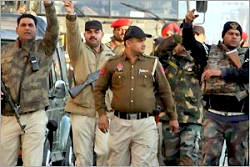
Terror alert in Gujarat: Security heightened, NSG teams on standby; raids in Kutch

March 6, 2016

Gujarat Ahmedabad, Mar 6: Gujarat was on high alert on Sunday following intelligence inputs that terrorists have sneaked into the state, with raids being conducted at Kutch and other places, security beefed up at vital installations and sensitive areas and NSG teams on standby.

The leave of all police personnel, including officers, has been cancelled and the state government has increased security at all the main temples of the state for 'Maha Shivaratri' festival tomorrow.

A massive security operation has been launched and raids were conducted by a police team, led by South Kutch Superintendent of Police Makrand Chauhan, early this morning in Varnora village of Bhuj taluka in Kutch district bordering Pakistan, police sources said.

The Kutch police also raided Noorani Mahel hotel and Muslim Jamat Khana in Bhuj, they said.

"The state government received a serious information from central government on Saturday that terrorists have entered Gujarat. We held a meeting where it was discussed that all measures will be taken to ensure no untoward incident takes place," Gujarat Minister of State for Home Rajni Patel said.
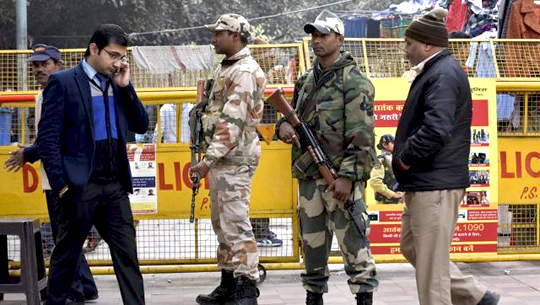
alert

With 'Maha Shivaratri' festival tomorrow, the state government has also increased security at all the main temples.

"Especially during Maha Shivratri, lakhs of pilgrims visit temples in Junagadh, Somnath and other temples. So we have issued high alert for security of these temples too," Patel said.

Two National Security Guard (NSG) teams comprising nearly 200 personnel have been sent from Delhi to Gujarat to meet any eventuality, official sources said.

Policemen were seen patrolling the highways since early morning. Security of all the Air Force and Army bases has also been ramped up.

"The Centre has offered all help and NSG task-force has arrived here which is currently being briefed about the various (vital and sensitive) locations," he said.

"We have alerted coastal as well as border police near Kutch to take all necessary steps to beef-up security. In Kutch, we have asked the local police to remain in co-ordination with Border Security Force (BSF)," he said.

"Till now, we have not found any suspicious person. However, whatever information is received by us is serious and we are taking all necessary steps about it," Patel said.

State Director General of Police P C Thakur, who issued orders late last night cancelling leave of all policemen, said they were prepared to deal with any situation.

"We are on high alert and prepared to deal with any situation. We have started combing operations across various locations. We have also sensitised places that see high rate of footfall," Thakur said.

"We are taking all precautions. Security across coastal areas and other vital installations has been increased. If required, NSG team will be deployed as per their protocol," he said.

On reports claiming that Pakistan alerted Indian authorities about the possible infiltration of terrorists in Gujarat, state Director General of Police (IB & CID) Pramod Kumar said the state Intelligence Bureau received information from the Central IB.

"We don't know anything about Pakistan's role in providing this information. We received this information from Central IB. I don't know anything more than that," said Kumar.

Tight vigil is being kept at railway stations and airports.

Notably, a Pakistani fishing boat was seized on Friday by a BSF patrol party after its occupants fled upon seeing the border security personnel in the Koteshwar creek area off the Kutch coast along the Indo-Pakistan border.

BSF officials had said that nothing suspicious was found in the boat.

Comments

Rikaz
 - 
Sunday, 6 Mar 2016

Indians should stop fishing for the time being in the western coastal area so that Pakistani boats with terrorists can be identified easily....our fishermen should be compensated for taking off from work as they will have to feed their families too....

ali
 - 
Sunday, 6 Mar 2016

Real Terrorist are hiding in BJP or RSS headquarters.
Just an political publicity to attract voters towards them.
If there was real threat, then officials used to work and solves secretly but now a days these politicians make statement in media to show people about their actions for nothing.
Like film stars appears in reality show for the promotion of their films, now BJP Jumla Govt. is using same kind of trend in different way.

Meghana
 - 
Sunday, 6 Mar 2016

go to hell !!! your type of people just dont want to c the growing india,

Mohan Poojary
 - 
Sunday, 6 Mar 2016

Good plan to retain image from Rohit Vemula and JNU row.... Plan to catch some beared muslims.........!!! Just be alert and wait for some unexpected feku operation...

Add new comment

  • Coastaldigest.com reserves the right to delete or block any comments.
  • Coastaldigset.com is not responsible for its readers’ comments.
  • Comments that are abusive, incendiary or irrelevant are strictly prohibited.
  • Please use a genuine email ID and provide your name to avoid reject.
Agencies
May 3,2020

Lucknow, May 3:Holding the Tablighi Jamaat responsible for the spread of COVID-19, Uttar Pradesh Chief Minister Yogi Adityanath on Saturday said that being infected with a virus is not a crime but to hide it is definitely a crime.

Speaking at a programme of a news channel, Adityanath said, "The role of Tablighi Jamaat was most condemnable. To get a disease is not a crime but to hide a disease which is infectious is definitely a crime. And this crime has been done by those associated with the Tablighi Jamaat."

"In Uttar Pradesh and other places where the spread of the coronavirus has been seen, Tablighi Jamaat is behind it. Had they not hidden the disease and went about like its carriers, then perhaps we would have controlled the coronavirus outbreak to a large extend," he said.

The chief minister said action would be taken against them for the "crime that they have committed".

A Tablighi Jamaat congregation in Delhi in March turned out to be a major source of COVID-19 cases, with those who attended the meet returned home in different parts of the country after being infected with the deadly virus.

Comments

Add new comment

  • Coastaldigest.com reserves the right to delete or block any comments.
  • Coastaldigset.com is not responsible for its readers’ comments.
  • Comments that are abusive, incendiary or irrelevant are strictly prohibited.
  • Please use a genuine email ID and provide your name to avoid reject.
News Network
February 21,2020

Washington, Feb 21: Days ahead of his India visit, US President Donald Trump on Thursday said the two countries could make a "tremendous" trade deal.

"We're going to India, and we may make a tremendous deal there," Trump said in his commencement address at the Hope for Prisoners Graduation Ceremony in Las Vegas.

Trump, accompanied by First Lady Melania Trump, is scheduled to travel to Ahmedabad, Agra and New Delhi on February 24 and 25.

Ahead of the visit, there have been talks about India and the United States agreeing on a trade package as a precursor to a major trade deal.

During his commencement address, Trump indicated that the talks on this might slowdown if he did not get a good deal.

"Maybe we'll slow down. We'll do it after the election. I think that could happen too. So, we'll see what happens," he said.

"But we're only making deals if they're good deals because we're putting America first. Whether people like it or not, we're putting America first," Trump said.

Bilateral India-US trade in goods and services is about three per cent of the US' world trade.

In a recent report, the Congressional Research Service (CRS) said the trading relationship is more consequential for India -- in 2018 the United States was its second largest goods export market (16.0 per cent share) after the European Union (EU, 17.8 per cent), and third largest goods import supplier (6.3 per cent) after China (14.6 per cent) and the EU 28 (10.2 per cent).

"The Trump Administration takes issue with the US trade deficit with India, and has criticised India for a range of 'unfair' trading practices," the CRS said.

"Indian Prime Minister Modi's first term fell short of many observers' expectations, as India did not move forward with anticipated market opening reforms, and instead increased tariffs and trade restrictions," it said.

"Modi's strong electoral mandate may embolden the Indian government to press ahead with its reform agenda with greater vigour. Slowing economic growth in India raises concerns about its business environment," CRS said.

As per a fact sheet issued by the Council on Foreign Relations (CFR), trade in goods and services between the two countries from 1999 to 2018 surged from $16 billion to $142 billion.

India is now the United States' eighth-largest trading partner in goods and services and is among the world's largest economies.

India's trade with the United States now resembles, in terms of volume, the US' trade with South Korea ($167 billion in 2018) or France ($129 billion), said Alyssa Ayres from CFR.

"The United States for two years now has set out in stone pretty clearly the things that they wanted to see to try to get an agreement, and it's basically then on India's doorstep on whether they want to take those steps," Rick Rossow, Wadhwani Chair in US-India Policy Studies at the Center for Strategic and International Studies think-tank told reporters during a conference call.

"The list of US asks has been pretty static all throughout. Not to say that any of these things are easy for India to do, but the United States to my knowledge didn't change the goalposts just because we now consider India to be a middle-income country. The things that we wanted to see happen to get this trade agreement have been pretty static all throughout, no matter how difficult they are," he said in response to a question.

Comments

Add new comment

  • Coastaldigest.com reserves the right to delete or block any comments.
  • Coastaldigset.com is not responsible for its readers’ comments.
  • Comments that are abusive, incendiary or irrelevant are strictly prohibited.
  • Please use a genuine email ID and provide your name to avoid reject.
News Network
April 23,2020

Washington, Apr 23: Air pollution over northern India has plummeted to a 20-year-low for this time of the year, according to satellite data published by US space agency National Aeronautics and Space Administration (NASA).
The US space agency's satellite sensors observed aerosol levels at a 20-year low post the countrywide lockdown, implemented to slow the spread of the novel coronavirus.

"We knew we would see changes in atmospheric composition in many places during the lockdown," said Pawan Gupta, a Universities Space Research Association (USRA) scientist at NASA''s Marshall Space Flight Center. "But I have never seen aerosol values so low in the Indo-Gangetic Plain at this time of year," added Mr Gupta.

Acting Assistant Secretary of State for South and Central Asia Alice G Wells tweeted, "These images from NASA were taken each spring starting in 2016 and show a 20-year low in airborne particle levels over India. When India and the world are ready to work and travel again, let's not forget that collaborative action can result in cleaner air."

The data published with maps show aerosol optical depth (AOD) in 2020 compared to the average for 2016-2019. Aerosol optical depth is a measure of how light is absorbed or reflected by airborne particles as it travels through the atmosphere.

If aerosols are concentrated near the surface, an optical depth of 1 or above indicates very hazy conditions. An optical depth, or thickness, of less than 0.1 over the entire atmospheric vertical column is considered "clean." The data were retrieved by the Moderate Resolution Imaging Spectroradiometer (MODIS) on NASA's Terra satellite.

In the first few days of the lockdown, it was difficult to observe a change in the pollution signature. "We saw an aerosol decrease in the first week of the shutdown, but that was due to a combination of rain and the lockdown," said Mr Gupta.

Around March 27, heavy rain poured over vast areas of northern India and helped clear the air of aerosols. Aerosol concentrations usually increase again after such heavy precipitation.

"After the rainfall, I was really impressed that aerosol levels did not go up and return to normal. We saw a gradual decrease and things have been staying at the level we might expect without anthropogenic emissions," Mr Gupta said.

On March 25, the Indian government placed its 1.3 billion citizens under a strict lockdown to reduce the spread of COVID-19. The countrywide mandate decreased activity at factories and severely reduced car, bus, truck and airplane traffic. Every year, aerosols from anthropogenic (human-made) sources contribute to unhealthy levels of air pollution in many Indian cities.

Aerosols are tiny solid and liquid particles suspended in the air that reduce visibility and can damage the human lungs and heart.

In southern India though, the story is a little hazier. Satellite data show aerosol levels have not yet decreased to the same extent. In fact, levels seem to be slightly higher than in the past four years. The reasons are unclear but could be related to recent weather patterns, agricultural fires, winds or other factors.

"This a model scientific experiment," Robert Levy, program leader for NASA's MODIS aerosol products, said about the lockdown and its effects on pollution.

"We have a unique opportunity to learn how the atmosphere reacts to sharp and sudden reductions in emissions from certain sectors. This can help us separate how natural and human sources of aerosols affect the atmosphere," Mr Levy added.

Comments

Add new comment

  • Coastaldigest.com reserves the right to delete or block any comments.
  • Coastaldigset.com is not responsible for its readers’ comments.
  • Comments that are abusive, incendiary or irrelevant are strictly prohibited.
  • Please use a genuine email ID and provide your name to avoid reject.