


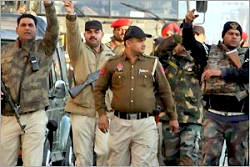
Terror alert in Gujarat: Security heightened, NSG teams on standby; raids in Kutch

March 6, 2016

Gujarat Ahmedabad, Mar 6: Gujarat was on high alert on Sunday following intelligence inputs that terrorists have sneaked into the state, with raids being conducted at Kutch and other places, security beefed up at vital installations and sensitive areas and NSG teams on standby.

The leave of all police personnel, including officers, has been cancelled and the state government has increased security at all the main temples of the state for 'Maha Shivaratri' festival tomorrow.

A massive security operation has been launched and raids were conducted by a police team, led by South Kutch Superintendent of Police Makrand Chauhan, early this morning in Varnora village of Bhuj taluka in Kutch district bordering Pakistan, police sources said.

The Kutch police also raided Noorani Mahel hotel and Muslim Jamat Khana in Bhuj, they said.

"The state government received a serious information from central government on Saturday that terrorists have entered Gujarat. We held a meeting where it was discussed that all measures will be taken to ensure no untoward incident takes place," Gujarat Minister of State for Home Rajni Patel said.
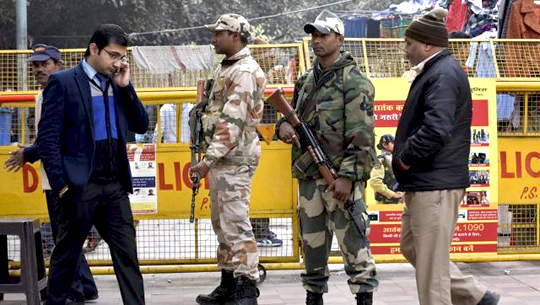
alert

With 'Maha Shivaratri' festival tomorrow, the state government has also increased security at all the main temples.

"Especially during Maha Shivratri, lakhs of pilgrims visit temples in Junagadh, Somnath and other temples. So we have issued high alert for security of these temples too," Patel said.

Two National Security Guard (NSG) teams comprising nearly 200 personnel have been sent from Delhi to Gujarat to meet any eventuality, official sources said.

Policemen were seen patrolling the highways since early morning. Security of all the Air Force and Army bases has also been ramped up.

"The Centre has offered all help and NSG task-force has arrived here which is currently being briefed about the various (vital and sensitive) locations," he said.

"We have alerted coastal as well as border police near Kutch to take all necessary steps to beef-up security. In Kutch, we have asked the local police to remain in co-ordination with Border Security Force (BSF)," he said.

"Till now, we have not found any suspicious person. However, whatever information is received by us is serious and we are taking all necessary steps about it," Patel said.

State Director General of Police P C Thakur, who issued orders late last night cancelling leave of all policemen, said they were prepared to deal with any situation.

"We are on high alert and prepared to deal with any situation. We have started combing operations across various locations. We have also sensitised places that see high rate of footfall," Thakur said.

"We are taking all precautions. Security across coastal areas and other vital installations has been increased. If required, NSG team will be deployed as per their protocol," he said.

On reports claiming that Pakistan alerted Indian authorities about the possible infiltration of terrorists in Gujarat, state Director General of Police (IB & CID) Pramod Kumar said the state Intelligence Bureau received information from the Central IB.

"We don't know anything about Pakistan's role in providing this information. We received this information from Central IB. I don't know anything more than that," said Kumar.

Tight vigil is being kept at railway stations and airports.

Notably, a Pakistani fishing boat was seized on Friday by a BSF patrol party after its occupants fled upon seeing the border security personnel in the Koteshwar creek area off the Kutch coast along the Indo-Pakistan border.

BSF officials had said that nothing suspicious was found in the boat.

Comments

Rikaz
 - 
Sunday, 6 Mar 2016

Indians should stop fishing for the time being in the western coastal area so that Pakistani boats with terrorists can be identified easily....our fishermen should be compensated for taking off from work as they will have to feed their families too....

ali
 - 
Sunday, 6 Mar 2016

Real Terrorist are hiding in BJP or RSS headquarters.
Just an political publicity to attract voters towards them.
If there was real threat, then officials used to work and solves secretly but now a days these politicians make statement in media to show people about their actions for nothing.
Like film stars appears in reality show for the promotion of their films, now BJP Jumla Govt. is using same kind of trend in different way.

Meghana
 - 
Sunday, 6 Mar 2016

go to hell !!! your type of people just dont want to c the growing india,

Mohan Poojary
 - 
Sunday, 6 Mar 2016

Good plan to retain image from Rohit Vemula and JNU row.... Plan to catch some beared muslims.........!!! Just be alert and wait for some unexpected feku operation...

Add new comment

  • Coastaldigest.com reserves the right to delete or block any comments.
  • Coastaldigset.com is not responsible for its readers’ comments.
  • Comments that are abusive, incendiary or irrelevant are strictly prohibited.
  • Please use a genuine email ID and provide your name to avoid reject.
News Network
April 21,2020

New Delhi, Apr 21: The historic rout in oil markets that sent US crude prices plummeting to as much as minus USD 40 a barrel is unlikely to translate into any big reduction in petrol and diesel prices in India as domestic pricing is based on different benchmark, and refineries are already filled up to brim and cannot buy US crude just yet.

With storage capacity already overflowing amid coronavirus-induced demand collapse, traders rushed to to get rid of unwanted stocks triggering the collapse of US West Texas Intermediate (WTI) crude for May delivery.

Indian Oil Corp (IOC) Chairman Sanjiv Singh said the collapse was triggered by traders unable to take deliveries of crude they had previously booked because of a demand collapse. And so they paid the seller to keep oil in their storage.

"If you look at June futures, it is trading in positive territory... around USD 20 per barrel," he said.

Low oil prices may seem good in short-term but in the long run it will hurt the oil economy as producers will have no surplus to invest in exploration and production which will lead to a drop in production, he said.

He did not comment on retail fuel prices that have been static since March 16.

Oil companies have not changed rates despite a fall in international prices as they first adjusted them against the increase that was warranted from a Rs 3 per litre hike in excise duty and close to Re 1 per litre additional cost of switching over to cleaner BS-VI grade fuel from April 1.

Petrol in Delhi is priced at Rs 69.59 a litre and diesel comes for Rs 62.29 per litre.

"The negative price has no direct impact on India or Indian oil prices, as this has taken place due to crude oil produced and traded within the US. India's prices are driven partly by another benchmark, the Brent, which is still trading at USD 25/barrel. Therefore, the retail price of fuels in India are unlikely to fall," said Amit Bhandari, Fellow, Energy and Environment Studies, Gateway House.

Also, Indian refineries are already overflowing as fuel demand has evaporated due to the unprecedented nationwide lockdown imposed to curb spread of COVID-19. So, they can't rush to buy US crude.

The refineries have already cut operating rate to half because the fuel they produce has not been sold yet.

India imports 4 million barrels/day (1.4 billion barrels/year) of oil. The country has been benefitting from the falling prices of oil for the last five years, when oil dropped from a peak of USD 110/barrel to USD 50-60/barrel last year, enabling India to invest in public service programmes.

"However, the additional USD 30 fall of this week is good for India - but there is also a downside. If oil prices are too low, the economies of oil-rich gulf countries will be hurt, threatening the job prospects of the 8 million Indians working in the Gulf countries. India is the largest recipient of foreign remittances due to these workers – very low oil prices will hurt this cash stream," Bhandari said.

He said the negative price of oil shows how much oil oversupply exists in international markets today. "Global oil consumption has fallen due to the COVID-19 pandemic that traders are willing to pay customers to get rid of the barrels they can't store. The world does not have enough storage capacity, and dumping the oil is an environmental crime."

The first half of April saw Brent crude oil prices plummet 63.6 per cent to USD 26.9 per barrel. Prices of Western Texas Intermediate (WTI), the American oil, had also fallen similarly by 63.1 per cent.

But on April 20, WTI prices turned rapidly negative because traders on the Nymex exchange rushed to offload their May futures positions a day before expiry of contracts (on April 21).

Such WTI futures are traded on the Nymex exchange with contracts settled in physical crude oil. Problem is, those who had gone long are unable to find storage facilities for the oil and had to liquidate their contracts before expiry. This caused the plunge in WTI prices.

Contrast to this, June WTI Nymex futures prices is hovering around USD 21, while Brent for June delivery is at USD 25.

Miren Lodha, Director, CRISIL Research said the demand for crude oil was declining already because of economic slowdown when the COVID-19 pandemic-driven lockdowns crushed it further.

Consequently, oil demand is expected to contract by 8-10 million barrels per day (mbpd) in 2020 assuming demand recovery begins from the third quarter of the year, he said, adding if recovery doesn't happen by then, further demand destruction could occur.

On the supply side, producers reining in output following a strategic deal between OPEC members, Russia and the US.

Under this agreement, OPEC+ would reduce oil production by 9.7 mbpd for May and June, but gradually ease the curb to 7.7 mbpd between July and December 2020, and to 5.8 mbpd till April 2022 to stabilise prices.

"This is expected to reduce some surplus in the market by the end of 2020," Lodha said.

Crude oil demand is expected to decline by over 20 mbpd in April alone. Typically, monthly global demand is about 100 mbpd. Given this scenario, supply curbs would have limited influence.

Consequently, Brent oil prices is expected to be in the USD 25-30 range for the second quarter while increasing marginally in the last 2 quarters of 2020.

"The gigantic inventory build-ups and lack of storage facilities would also put pressure on prices," he said, adding overall Brent could average USD 30-35 in 2020, with a strong downward bias.

Comments

Add new comment

  • Coastaldigest.com reserves the right to delete or block any comments.
  • Coastaldigset.com is not responsible for its readers’ comments.
  • Comments that are abusive, incendiary or irrelevant are strictly prohibited.
  • Please use a genuine email ID and provide your name to avoid reject.
News Network
June 8,2020

New Delhi, June 8: Only 20.26 lakh migrant workers of the targeted 8 crore such labourers have received free food grains in May and June (2020), according to data released by the Ministry of Consumer Affairs, Food and Public Distribution.

In the middle of May, as part of the Rs 20 lakh crore Atma Nirbhar Bharat package, the Modi government had announced that migrant labourers who are not covered under the National Food Security Act (NFSA) or any state-run PDS scheme, will receive free food grains for two months.

"Non-card holders shall be given 5 kg wheat or rice per person and 1 kg chana per family per month for the next 2 months. About 8 crore migrants will benefit from this scheme that will cost the government Rs 3500 crore,” Finance Minister Nirmala Sitharaman had said at a press conference following PM Modi’s announcement.

But the Ministry of Consumer Affairs, Food and Public Distribution said on Sunday, "The states and UTs have lifted 4.42 LMT (lakh metric tonne) of food grains and distributed 10,131 MT of it to 20.26 lakh beneficiaries."

It added, "The Government of India also approved 39,000 MT pulses for 1.96 crore migrant families. Around 28,306 MT gram/dal have been dispatched to the states and UTs. A total 15,413 MT gram have been lifted by various states and UTs". The state governments, the ministry added, had distributed only 631MT (metric tonnes) of gram so far.

Because of the constant movement of migrant workers, the Centre had said that the states will be responsible for identifying the migrants and subsequent food distribution.

The Centre claims it is spending approximately Rs 3,109 crore for food grains and Rs 280 crores for grams/chana under this package.

Comments

Add new comment

  • Coastaldigest.com reserves the right to delete or block any comments.
  • Coastaldigset.com is not responsible for its readers’ comments.
  • Comments that are abusive, incendiary or irrelevant are strictly prohibited.
  • Please use a genuine email ID and provide your name to avoid reject.
Agencies
April 23,2020

New Delhi, Apr 23: The nationwide lockdown in India which started about a month ago has impacted nearly 40 million internal migrants, the World Bank has said.

The lockdown in India has impacted the livelihoods of a large proportion of the country's nearly 40 million internal migrants. Around 50,000 60,000 moved from urban centers to rural areas of origin in the span of a few days, the bank said in a report released on Wednesday.

According to the report -- 'COVID-19 Crisis Through a Migration Lens' -- the magnitude of internal migration is about two-and-a-half times that of international migration.

Lockdowns, loss of employment, and social distancing prompted a chaotic and painful process of mass return for internal migrants in India and many countries in Latin America, it said.

Thus, the COVID-19 containment measures might have contributed to spreading the epidemic, the report said.

Governments need to address the challenges facing internal migrants by including them in health services and cash transfer and other social programmes, and protecting them from discrimination, it said.

World Bank said that coronavirus crisis has affected both international and internal migration in the South Asia region.

As the early phases of the crisis unfolded, many international migrants, especially from the Gulf countries, returned to countries such as India, Pakistan, and Bangladesh until travel restrictions halted these flows.

Some migrants had to be evacuated by governments, such as those of China and Iran, it said.

Before the coronavirus crisis, migrant outflows from the region were robust, the report said.

The number of recorded, primarily low-skilled emigrants from India and Pakistan rose in 2019 relative to the prior year but is expected to decline in 2020 due to the pandemic and oil price declines impacting the Gulf countries.

In India, the number of low-skilled emigrants seeking mandatory clearance for emigration rose slightly by eight percent to 368,048 in 2019.

In Pakistan, the number of emigrants jumped 63 per cent to 6,25,203 in 2019, largely due to a doubling of emigration to Saudi Arabia, it said.

According to the bank, migration flows are likely to fall, but the stock of international migrants may not decrease immediately, since migrants cannot return to their countries due to travel bans and disruption to transportation services.

In 2019, there were around 272 million international migrants.

The rate of voluntary return migration is likely to fall, except in the case of a few cross-border migration corridors in the South (such as Venezuela-Colombia, Nepal-India, Zimbabwe South Africa, Myanmar-Thailand), it said.

Migrant workers tend to be vulnerable to the loss of employment and wages during an economic crisis in their host country, more so than native-born workers.

Lockdowns in labour camps and dormitories can also increase the risk of contagion among migrant workers.

Many migrants have been stranded due to the suspension of transport services. Some host countries have granted visa extensions and temporary amnesty to migrant workers, and some have suspended the involuntary return of migrants, it said.

Observing that government policy responses to the COVID-19 crisis have largely excluded migrants and their families back home, the World Bank said there is a strong case for including migrants in the near-term health strategies of all countries, given the externalities associated with the health status of an entire population in the face of a highly contagious pandemic.

The Bank said governments would do well to consider short, medium and long-term interventions to support stranded migrants, remittance infrastructure, loss of subsistence income for families back home, and access to health, housing, education, and jobs for migrant workers in host/transit countries and their families back home.

The pandemic has also highlighted the global shortage of health professionals and an urgent need for global cooperation and long-term investments in medical training, it said.

Comments

Add new comment

  • Coastaldigest.com reserves the right to delete or block any comments.
  • Coastaldigset.com is not responsible for its readers’ comments.
  • Comments that are abusive, incendiary or irrelevant are strictly prohibited.
  • Please use a genuine email ID and provide your name to avoid reject.