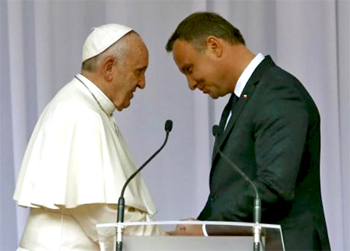
Terror attacks prove world is at war; religion not to blame: Pope

July 28, 2016

Pope Francis said on Wednesday that a string of recent attacks, including the murder of a priest in France, was proof that the "world is at war".

popeHowever, speaking to reporters aboard a plane taking him to Poland, the pope said he was not talking about a war of religion, but rather one of domination of peoples and economic interests.

"The word that is being repeated often is insecurity, but the real word is war," he said in brief comments to reporters while flying to southern Poland for a five-day visit.

"Let's recognize it. The world is in a state of war in bits and pieces," he said, adding that the attacks could be seen as another world war, specifically mentioning World War One and Two.

"Now there is this one (war). It is perhaps not organic but it is organized and it is war," he said. "We should not be afraid to speak this truth. The world is at war because it has lost peace."

About 15 minutes later, after greeting journalists individually, Francis took the microphone again and said he wanted "to clarify" that he was not referring to a war of religion.

"Not a war of religion. There is a war of interests. There is a war for money. There is a war for natural resources. There is a war for domination of peoples. This is the war," he said.

"All religions want peace. Others want war. Do you understand?" he said.

He called Jacques Hamel, the priest forced to his knees by terrorists on Tuesday who then slit his throat, "a saintly priest", but said he was just one of many innocent victims.

He thanked the many people around the world who have sent their condolences over the killing of Father Hamel, particularly French President Francois Hollande, who spoke to the Pope on Tuesday.

Comments

Ahmed
 - 
Thursday, 28 Jul 2016

All credit goes to the Mighty America for creating 1000s of revenge takers who ultimately called as \Terrorists\" I believe most of them must have lost their loved ones because of attack on innocent in Afghanistan, Iraq, Syria etc, etc,"

Add new comment

  • Coastaldigest.com reserves the right to delete or block any comments.
  • Coastaldigset.com is not responsible for its readers’ comments.
  • Comments that are abusive, incendiary or irrelevant are strictly prohibited.
  • Please use a genuine email ID and provide your name to avoid reject.
Ram Puniyani
February 4,2020

As democracy is seeping in slowly all over the world, there is an organization which is monitoring the degree of democracy in the individual countries, The Economist Intelligence Unit. As such in each country there are diverse factors which on one hand work to deepen it, while others weaken it. Overall there is a march from theoretical democracy to substantive one. The substantive democracy will herald not just the formal equality, freedom and community feeling in the country but will be founded on the substantive quality of these values. In India while the introduction of modern education, transport, communication laid the backdrop of beginning of the process, the direction towards deepening of the process begins with Mahatma Gandhi when he led the non-cooperation movement in 1920, in which average people participated. The movement of freedom for India went on to become the ‘greatest ever mass movement’ in the World.

The approval and standards for democracy were enshrined in Indian Constitution, which begins ‘We the people of India’, and was adopted on 26th January 1950. With this Constitution and the policies adopted by Nehru the process of democratization started seeping further, the dreaded Emergency in 1975, which was lifted later restored democratic freedoms in some degree. This process of democratisation is facing an opposition since the decade of 1990s after the launch of Ram Temple agitation, and has seen the further erosion with BJP led Government coming to power in 2014. The state has been proactively attacking civil liberties, pluralism and participative political culture with democracy becoming flawed in a serious way. And this is what got reflected in the slipping of India by ten places, to 51st, in 2019. On the index of democracy India slipped down from the score of 7.23 to 6.90. The impact of sectarian BJP politics is writ on the state of the nation, country.

Ironically this lowering of score has come at a time when the popular protests, the deepening of democracy has been given a boost and is picking up with the Shaheen Bagh protests. The protest which began in Shaheen Bagh, Delhi in the backdrop of this Government getting the Citizenship amendment Bill getting converted into an act and mercilessly attacking the students of Jamia Milia Islamia, Aligarh Muslim University along with high handed approach in Jamia Nagar and neighbouring areas.  From 15th December 2019, the laudable protest is on.

It is interesting to note that the lead in this protest has been taken by the Muslim women, from the Burqa-Hijab clad to ‘not looking Muslim’ women and was joined by students and youth from all the communities, and later by the people from all the communities. Interestingly this time around this Muslim women initiated protest has contrast from all the protests which earlier had begun by Muslims. The protests opposing Shah Bano Judgment, the protests opposing entry of women in Haji Ali, the protests opposing the Government move to abolish triple Talaq. So far the maulanas from top were initiating the protests, with beard and skull cap dominating the marches and protests. The protests were by and large for protecting Sharia, Islam and were restricted to Muslim community participating.

This time around while Narendra Modi pronounced that ‘protesters can be identified by their clothes’, those who can be identified by their external appearance are greatly outnumbered by all those identified or not identified by their appearance.

The protests are not to save Islam or any other religion but to protect Indian Constitution. The slogans are structured around ‘Defence of democracy and Indian Constitution’. The theme slogans are not Allahu Akbar’ or Nara-E-Tadbeer’ but around preamble of Indian Constitution. The lead songs have come to be Faiz Ahmad Faiz’s ‘Hum Dekhenge’, a protest against Zia Ul Haq’s attempts to crush democracy in the name of religion. Another leading protest song is from Varun Grover, ‘Tanashah Aayenge…Hum Kagaz nahin Dikhayenge’, a call to civil disobedience against the CAA-NRC exercise and characterising the dictatorial nature of the current ruling regime.

While BJP was telling us that primary problem of Muslim women is Triple talaq, the Muslim women led movements has articulated that primary problem is the very threat to Muslim community. All other communities, cutting across religious lines, those below poverty line, those landless and shelter less people also see that if the citizenship of Muslims can be threatened because of lack of some papers, they will be not far behind in the victimization process being unleashed by this Government.

While CAA-NRC has acted as the precipitating factor, the policies of Modi regime, starting from failure to fulfil the tall promises of bringing back black money, the cruel impact of demonetisation, the rising process of commodities, the rising unemployment, the divisive policies of the ruling dispensation are the base on which these protest movements are standing. The spread of the protest movement, spontaneous but having similar message is remarkable. Shaheen Bagh is no more just a physical space; it’s a symbol of resistance against the divisive policies, against the policies which are increasing the sufferings of poor workers, the farmers and the average sections of society.

What is clear is that as identity issues, emotive issues like Ram Temple, Cow Beef, Love Jihad and Ghar Wapasi aimed to divide the society, Shaheen Bagh is uniting the society like never before. The democratisation process which faced erosion is getting a boost through people coming together around the Preamble of Indian Constitution, singing of Jan Gan Man, waving of tricolour and upholding the national icons like Gandhi, Bhagat Singh, Ambedkar and Maulana Azad. One can feel the sentiments which built India; one can see the courage of people to protect what India’s freedom movement and Indian Constitution gave them.

Surely the communal forces are spreading canards and falsehood against the protests. As such these protests which is a solid foundation of our democracy. The spontaneity of the movement is a strength which needs to be channelized to uphold Indian Constitution and democratic ethos of our beloved country.


Comments

Add new comment

  • Coastaldigest.com reserves the right to delete or block any comments.
  • Coastaldigset.com is not responsible for its readers’ comments.
  • Comments that are abusive, incendiary or irrelevant are strictly prohibited.
  • Please use a genuine email ID and provide your name to avoid reject.
News Network
July 13,2020

Bengaluru, Jul 13: The Bruhat Bengaluru Mahanagara Palike (BBMP) has initiated the process of recruiting 1,700 medical professionals, doctors, staff nurses and support staff to scale up its workforce to set up 30,000 COVID-19 care beds, an official said on Sunday.

According to the official, to establish and run 30,000 COVID care beds, 1,800 doctors and 3,600 nurses are required. A 10,100-bed facility was set up last week in the Bengaluru International Exhibition centre (BIEC) on Tumkur road.

The Health Department has calculated that one doctor per shift is needed for every 100 patients and one staff nurse for every 50 patients. Similarly, two supporting staff and three Group D employees are needed per shift for every 100 patients. Generally, a day is divided into three shifts of eight hours each.

According to the director of medical education, there are 25,000 nursing students who have completed GNM and BSc Nursing courses and are pursuing higher education.

Likewise, there are 3,231 medical, dental and Aayush interns, while MD and MS postgraduate students have been identified to be 1,613 in Bengaluru colleges.

"The department plans to actively utilise the services of interns and postgraduate students for the COVID Care Centre (CCC) operations," said the official.

Currently, there are 2,100 CCC beds operational under the civic body in Bengaluru with a pool of 503 doctors, 167 ayush doctors, 128 nursing and paramedical staff.

Earlier in May, the civic body also notified the recruitment of 380 microbiologists, technicians and data entry operators for six months. In June, the civic body again notified the recruitment of 637 doctors, nurses, technicians and group d employees to strengthen its fight against the pandemic.

Bengaluru has recently seen a spike in COVID-19 in Karnataka, accounting for 61% of all active cases in the state.

On Saturday, the city reported 1,533 new cases, taking its total tally to 16,862, of which 12,793 are active.

Karnataka recorded 2,798 more coronavirus cases and 70 more casualties on Saturday evening, raising the state's total cases to 36,216 and the death toll to 613.

Comments

Add new comment

  • Coastaldigest.com reserves the right to delete or block any comments.
  • Coastaldigset.com is not responsible for its readers’ comments.
  • Comments that are abusive, incendiary or irrelevant are strictly prohibited.
  • Please use a genuine email ID and provide your name to avoid reject.
News Network
April 18,2020

Bengaluru, Apr 18: Hours after announcing that two-wheelers will be allowed to ply and that IT/BT companies can resume operations with 33 per cent strength, Chief Minister B S Yediyurappa on Saturday took a u-turn and rolled them back, citing “public opinion” as the reason. 

Earlier in the day, Yediyurappa announced that, after April 20, there will not be any restriction on the movement of two-wheelers in areas that are not COVID-19 containment zones. Yediyurappa also said that a third of IT/BT employees will be allowed to go to the office after April 20. 

“In the backdrop of public opinion and after discussions with senior officials, it has been decided that the prohibition on two-wheelers will continue throughout the lockdown period,” a statement from the Chief Minister’s Office said. “And in the IT/BT sector, only essential services will be allowed and the work-from-home policy will continue.” 

According to sources, the u-turn came following opposition from Yediyurappa’s Cabinet colleagues. “If I was in the meeting, I’d not have allowed it,” a minister said. Only Home Minister Basavaraj Bommai and Revenue Minister R Ashoka were in the meeting Yediyurappa held earlier in the day. The Opposition also stemmed from the fact that there was no need to make decisions on the lockdown when the Cabinet was scheduled to meet on April 20, sources said. 

The incoordination was apparent on Friday when Deputy Chief Minister CN Ashwath Narayan, the IT/BT minister, said 50 per cent of employees in the sector will be permitted to work while Yediyurappa said this would depend on the number of cases reported in the coming days. 

Other announcements made by Yediyurappa remain unchanged.

“Places, where COVID-19 cases are reported, will be identified as containment zones. In such containment zones, an incident commander will be appointed and given magisterial power. Teams comprising the police and health department officials will oversee the lockdown,” Yediyurappa said. “Lockdown will be much more stringent in these areas and no one will be allowed to step out. Essential supplies will be delivered home.”

According to Bommai, there were 32 containment zones in Bengaluru and ‘hotspots’ have been identified in eight districts.

With an eye on restarting economic activities, the government will allow construction work and industries. “In urban areas, construction work will be allowed to start wherever construction workers have the facility to stay on site,” Yediyurappa said. “The manufacturing sector in rural areas and industrial units located in the special economic zones (SEZ) and townships in urban areas will be allowed to function,” he said.

Stating that inter-state travel will be prohibited, Yediyurappa said the districts of Bengaluru Urban, Bengaluru Rural and Ramnagara will be considered as one only for the movement of industrial workers.

Asked about liquor sale, Yediyurappa said a decision will be taken after May 3. The government has already prohibited liquor sale till April 20 midnight.

Comments

Add new comment

  • Coastaldigest.com reserves the right to delete or block any comments.
  • Coastaldigset.com is not responsible for its readers’ comments.
  • Comments that are abusive, incendiary or irrelevant are strictly prohibited.
  • Please use a genuine email ID and provide your name to avoid reject.