



Terror theory for missing Malaysian jet; floating door spotted

March 10, 2014

Floating_doorKuala Lumpur, Mar 10: Vietnamese authorities on Sunday said they had spotted what looked like one of the doors of the missing Boeing 777 jetliner that crashed into the sea between Malaysia and Vietnam a day and a half ago. What caused the crash remained a mystery, even as authorities were checking out the identities of two passengers who were flying on stolen passports. A possible terror attack, or suicide mission, however, remained in the realm of speculation as no evidence has been found and no group has claimed responsibility so far.

Malaysia's air force chief Rodzali Daud said radar indicated that the plane may have turned back, but did not give further details on which direction it went or how far it veered off course. "We are trying to make sense of this," Daud said at a news conference. "The military radar indicated that the aircraft may have made a turn back, and in some parts this was corroborated by civilian radar."

The plane, which was carrying 239 people — five Indians among them — lost contact with ground controllers off Vietnam after leaving Kuala Lumpur early Saturday morning for Beijing. The missing plane apparently fell from the sky at cruising altitude in fine weather, and the pilots were either unable or had no time to send a distress signal — unusual circumstances under which a modern jetliner operated by a professional airline would crash.

A Vietnam army officer was reported in the state-run newspaper as saying searchers in a low-flying plane had spotted an object that looked like a door from the Malaysia Airlines plane. It was found in waters about 90km south of Tho Chu island, in the same area where oil slicks were spotted on Saturday. "From this object, hopefully, (we) will find the missing plane," the officer said. Two ships from the maritime police were headed for the site.

Malaysia Airlines chief executive Ahmad Jauhari Yahya said pilots are supposed to inform the airline and traffic control authorities if the plane does a U-turn. "From what we have, there was no such distress signal or distress call per se, so we are equally puzzled," he said.

Authorities were checking on the identities of the two passengers who boarded the plane with stolen passports. On Saturday, the foreign ministries in Italy and Austria said the names of two citizens listed on the flight's flyers' list matched the names on two passports reported stolen in Thailand. "I can confirm that we have the visuals of these two people on CCTV," Malaysian transport minister Hishammuddin Hussein said at a news conference late on Sunday, adding that the footage was being examined. "We have intelligence agencies, both local and international, on board."

"Our focus now is to find the aircraft," he said, adding that finding the plane would make it easier for authorities to investigate any possible foul play.

Interpol confirmed that at least two stolen passports used by passengers on the plane were registered in its databases. It said no one had checked the databases, but added that most airlines and countries do not usually check for stolen passports. Hishammuddin said only two passengers had used stolen passports, and that earlier reports that the identities of two others were under investigation were not true.

In addition to the plane's sudden disappearance, which experts say is consistent with a possible onboard explosion, the stolen passports have strengthened concerns about terrorism as a possible cause. Al-Qaida militants have used similar tactics to try and disguise their identities.

Still, other possible causes would seem just as likely at this stage, including a catastrophic failure of the plane's engines, extreme turbulence, or pilot error or even suicide. Establishing what happened with any certainty will need data from flight recorders and a detailed examination of any debris, something that will take months if not years.

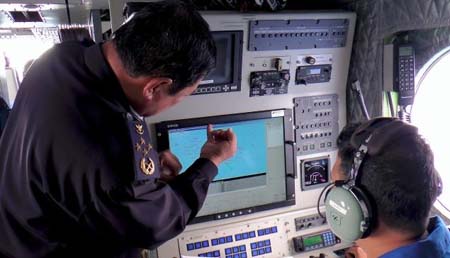
The multinational search for the missing plane is on. A total of 34 aircraft and 40 ships have been deployed to the area by Malaysia, Thailand, Australia, Singapore, Indonesia, China and the United States, in addition to Vietnam's fleet. Vietnamese air force jets spotted two large oil slicks Saturday, but it was unclear whether they were linked to the missing plane.

Two-thirds of the jet's passengers were Chinese. The rest were from elsewhere in Asia, North America and Europe.

After more than 30 hours without contact with the aircraft, Malaysia Airlines told family members they should "prepare themselves for the worst", Hugh Dunleavy, the commercial director for the airline, told reporters.

Finding traces of an aircraft that disappears over sea can take days or longer, even with a sustained search effort. Depending on the circumstances of the crash, wreckage can be scattered over many square kilometers (miles). If the plane enters the water before breaking up, there can be relatively little debris.

Malaysia Airlines has a good safety record, as does the 777, which had not had a fatal crash in its 19-year history until an Asiana Airlines plane crashed last July in San Francisco, killing three passengers.

Comments

Add new comment

  • Coastaldigest.com reserves the right to delete or block any comments.
  • Coastaldigset.com is not responsible for its readers’ comments.
  • Comments that are abusive, incendiary or irrelevant are strictly prohibited.
  • Please use a genuine email ID and provide your name to avoid reject.
News Network
May 20,2020

Kensington (United States), May 20: The world cut its daily carbon dioxide emissions by 17% at the peak of the pandemic shutdown last month, a new study found.

But with life and heat-trapping gas levels inching back toward normal, the brief pollution break will likely be “a drop in the ocean" when it comes to climate change, scientists said.

In their study of carbon dioxide emissions during the coronavirus pandemic, an international team of scientists calculated that pollution levels are heading back up — and for the year will end up between 4% and 7% lower than 2019 levels.

That's still the biggest annual drop in carbon emissions since World War II.

It'll be 7% if the strictest lockdown rules remain all year long across much of the globe, 4% if they are lifted soon.

For a week in April, the United States cut its carbon dioxide levels by about one-third.

China, the world's biggest emitter of heat-trapping gases, sliced its carbon pollution by nearly a quarter in February, according to a study Tuesday in the journal Nature Climate Change. India and Europe cut emissions by 26% and 27% respectively.

The biggest global drop was from April 4 through 9 when the world was spewing 18.7 million tons (17 million metric tons) of carbon pollution a day less than it was doing on New Year's Day.

Such low global emission levels haven't been recorded since 2006. But if the world returns to its slowly increasing pollution levels next year, the temporary reduction amounts to ''a drop in the ocean," said study lead author Corinne LeQuere, a climate scientist at the University of East Anglia.

“It's like you have a bath filled with water and you're turning off the tap for 10 seconds," she said.

By April 30, the world carbon pollution levels had grown by 3.3 million tons (3 million metric tons) a day from its low point earlier in the month. Carbon dioxide stays in the air for about a century.

Outside experts praised the study as the most comprehensive yet, saying it shows how much effort is needed to prevent dangerous levels of further global warming.

“That underscores a simple truth: Individual behavior alone ... won't get us there,” Pennsylvania State University climate scientist Michael Mann, who wasn't part of the study, said in an email.

“We need fundamental structural change.”

If the world could keep up annual emission cuts like this without a pandemic for a couple decades, there's a decent chance Earth can avoid warming another 1.8 degrees (1 degree Celsius) of warming from now, study authors said. But getting the type of yearly cuts to reach that international goal is unlikely, they said.

If next year returns to 2019 pollution levels, it means the world has only bought about a year's delay in hitting the extra 1.8 degrees (1 degree Celsius) of warming that leaders are trying to avoid, LeQuere said. That level could still occur anywhere from 2050 to 2070, the authors said.

The study was carried out by Global Carbon Project, a consortium of international scientists that produces the authoritative annual estimate of carbon dioxide emissions. They looked at 450 databases showing daily energy use and introduced a measurement scale for pandemic-related societal “confinement” in its estimates.

Nearly half the emission reductions came from less transportation pollution, mostly involving cars and trucks, the authors said. By contrast, the study found that drastic reductions in air travel only accounted for 10% of the overall pollution drop.

In the US, the biggest pollution declines were seen in California and Washington with plunges of more than 40%.

Comments

Add new comment

  • Coastaldigest.com reserves the right to delete or block any comments.
  • Coastaldigset.com is not responsible for its readers’ comments.
  • Comments that are abusive, incendiary or irrelevant are strictly prohibited.
  • Please use a genuine email ID and provide your name to avoid reject.
Agencies
August 8,2020

Washington, Aug 8: The United States has reported 58,173 new coronavirus cases on Friday, bringing the total past 4.9 million, according to Johns Hopkins University.

"The first case of COVID-19 in the US was reported 198 days ago on 22.01.2020.Yesterday, the country reported 58,173 new confirmed cases and 1,243 deaths," it said.

The country is expected to cross the 5 million thresholds in the coming days. It leads the world both in terms of coronavirus cases and deaths estimated at over 161,300.

Overall, there have been 19.4 million cases confirmed globally and almost 721,800 people have died from virus-related complications. Another 11.7 million have recovered.

Comments

Add new comment

  • Coastaldigest.com reserves the right to delete or block any comments.
  • Coastaldigset.com is not responsible for its readers’ comments.
  • Comments that are abusive, incendiary or irrelevant are strictly prohibited.
  • Please use a genuine email ID and provide your name to avoid reject.
News Network
May 27,2020

Washington, May 27: Most viruses and other germs do not spread easily on flights, the US Center for Disease Control and Prevention has said in its COVID-19 guidelines which do not recommend following social distancing between two passengers inside a plane or keeping the middle seat unoccupied.

As a result of coronavirus pandemic, air traffic inside the US has come to a near halt. Air traffic is said to be down to about 90 per cent. For all travellers coming from overseas, the Center for Disease Control and Prevention (CDC) has recommended 14 days quarantine.

"Most viruses and other germs do not spread easily on flights because of how air circulates and is filtered on aeroplanes," the CDC has said in its set of COVID-19 guidelines for air travellers.

However, it noted that the air travellers were not risk-free especially in the time of the coronavirus pandemic and recommended Americans to avoid travel as far as possible.

"Air travel requires spending time in security lines and airport terminals, which can bring you in close contact with other people and frequently touched surfaces," it said.

"Social distancing is difficult on crowded flights, and you may have to sit near others (within six feet), sometimes for hours. This may increase your risk for exposure to the virus that causes COVID-19," the CDC said.

But instead of recommended social distancing inside commercial planes, the CDC has advised a series of preventive and hygienic measures to be taken by the airlines pilot and crew to prevent the spread of coronavirus.

The US Department of Transportation and Federal Aviation Administration in its latest safety alerts for operators on May 11 said that air carriers and crews conducting flight operations having a nexus to the US, including both domestic and foreign air carriers, should follow CDC's occupational health and safety guidance.

The CDC issued its guidelines in first guidelines for the airlines and airline crew on March and again in May.

The CDC, which has issued an exhaustive social guideline measures in various sections, is silent on keeping the middle seat of a plane unoccupied so as to maintain the six feet distance between two passengers.

It calls for the plane crew to report to the CDC a traveller with specific COVID-19 symptoms like fever, persistent cough, difficulty in breathing and appearing unwell.

Asking the airlines and cabin crew to review infection control guidelines for cabin crew, the CDC recommends several measures for cabin crew to protect themselves and others, manage a sick traveller, clean contaminated areas, and take actions after a flight.

Prominent among them include washing hands often with soap and water for at least 20 seconds, particularly after assisting sick travellers or touching potentially contaminated body fluids or surfaces and use of alcohol-based hand sanitizer (containing at least 60 per cent alcohol) if soap and water are not available.

Airlines should consider providing alcohol-based hand sanitizer to cabin and flight crews for their personal use, it said.

The CDC guidelines do not recommend following social distancing inside a plane between two passengers or keeping the middle seat unoccupied. But it asks to minimise contact between passengers and cabin crew and the sick person.

"If possible, separate the sick person from others (by a distance of 2 meters or 6 feet, ideally) and designate one crew member to serve the sick person. Offer a facemask, if available and if the sick person can tolerate it. If a facemask is not available or cannot be tolerated, ask the sick person to cover their mouth and nose with tissues when coughing or sneezing," said the CDC guidelines.

If no symptomatic passengers were identified during or immediately after the flight, the CDC recommends airlines to follow routine operating procedures for cleaning aircraft, managing solid waste, and wearing PPE.

"If symptomatic passengers are identified during or immediately after the flight, routine cleaning procedures should be followed, and enhanced cleaning procedures should also be used," it said.

Clean porous (soft) surfaces (e.g, cloth seats, cloth seat belts) at the seat of the symptomatic passengers and within 6 feet of the symptomatic passengers in all directions, it added.

Comments

Add new comment

  • Coastaldigest.com reserves the right to delete or block any comments.
  • Coastaldigset.com is not responsible for its readers’ comments.
  • Comments that are abusive, incendiary or irrelevant are strictly prohibited.
  • Please use a genuine email ID and provide your name to avoid reject.