



Test for reform zeal of Modi government in make-or-break Budget today, tax sops likely

February 28, 2015

New Delhi, Feb 28: Prime Minister Narendra Modi's stomach for free-market economics faces a major test on Saturday when the first full Budget will be unveiled by Finance Minister Arun Jaitely.
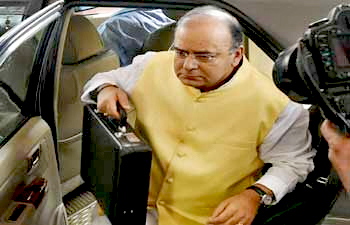
Modi governmentReaping the benefits of low global prices for oil, India's main import, Modi's government sees itself in a sweet spot with spare cash to modernize ageing roads and railways without busting fiscal deficit and inflation targets.

"Let us stop unnecessary expenditure so that money can reach the poor," Modi told Parliament on Friday after the Economic Survey report committed to bringing the fiscal deficit down to 3 per cent of gross domestic product - from more than 4 per cent at present - in the medium-term. "We believe in optimum utilisation of our infrastructure," he said.

An overhaul of economic data has propelled India to the top of the league of fast-growing major economies, and the current account deficit is projected to fall below 1 per cent in 2016, which would help stabilize the rupee and build up reserves.

But expectations for a further shift in expenditure from subsidies to infrastructure are sky high among investors who made India the best performing stock market in Asia after China last year on hopes Modi's government brings sweeping reforms to labour, tax and land laws.

The rally has continued in 2015 on expectations that legislative reform will push ahead stalled private investment and consumer demand, and reverse a decline in corporate earnings to make Asia's third-largest economy a global growth driver.

The Budget being hyped as a 'make or break' exercise, is widely expected to unveil sops for tax payers while pushing forward the 'Make In India' campaign. Coming as it does after the Delhi electoral defeat and the Assembly elections scheduled in Bihar later in 2015, speculation is on whether the Budget will be populist. There is expectation that the Finance Minister could raise tax slabs or hike investment limit in saving instruments.

He is also likely to pursue the path of fiscal consolidation and keep the fiscal deficit target at 3.6 per cent of GDP, down from 4.1 per cent expected in 2015. Besides sops to individual tax payers, he is also expected to unveil initiatives to boost investments by corporates and promote manufacturing as part of the 'Make In India' campaign that aims to make the country a global manufacturing hub and create jobs.

The Economic Survey released on Friday underlined the need for 'Big Bang' reforms to boost growth to 8-10 per cent in the coming years. Besides , it has pitched for raising public investments to drive economic growth and improving business environment by making regulation and taxes less onerous.

Jaitley, who in his maiden Budget in July 2014 had outlined his approach to providing relief to individual tax payers, is expected to continue this in the BJP government's first full year Budget on Saturday. in 2014, he had raised the personal income tax exemption limit by Rs 50,000 to Rs 2.50 lakh and also raised by same amount the exemption from payment of I-T on savings to Rs 1.50 lakh.

However, this time around Jaitley, according to experts, may choose only one of them as he looks at additional revenue to boost public spending and push economy to high growth path. He may also look to raise the tax exempted investment limit in health insurance as well as exempt savings in pension schemes at all three stages -- entry, accrual and withdrawal.

Analysts warn that Indian stocks are overvalued and that equity markets could see a sell off of 6-8 per cent if the pro-growth measures in the budget fall short of expectations. Modi has capitalised on low oil prices to shake off some of the fuel subsidies that have hobbled India's national accounts for years. But he has been unable to pass reform in the upper house of Parliament, where the Bharatiya Janata Party-led government has no majority.

Comments

Add new comment

  • Coastaldigest.com reserves the right to delete or block any comments.
  • Coastaldigset.com is not responsible for its readers’ comments.
  • Comments that are abusive, incendiary or irrelevant are strictly prohibited.
  • Please use a genuine email ID and provide your name to avoid reject.
News Network
May 7,2020

Visakhapatnam, May 7: Unconscious children being carried by parents in their arms, people laying on roads, health workers scrambling to attend to those affected by the styrene vapour leak and residents fleeing were some of the scenes that played out near here on Thursday, bringing back grim memories of the 1984 Bhopal gas tragedy.

The leak of styrene, a chemical used to make synthetic rubber and resins, among others, occurred in the wee hours of Thursday while people were still fast asleep.

Women and children were seen lying on roads struggling to breath, reminiscent of the infamous Bhopal gas tragedy when a leak from the Union Carbide plant left around 3,500 dead and many maimed.

The worst-hit Gopalapatnam village reverberated with cries of people for help.

Many people fell unconscious during their sleep, a villager said.

Affected people, suffering writ large on their faces, were rushed to hospitals in autorickshaws and on two wheelers.

Visakhapatnam Collector Vinay Chand said 20 ambulances were pressed into service as soon information about the gas leak was received.

Exposure to styrene, also known as ethenylbenzene, vinylbenzene can affect the central nervous system (CNS), causing headache, fatigue, weakness, and depression.

It is primarily used in the production of polystyrene plastics and resins.

The gas leak took place at LG Polymers chemical plant.

LG Polymers was established in 1961 as "Hindustan Polymers" for manufacturing Polystyrene and its co-polymers at Visakhapatnam. It merged with McDowell & Co. Ltd of UB Group in 1978, according to the company's website.

Taken over by LG Chem (South Korea), Hindustan Polymers was renamed LG Polymers India Private Limited (LGPI) in July, 1997.

Comments

Add new comment

  • Coastaldigest.com reserves the right to delete or block any comments.
  • Coastaldigset.com is not responsible for its readers’ comments.
  • Comments that are abusive, incendiary or irrelevant are strictly prohibited.
  • Please use a genuine email ID and provide your name to avoid reject.
News Network
January 17,2020

New Delhi, Jan 17: Airports in Srinagar and Jammu are to be “immediately” brought under the security cover of the CISF in view of the arrest of DSP Davinder Singh, a Jammu and Kashmir government order has said.

The two sensitive airports are to be “handed over” to the CISF by January 31, the order of the Jammu and Kashmir Home Department to the Director General of Police (DGP) said.

“This issue (CISF security at Srinagar and Jammu airports) has acquired immediacy in view of the recent developments relating to the arrest of Davinder Singh, DSP airport security, for trying to assist militants to travel to other parts of the country,” the order issued on Wednesday said.

Police had arrested Singh, a deputy superintendent of police, at Mir Bazar in Jammu and Kashmir’s Kulgam district on Saturday, along with Hizbul Mujahideen terrorists Naveed Baba and Altaf, besides a lawyer who was operating as an overground worker for terror outfits.

The two airports are guarded by the CRPF and the J-K Police at present.

The Union government had last year decided that the Central Industrial Security Force (CISF) will be handed over security of these two airports along with the one in Leh in view of their sensitive and strategic location and the threats it faced related to possible terrorist and hijack attempts.

CISF is the national civil aviation security force and at present it guards 61 airports including the ones at Delhi and Mumbai.

News agency had on January 13 reported that the Union home ministry sanctioned about 800 personnel to the CISF in order to take over security duties at the three airports of the newly created Union Territories of Jammu and Kashmir and Ladakh.

As per the original plan, the CISF was to take over Jammu airport by next month and the Srinagar and Leh airports after the spell of severe cold ends.

However, officials said, keeping in mind the arrest of the DSP and his alleged links, the latest order has been issued which also directs the J-K Police to make arrangements for accommodation, transport and other logistical requirements of the armed contingent of the CISF on a quick basis.

Once inducted at the most-sensitive Srinagar airport, the CISF will secure access control at both city and air side (tarmac area) while the CRPF will be responsible for securing the outer periphery. At the Jammu airport, the peripheral security duties will be rendered by the JK Police.

An assortment of surveillance and security gadgets like CCTVs, observation monitors, hand-held metal detectors, bullet-proof patrol vehicles and bomb detection and disposal equipment are also being provided by the airport operator, the Airports Authority of India (AAI), to the CISF.

The Union government sometime back made it clear that CISF will be the only civil airports guarding force and all such facilities in the country will be gradually brought under its command to bolster aviation security and tighten anti-terror and anti-hijack protocols.

Comments

Add new comment

  • Coastaldigest.com reserves the right to delete or block any comments.
  • Coastaldigset.com is not responsible for its readers’ comments.
  • Comments that are abusive, incendiary or irrelevant are strictly prohibited.
  • Please use a genuine email ID and provide your name to avoid reject.
Agencies
January 12,2020

Mumbai, Jan 12: Thousands of citizens on Sunday congregated in Mumbai's suburban Jogeshwari to oppose the new citizenship law, the proposed NRC and NPR.

They also condemned last Sunday's violence on the JNU campus in Delhi, where masked men ran riot and attacked students. Leftist organisations had claimed RSS-affiliated ABVP's role in the attack, a charge denied by the students' body.

Former Tata Institute of Social Science (TISS) general secretary Fahad Ahmed told PTI that they assembled under the aegis of 'Hum Bharat Ke Log' in Millat Nagar area.

"Prime minister Narendra Modi should call 56 students from across the country to debate on the CAA, NRC and NPR," Ahmed said in an apparent jibe at Modi's "56 inch chest" remark, which the latter had made ahead of the 2014 Lok Sabha polls.

"Why the PM is not talking to us? Why is he not communicating? Even the Britishers used to talk to Indians whom they ruled, but our PM is not talking to poor people," he alleged.

Bollywood actor Sushasht Singh also spoke on the occasion.

"We are people of this country and such acts (CAA) are tarnishing the image of our country," he said.

At the gathering, people waved banners with slogans like "I Am From Gujarat, My Documents Burned in 2002", "No CAA, Boycott NRC, Stop Dividing India, Don't Divide us", "Save Constitution", written on them.

A large number of police personnel were present at the venue.

The Citizenship Amendment Act (CAA), which was notified on January 10, grants Indian citizenship to non-Muslim minorities migrated to India from Afghanistan, Pakistan and Bangladesh till December 31, 2014, following persecution over their faith.

Massive protests were witnessed against the CAA, mainly by the student community, since its passage by Parliament in December last year.

Opposition parties have been dubbing the CAA an "anti-Muslim" legislation, a charge being debunked by the government.

The Congress and other parties like the TMC have also opposed the proposed National Register of Citizens (NRC) and the National Population Register (NPR).

Union home minister Amit Shah has said that the government won't rest until persecuted refugees are granted Indian citizenship.

Comments

Add new comment

  • Coastaldigest.com reserves the right to delete or block any comments.
  • Coastaldigset.com is not responsible for its readers’ comments.
  • Comments that are abusive, incendiary or irrelevant are strictly prohibited.
  • Please use a genuine email ID and provide your name to avoid reject.