


Those who killed cow and ate beef were Hindu Jagarana Vedike members

[email protected] (CD Network)
July 28, 2016

Chikkamagaluru, Jul 28: The members of a Dalit family in Koppa taluk of Chikkamagaluru district, who were attacked by Bajrang Dal activists for slaughtering cow and eating beef, have revealed that they were also members of a hard-line Hindutva outfit.
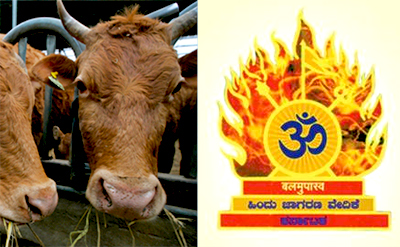
JagaranaGurumurthy, one among the five Dalits attacked on July 10 in Shantipura colony, was in fact one of the founders of Hindu Jagarana Vedike's branch in Kunduru village near here. Four years ago, he conducted an event in the village organising all Dalits.

However, the family members gradually distanced themselves from the Hindutva activities after facing discrimination by the leaders of the Vedike.

“We stopped participating in the events of Hindu Jagarana Vedike after we realised that the leaders were opposed to our food habits,” the family members said.

“If they are Hindus, what are we then? Even though we eat beef we are also Hindus. Many Hindus eat beef in our region,” they claimed.

23-year-old Dhanush, who suffered severe injuries in Bajrang Dal attack, admitted that beef was part of their diet and food culture. “If consuming it is against law, let the police take action. How can anyone else beat us up?”

Many Dalit families in the village have expressed solidarity with the victims and claimed that beef had been part of their food culture for ages. “Beef is affordable and healthily. We can't afford mutton (sheep or goat), which costs more than Rs 400 a kg,” said a housewife.

A few Dalit families held upper caste families in the neighbourhood responsible for atrocities on them. “The upper caste people in the village do not tolerate if we move around wearing good clothes. They look for some reason to assault us,” lamented Mr Gurumurthy.

Comments

Roosevelt Larochelle
 - 
Monday, 29 Aug 2016

Once the cow became sacred and the Broken Men continued to eat beef, there was no other fate left for the Broken Men except to be treated unfit for association, i.e., as Untouchables. There was a time when the ancestors of the present day Untouchables were not Untouchables vis-a-vis the villagers but were merely Broken Men, no more and no less, and the only difference between them and the villagers was that they belonged to differ

Satyameva Jayate
 - 
Friday, 29 Jul 2016

Naren and Viren.....if you dont like the journalism of CD why waste your time here....Go and read any RSS note books...you can learn more hatred....and Burn your GAaf........and then Use Itch Guard...

kr
 - 
Friday, 29 Jul 2016

Hey has keep there women in burkha ha ha

Unity
 - 
Thursday, 28 Jul 2016

Days to come (In-Shaa Allah) all the LIES and Deceptions of Hindutuva terrorist will come out.
The Dalit should not fear in exposing their Discriminations... cheddis hold outs are getting fired from the bottom... and they already started feeling the burn when muslims started to oppose their discrimination. We Muslims & Dalits should unite to fight their discrimination agenda... We Muslims know their hatred propaganda.. but WE believe ALLAH will take care of their evil agenda. Till now we know many things are exposed. When it is out of their hands they resort to acts like Cowards like killing.

naren kotian
 - 
Thursday, 28 Jul 2016

ya ya .. CD digest journo ( i dont think he has passed journalism course ) has seen and was seeing Beeef eating of HJV ... cmon guys .. right sensible articles ...

noor
 - 
Thursday, 28 Jul 2016

may be this cow has got married to bull

Shaad
 - 
Thursday, 28 Jul 2016

The same Gujarat dalit was used against Muslims in Godhra communal riots. Big fishes supplied all the weapons to Dalit prior riots and Dalits used that opportunity more than big Fish's expectations. Thousands of lives irrespective women, child, old age, youths, teens burned everywhere and thousands of rapes, loot since law and order tied up by Gujarat CM.

Faizal
 - 
Thursday, 28 Jul 2016

World beef exports - Ranking of countries.............

1. India

2. Australia

3. Brazil

4. USA

Rikaz
 - 
Thursday, 28 Jul 2016

I think it is better change their religion to Islam....where they would get desired respect and dignity....there is no upper and lower caste in it....Well come guys!

Add new comment

  • Coastaldigest.com reserves the right to delete or block any comments.
  • Coastaldigset.com is not responsible for its readers’ comments.
  • Comments that are abusive, incendiary or irrelevant are strictly prohibited.
  • Please use a genuine email ID and provide your name to avoid reject.
Agencies
July 25,2020

New Delhi, Jul 25: Nearly a year after Cafe Coffee Day founder V.G. Siddhartha's death, the probe committee appointed by the Board of Coffee Day Enterprises Ltd (CDEL) has given a virtual clean chit to private equity investors and the Income Tax Department who were named in his last letter.
The investigation report noted that Siddhartha may have felt "aversive behavioural stimulus" due to persistent reminders from the PE investors and other lenders.

"However, such reminders and follow-ups by the PE investors and lenders are not something which are beyond normal industry practices and we believe that PE investors were acting as per accepted legal and business norms," said that report.

It further said that the investigators were not provided with any documentary evidence to show any "advertent or inadvertent harassment" from the Income Tax Department.

It however, said that the financial records suggest a serious liquidity crunch which may have arisen due to the attachment of Mindtree shares by the IT Department.

Further, the probe revealed that MACEL, a private firm of Siddhartha, owes Rs 2,693 crore to Coffee Day Enterprises, which the report says, "needs to be addressed".

The Cafe Coffee Day founder's body was fished out of the Netravathi river in Karnataka by a group of fishermen on July 31 last year, a day after he went missing.

His last note raised several questions about the role of investors, and tax officials.

He had written: "Tremendous pressure from other lenders lead to me succumbing to the situation. There was a lot of harassment from the previous DG Income Tax in the form of attaching our shares on two separate occasions to block our Mindtree deal and then taking possession of our Coffee Day shares, although the revised returns have been filed by us. This was very unfair and has led to a serious liquidity crunch."

The massive shock to the industry and the country also led the government to assure that tax officials would not harass businessmen and the situation would improve.

Comments

Add new comment

  • Coastaldigest.com reserves the right to delete or block any comments.
  • Coastaldigset.com is not responsible for its readers’ comments.
  • Comments that are abusive, incendiary or irrelevant are strictly prohibited.
  • Please use a genuine email ID and provide your name to avoid reject.
News Network
March 8,2020

Bengaluru, Mar 8: The economic slowdown in the country had a cascading effect on Karnataka, as its growth rate for outgoing fiscal 2019-20 is projected to be 6.8 per cent against 7.8 per cent in the last fiscal (2018-19), a senior official said on Saturday.

"The Gross State Domestic Product (GSDP) is estimated to be 1 per cent less at 6.8 per cent for this fiscal from 7.8 per cent in the last fiscal due to slowdown in manufacturing (industry) and services sectors," an official of the state finance department told media.

Though the agriculture sector has revived from 1.6 per dent in the drought-hit last fiscal (2018-19) to register 3.9 per cent this fiscal, growth rates of industries and services will be 4.8 per cent and 7.9 per cent for 2019-20 against 5.6 per cent and 9.8 per cent respectively in 2018-19.

"The GSDP is projected to grow at 6.3 per cent in the ensuing fiscal of 2020-21 due to continued slowdown in the national economy," the official hinted.

According to the state's economic survey for 2019-20, the farm sector grew more than double to 3.9 per cent from 1.6 per cent a year ago due to increase in the production of foodgrains, dairy products and fish catch.

Foodgrain production across the state rose to 136 lakh tonnes from 128 lakh tonnes a year ago, the survey revealed.

"In line with the national Gross Domestic Product (GDP) growth rate decline, Karnataka's GSDP has declined from a high of 13.3 per cent in 2016-17 to a low of 6.8 per cent in 2019-20.

"The GSDP has declined from a double-digit growth of 10.8 per cent in 2017-18 to 7.8 per cent in 2018-19 and 6.8 per cent in 2019-20," the survey pointed out.

The survey has adopted the all-India growth rate for the services sector growth in the state, which reflects the impact of slowdown in the key sector.

At current prices, the southern state's GSDP is expected to be Rs 16,99,115 crore (budget estimates) with a 10 per cent growth rate in the next fiscal (2020-21).

"Real estate, professional services and ownership of dwellings contributed 35.31 per cent to the GSDP in 2019-20, followed by manufacturing with 15.32 per cent, trade and repair services 9.51 per cent and crops 7.44 per cent," said the survey findings.

Per capital income in the state at current prices is estimated to be Rs 2,31,246 in 2019-20, an increase of 8.8 per cent from Rs 2,12,477 in 2018-19.

"The per capita income in the state is 58.4 per cent more than that of all-India rate at Rs 1,35,050 in this fiscal," the survey added.

Comments

Add new comment

  • Coastaldigest.com reserves the right to delete or block any comments.
  • Coastaldigset.com is not responsible for its readers’ comments.
  • Comments that are abusive, incendiary or irrelevant are strictly prohibited.
  • Please use a genuine email ID and provide your name to avoid reject.
News Network
May 19,2020

Bengaluru, May 19: Containment zones in Karnataka will be much smaller in size under the latest lockdown norms. However, rules and loopholes will be tightened and action against violators will be stringent in order to check the spread of the disease.

Revised guidelines issued by the Centre to the state, reveal containment zones are delineated based on mapping of cases and contacts. Intensive action will be carried out in these areas with the aim of breaking the chain of transmission. Therefore, the area of a containment zone should be appropriately defined by the district administration/local urban bodies with technical inputs at local level.

The health department is considering shrinking the size of containment zones from the existing 100 metres to open up more space for economic activities. Medical education minister K Sudhakar, also a member of the Covid taskforce, said additional chief secretary (health department) Javed Akthar will issue a new definition of a containment zone after the Covid-19 taskforce holds its next meeting.

“We are planning to further shrink it and restrict containment zones to an apartment complex, independent house or even a lane where the Covid-19 patient resides,” Sudhakar said. He went on to say bigger containment zones will impede businesses and normal activities in the vicinity, something which the government wants to avoid.

The minister said Karnataka will also do away with colour-coding districts. “With restrictions being relaxed for almost all activities, it does not make sense to pursue with colour codes. It is either containment zone or outside containment zone,” he said.

In rural areas, the minister said containment zones will be identified by the taluk heads. Government sources say it is difficult to restrict activities to certain areas or smaller location in rural areas as farmers and people will have to travel to the outskirts of their villages for their livelihood.

An official said, a containment operation (large outbreak or cluster) is deemed successful when no case is reported in 28 days from the containment zone.

Comments

Add new comment

  • Coastaldigest.com reserves the right to delete or block any comments.
  • Coastaldigset.com is not responsible for its readers’ comments.
  • Comments that are abusive, incendiary or irrelevant are strictly prohibited.
  • Please use a genuine email ID and provide your name to avoid reject.