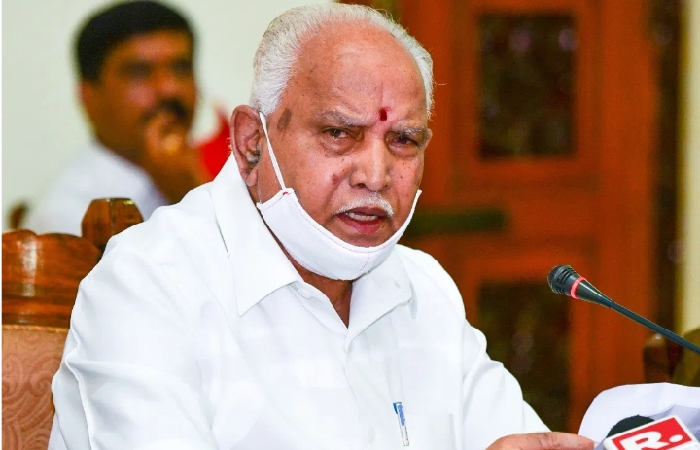
Those who shamed party in past may miss BJP ticket now

DHNS
January 25, 2018

Bengaluru, Jan 25: The BJP central leadership, virtually taking over the state unit ahead of the Assembly polls, has made several leaders, especially those who have embarrassed the party in the past, jittery.

These leaders, including several legislators, apprehend that they may not be able to secure the ticket to contest the polls, if the process is controlled by the central leadership. At the same time, a section of leaders, who feel that they can win due to their personal clout, are resisting the direction of the central leaders to strengthen the party at the grassroot.

They are of the view that they know how to emerge victorious in the elections on their own without taking up the tasks set by central leadership such as constituting booth committees. Their fear is that they might lose their hold over the constituencies if the booth-level committees are strengthened.

When in power, the BJP had to face embarrassment several times due to its own legislators. As many as 11 MLAs rebelled against the then chief minister B S Yeddyurappa.

They were disqualified and later reinstated on the direction of the Supreme Court. They include Balachandra Jarkiholi, Beluru Gopalakrishna, Anand Asnotikar, Sarvabhauma Bagali, V Nagaraju, Raju Kage, Y Sampangi, Nanjundaswamy, S K Bellubbi, H S Shankaralinge Gowda and Shivanagouda Naik.

Except Shankaralinge Gowda, who passed away, and Asnotikar, who quit the party, the remaining are still in the party and are ticket aspirants. Then there are those leaders who put the party in a spot by finding themselves in awkward situation - Hartal Halappa (rape charges), M P Renukacharya and S A Ramdas (both were accused by women of exploiting them), Lakshman Savadi, C C Patil (caught watching porn in Assembly on a phone belonging to another leader Krishna Palemar).

Again, all are aspiring for the ticket. The central leadership has made it clear that tickets will be issued after three rounds of survey, extensive consultation with local functionaries and the RSS. The apprehension is that those who embarrassed the party in the past may not make it to the final list. The feeling is that these leaders could stand a chance if the process is handed over to the state unit. However, the sources said the central leadership will have a final say.

The vice-like grip of the central leadership over the state unit has also disgruntled some leaders. Vijayanagara (Hosapete) MLA B Anand Singh, who has distanced himself from the party, is a case in point. Singh kept away from the Navakarnataka Nirmana Parivarthana Yatra. He was issued a notice for participating in Tipu Jayanti. He is now planning to join the Congress.

Comments

Danish
 - 
Thursday, 25 Jan 2018

Shame on you BJP people. Yeddy blames siddaramaiah on this. Now these people only stating that BJP people are opportunists

Kumar
 - 
Thursday, 25 Jan 2018

All BJP leaders are opportunists

Hari
 - 
Thursday, 25 Jan 2018

LOL... In BJP all are shameless people. 

Abu Muhammad
 - 
Thursday, 25 Jan 2018

BJP itself is the SHAME of India, funny news!!!

Add new comment

  • Coastaldigest.com reserves the right to delete or block any comments.
  • Coastaldigset.com is not responsible for its readers’ comments.
  • Comments that are abusive, incendiary or irrelevant are strictly prohibited.
  • Please use a genuine email ID and provide your name to avoid reject.
News Network
April 7,2020

Bengaluru, Apr 7: The Karnataka Government indicated today that it is too early to take a call now on lifting the nation-wide lockdown but said it’s in favour of its extension in COVID-19 hotspots in the country by at least an additional two weeks.

“We need to see for another few days before taking final call,” Medical Education Minister Sudhakar K, who is in-charge of all matters related to COVID-19, told news agency Press Trust of India when asked if the State is in favour of the rollback after the 21-day period ends on April 14.

The minister opined that the decision on its withdrawal should be based on the COVID-19 pandemic situation at the time in terms of number of cases and response to the outbreak.

When the lockdown is lifted, it has to be in a staggered and phased manner, and not at one go, Mr Sudhakar stressed.

“Where there are red alerts and zones, those zones, in my opinion, should continue to be in a lockdown situation at least for two weeks…till this month-end, I will request them (the Centre) to do this,” he said.

The Telananga Chief Minister K Chandrasekhar Rao on Monday appealed to the Prime Minister Narendra Modi to extend the 21-day national lockdown imposed to contain COVID-19 outbreak beyond April 14, saying it was essential to save lives.

Mr Sudhakar said the Karnataka government is facing financial challenges because of drastic fall in revenues due to the lockdown, adding, it would take “tough decisions” to cut expenditure.

The Finance Department is in the process of evaluating the state’s fiscal position.

“Finance department is gathering information…what is the need now, what should be the overall expenditure, how much we can save; financial support for unorganised and organised sector, along with stimulus to other sectors, we have to see where we stand financially,” the minister said.

“Based on that, we have to take certain steps for sure because after all the government runs on the exchequer money. Once the exchequer is stopped because of lockdown, we are not getting GST, no motor vehicle tax. No tax money is coming.”

Government also has to run right? he said.

He said commitment and obligations with regard to paying interest on loans taken at the national and international level would have to be met.

“So, there are some financial constraints, and financial challenges before the government. The Government will take tough decisions only after studying the entire finance (position of the State).”

The Telangana government last week announced pay cut for government employees.

The Union Cabinet on Monday approved a 30 per cent cut in salaries of all Members of Parliament and a two-year suspension of the MP Local Area Development (MPLAD) scheme.

Comments

Add new comment

  • Coastaldigest.com reserves the right to delete or block any comments.
  • Coastaldigset.com is not responsible for its readers’ comments.
  • Comments that are abusive, incendiary or irrelevant are strictly prohibited.
  • Please use a genuine email ID and provide your name to avoid reject.
Agencies
February 6,2020

Even more than three years after demonetisation and all-out efforts to make most transactions through electronic, cash is still king, as it thrives in a digital India, said fintech start-up Paytm founder Vijay Sekhar Sharma.

"While cashless economy is not possible in India, less cash economy will be in the future. Less cash is the only solution, not the elimination of cash," Sharma told IANS in an interview after unveiling an all-in-one payment gateway on Tuesday.

Asserting that it would take 5-10 years for India to make the transition to digital payments from the traditional mode of cash, Sharma, 41, said the e-payment industry benefitted more from the November 8, 2016 note ban and withdrawal of old Rs 1,000 and Rs 500 denominations.

"I think it (demonetisation) helped the industry despite lack of specific help. But the world has changed since then. It is about the scale of distribution of merchants that is what is propelling digital payments," said Sharma.

Most of the cash not only came back into circulation, but also remains as the mode of payment for the majority due to its convenience for the people used to such transactions.

Expounding Paytm's zero service charge, Sharma said the strategy is sustainable as it leads to acquiring more customers and merchants, enabling newer business opportunities.

Paytm also does not levy a service charge to small merchants for its payments services, unlike organised players like Uber.

"Though there is a monetisation model, the merchants who are small shopkeepers, become our financial services customers as they open a bank account, which is profitable."

Paytm secured a Payments Bank license from the Reserve Bank of India to offer a savings bank account, Rupay debit card and money transfer services.

"We are banking on payment services acquiring customers and merchants who avail banking, lending, insurance, wealth and software services like billing software and business ledger software services eventually," Sharma noted.

The mobile first bank services include zero balance and zero digital transaction charge accounts.

"Basically, payments, cloud, commerce and financial services are a cohort we follow. So, payments is our customer as well as merchant acquisition. If it breaks even, we are happy because other line items make more money, he affirmed.

Noting that in a market like India, one cannot price services at a premium unlike in a developed country like the US, the billionaire businessman said a consumer in a developing country would not be able to afford such a hefty charge.

Forbes ranked Sharma as India's youngest billionaire in 2017, with a net worth of $2.1 billion.

While several countries operate on the model of higher service charges, Sharma said newer business models have to be discovered in India, as customer lifecycle value is accounted for more stages than in other nations.

Asked about an upscale retailer like Zara not giving a wallet payment option during its recent end of season sale in Bengaluru, Sharma said Paytm was addressing such hiccups with its all-in-one payment solutions.

"It's an opportunity, because if the retailer has our all-in-one point of sale machine, where in they enter the amount, it shows both the Quick Response code (QR) and card payment options," he observed.

Sharma compared older swiping payment machine to feature phones and modern ones to feature-rich smartphones.

"If you notice, they look like feature phones and the modern day card machine is more a smartphone like. You can add the smatphone components, which can add the features," reiterated Sharma.

Though Paytm's all-in-one QR point of sale machine integrates the billing system, its chief executive said it was not ideal to have an independent QR feature.

Paytm has 16 million strong merchant user base, which Sharma aims to raise to 26 million base in the next one year.

Sharma has launched in this tech city an all-in-one payment gateway and Paytm Business Payments solution, which enable digital payments through multiple methods for small and medium enterprises (SMEs) and an Android point of sale machine.

With the new gateway solution, collecting digital payments through multiple methods can be achieved seamlessly while Paytm Business Payments solution enables automated vendor payments, including employee salaries and customer refunds among others.

The One97 Communications-owned Paytm aims to help SMEs streamline and digitise their business activities using its new solutions, which enhance the overall efficiency of both accepting and making payments.

Paytm has a data bank of over 200 million saved cards and bank accounts, a feature which enables partner apps to shorten transaction times and propel faster conversions while using the all-in-one payment gateway.

Complementing the two solutions, Sharma also launched an all-in-one Android point of sale machine, which can accept payments through all forms such as cards, wallets, UPI apps and even cash.

The device has a QR code that supports all contact and contactless payments, coming with integrated billing software customized solutions for different sectors such as catering, ticketing, parking and others.

The handheld Android device is equipped with an in-built printer, scanner and can also generate bills.

Valued at $16 billion, Paytm is not alone in the fiercely competitive Indian fintech space where a dozen players like PhonePe, MobiKwik, Kotak 811 and deep pocketed international giants Google Pay and Amazon Pay are in the fray.


Comments

Add new comment

  • Coastaldigest.com reserves the right to delete or block any comments.
  • Coastaldigset.com is not responsible for its readers’ comments.
  • Comments that are abusive, incendiary or irrelevant are strictly prohibited.
  • Please use a genuine email ID and provide your name to avoid reject.
News Network
August 2,2020

Bengaluru, Aug 2: Within a year of returning to power for the fourth time as Chief Minister in Karnataka, septuagenarian B.S. Yediyurappa has consolidated his position in the ruling BJP to stay the course till the next Assembly elections in mid-2023.

"A combination of factors helped Yediyurappa to consolidate and stay the course for the remaining term of his office to ensure the saffron party retains power in the state though he is unlikely to stake claim for the chief minister's post again as he would be 80 years old by 2023," a party source told news agency here.

Since the 77-year-old seasoned politician assumed office on July 26, 2019, the first year has been tumultuous for him, as he had go through a "trial by fire" what with the party's mighty high command and detractors testing his patience in the face of natural calamities like drought, floods and the Covid pandemic.

The first 7-8 months of the term were spent in tackling drought and floods, winning 12 of the 15 by-elections in December to secure a majority for the ruling party in the lower house and expanding the cabinet in February.

Even as Yediyurappa was settling down to seriously govern after presenting the state budget for fiscal 2020-21 in early March, the coronavirus outbreak overwhelmed him, as the pandemic spread and wreaked havoc, disrupting life, livelihood, economic growth and development.

"While the emphatic victory in the by-elections ensured the government's stability till the assembly term up to mid-2023, the second cabinet expansion on February 6 posed a challenge to Yediyurappa, as he could induct only 10 of the 12 MLAs who defected from the Congress and the Janata Dal-Secular (JD-S) and won the by-elections, triggering a revolt in the party by the loyalists left out of the ministry," the source recalled.

Though Yeddiyurappa has been leading the battle against the virus from day 1 and initially succeeded in controlling it from spreading during the extended lockdown till May 31, reopening the state under Unlock since June has undone the gains, as positive cases shot up to 1,29,287 so far, including 73,219 in Bengaluru after 53,648 recovered from across the state till date, while 2,412 succumbed to the deadly disease since March 9.

"For a state of 7 crore population, the data reveals that the pandemic has been fought on war-footing to contain it from spreading in all the 30 districts, although there are no signs of it going away till a vaccine is found. The chief minister has been trying to balance unlocking the state and containing the infection," a member of the health task force told IANS.

With six cabinet posts in the 34-member ministry being vacant, filling them will be a daunting task for Yediyurappa, as at least 20 legislators, including 5-6 newly elected turncoats and party's veterans are lobbying to become ministers at any cost.

By appointing 20 party legislators as heads of state-run board and corporations, nominating 5 as members of the state legislative council, including JD-S defector A.H. Vishwanath in July and getting 2 Congress defectors R. Shankar and M.T.B. Nagaraj elected as MLCs in June with 2 others, Yediyurappa ensured that these lawmakers would not be in the reckoning for the 6 cabinet posts, as dozen MLAs are already pitching for them.

Nagaraj and Vishwanath lost in the December 5 by-elections, while Shankar was not given a ticket to contest in the by-poll but was assured of making him an MLC with another disgruntled member C.P. Yogeshwar, who lost in the 2018 May assembly polls to JD-S leader and former chief minister H.D. Kumaraswamy of the 14-month-old JD-S and Congress coalition government from May 23, 2018 to July 23, 2019.

Resignations of 17 rebels, including 14 from the Congress and 3 from the JD-S led to the fall of the coalition government, as Kumaraswamy lost the majority in the 225-member assembly on July 23, 2019 in their absence.

Though Yediyurappa led the party to win 105 seats in the 2018 assembly elections and formed a government on May 17, 2018, he resigned 3 days later on May 19, 2018, as he fell 8-9 seats short of the halfway mark (113) for a simple majority in the lower house.

In a post-poll alliance, the JD-S and the Congress formed the coalition government to keep the BJP out of power in May 2018, after the assembly elections gave split verdict and the Congress lost power then.

"The record victory of the ruling party in the May 2019 general elections, when 25 of its 27 contestants won out of 28 Lok Sabha seats from the state, reinforced the popular belief that Yediyurappa is the party's mascot in winning elections and an unquestionable leader of the politically dominant Lingayats in the state," the source pointed out.

When Yediyurappa left the BJP and floated a regional outfit (Karnataka Janata Party) in January 2013, he delivered a body blow to the BJP in the May 2013 state assembly polls, as the votes got split and was defeated by then Congress.

"Besides the party's high command, everyone in the party's state unit, including leaders and cadres are aware of Yediyurappa's popularity across the state, as has the wherewithal to connect with masses and win elections," the source added.

Comments

Add new comment

  • Coastaldigest.com reserves the right to delete or block any comments.
  • Coastaldigset.com is not responsible for its readers’ comments.
  • Comments that are abusive, incendiary or irrelevant are strictly prohibited.
  • Please use a genuine email ID and provide your name to avoid reject.