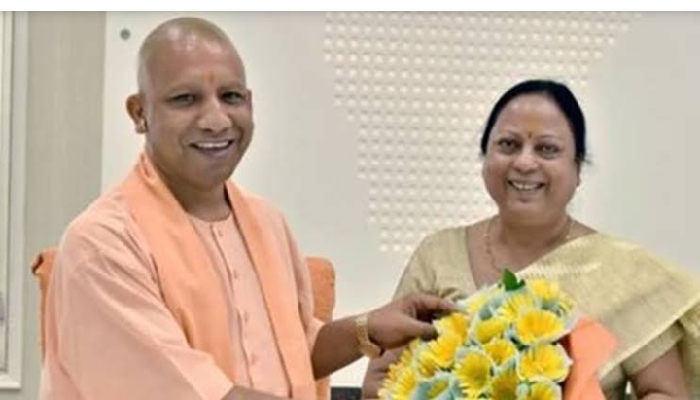
Those who talk about Hindu Terror are anti-nationals: Yogi

News Network
November 6, 2017

Lucknow, Nov 6: Recent remarks by a few artistes against Hindutva extremism and terrorism seem to have sparked a political storm as now Uttar Pradesh chief minister Yogi Adityanath has jumped into the discourse and branded individuals talking about intolerance and Hindu terrorism as anti-nationals.

“Those who market their intellectual wisdom for making money talk about intolerance in the country and those who talk about Hindu terrorism are surviving on hand-out of foreigners. They are anti-nationals and people of this country will never forgive them,” a news paper quoted him while he participated in a debate in Lucknow on Sunday.

“Sanatan dharm is the only religion in India. Rest are followers of different cults and beliefs. There is nothing called secularism in the country. It is the biggest lie in Independent India. Everyone has a right to follow their own cult or religion but above them is the nation and one cannot betray nation by raising their heads in the name of intolerance and Hindu terrorism,” said Yogi Adityanth.

Comments

Abu Muhammad
 - 
Monday, 6 Nov 2017

Whoever do not respect/recognise Indian Constitution, Indian Secularism is definitely an ANTI-NATIONAL. There is no ambiguity at all.

Abu Muhammad
 - 
Monday, 6 Nov 2017

Whoever do not respect/recognise Indian Constitution, Indian Secularism is definitely an ANTI-NATIONAL. There is no ambiguity at all.

Add new comment

  • Coastaldigest.com reserves the right to delete or block any comments.
  • Coastaldigset.com is not responsible for its readers’ comments.
  • Comments that are abusive, incendiary or irrelevant are strictly prohibited.
  • Please use a genuine email ID and provide your name to avoid reject.
News Network
May 25,2020

New Delhi, May 25: Realtors' apex body CREDAI has written a letter to Prime Minister Narendra Modi, seeking immediate relief measures to tide over the crisis caused by the COVID-19 pandemic.

The association, which has around 15,000 developer members, has sought one-time debt restructuring, lower interest rate on home loans and tax sops to boost liquidity and demand in the sector.

In an open letter to the prime minister, the Confederation of Real Estate Developers' Associations of India (CREDAI) said, "In this distressful situation arising out of the COVID-19 calamity, we in the real estate sector seek immediate relief for our survival."

Stating that the sector contributes substantially to the country's GDP and has backward and forward linkages with almost 250 industries, CREDAI said, "Our survival, therefore, is not just desirable, it is rather crucial for the economy."

Liquidity crunch, stagnant demand and cartelization of raw materials are major impediments for the industry to kickstart, it added.

CREDAI made seven recommendations to revive the sector and sought immediate intervention from the prime minister.

Pointing out that the situation is "much worse" than global financial crisis in 2008, CREDAI said "a one-time restructuring scheme as was permitted by RBI in 2008 may be quickly instituted by all lending institutions."

Since real estate was already reeling under a cyclical downturn before COVID-19, debt restructuring needs to be allowed for all accounts which were standard as on December 31, 2019, it added.

CREDAI demanded that all banks, non-banking financial companies (NBFCs) and housing finance companies (HFCs) should be directed to provide additional credit equal to 20 per cent of the existing real estate project related advances with no additional security and without the classification of project as NPA.

The penal interest charged by banks and financial institutions should be suspended for a period of one year or until such time as it takes for the pandemic to abate.

To revive housing demand, CREDAI suggested that "government should reduce the maximum rate of interest on new home loans to 5 per cent by subsidizing the interest component of EMIs for next five years."

The limit of principal deduction on housing loan under Section 80C should be increased to 2.5 lakh.

Interest deduction under Section 24 on housing loan for homebuyers may be increased to Rs 10 lakh, it said.

There should be no capital gains for residential properties held for a period longer than one year.

CREDAI also demanded that the subvention scheme be allowed again by National Housing Bank (NHB) and the Reserve Bank.

Under the scheme, builders used to pay EMIs on behalf of homebuyers during construction of projects.

"The economic uncertainty and job insecurity at the moment would not allow purchase of residential property at this time. A scheme whereby a homebuyer would need to pay only margin money with no EMI for 24 months will address this insecurity," the letter said.

The association pointed out that prices of cement and steel have been increased during the lockdown period, and asked for crackdown on cartelisation by manufacturers.

On the GST front, CREDAI said that the current regime of GST provides a rate of 1 per cent  for affordable housing.

"The limit of Rs 45 lakh serves as a criterion of affordability for the purpose of GST. On all other housing, GST is applied at the rate of 5 per cent without input tax credit. It has been felt that the criterion of Rs 45 lakh is too low an index of affordability anywhere across the country, and especially so in the metros," the letter said.

It will serve as an inducement to buyers in the metros if the benefit of GST at the rate of 1 per cent is extended to units costing up to Rs 75 lakh, the association said.

CREDAI pointed out that the flat rate of 5 per cent GST for under construction residential housing is causing cost build up and is acting as a deterrent for sale of under construction projects since there is no GST on completed units.

It suggested that GST rate of 1 per cent and 5 per cent, without input tax credit, should continue.

"However, an option of GST @12 per cent for normal housing/ 8 per cent for affordable housing (with 1/3rd deduction for land i.e. effective GST rate of 8 per cent for normal housing and effective GST rate of 5 per cent for affordable housing) with input tax credit (ITC) benefits in line with the scheme applicable for the works contracts for government may be revived and made applicable to the real estate," the letter said.

Lastly, CREDAI demanded that a Rs 25,000 crore stress fund for completing stalled housing projects should be deployed at the earliest.

"We shall be grateful for your much-needed intervention for the above mentioned measures required to revive the real estate sector," CREDAI said in the letter to the PM.


Comments

Add new comment

  • Coastaldigest.com reserves the right to delete or block any comments.
  • Coastaldigset.com is not responsible for its readers’ comments.
  • Comments that are abusive, incendiary or irrelevant are strictly prohibited.
  • Please use a genuine email ID and provide your name to avoid reject.
News Network
February 9,2020

Mumbai, Feb 9: Given the slow progress on the ongoing Rs 38,000-crore capacity expansion at the four largest metro airports, and also the surging traffic, the snaky queues will continue at least till 2023, warns a report.

The four largest airports -- New Delhi, Mumbai, Bengaluru and Hyderabad -- handle more than half of the traffic and are operating at 130 per cent of their installed capacity. These airports are under a record Rs 38,000-crore capex but the capacity will not come up before end-2023, says a Crisil report.

“With the dip in traffic growth largely behind, we expect congestion at the top four airports of New Delhi, Mumbai, Bengaluru and Hyderabad, which handle more than half of the load, to continue till about FY23,” says the report.

Already these airports are operating at over 130 percent of installed capacity, and the ongoing healthy traffic growth this operating rate is expected to rise further in the next 12 months.

“Operationalising of capacities in the following two fiscals will bring down utilisation levels albeit still high at over 90 per cent by fiscal 2023 and that is despite an unprecedented Rs 38,000 crore capex being undertaken by the operators of these airports over five fiscals 2020-24,” says the report.

Despite this unprecedented capex that is debt-funded, ratings are likely to be stable given the strong cash flows expected due to healthy traffic growth, low project risks associated with the capex and improving regulatory environment, notes the report.

“Capacity at these four airports will increase a cumulative 65 per cent to 228 million annually (from 138 million now) by fiscal 2023. However, traffic is expected to grow strong at up to 10 per cent per annum over the same period. Since additional capacities will become operational in phases only by fiscal 2023, high passenger growth will add to congestion till then,” warn the report.

High utilisation will ride on pent-up demand (accumulated in 2019 as traffic was impacted with the grounding of Jet Airways) and one-off issues with new aircraft of certain airlines.

Further impetus will also come from improving connectivity to lower-tier cities and reducing fare difference between air and rail. Increasing footfalls at airports provide a leg-up to non-aero streams such as advertising, rentals, food and beverage and parking, which comprise around half of the revenue of airports already.

These are expected to grow strongly at over 10-12 per cent, also supported by higher monetisation avenue coming along with current capex. The other half of revenue (aero revenue) is an entitlement approved by the regulator, providing a pre-determined, fixed return over the asset base and a pass-through of costs.

Aero revenue is also expected to get a bump up during fiscals 2022-24, when a new tariff order for airports is likely. Overall aggregate cash flows are likely to double by fiscal 2024 and provide a healthy cushion against servicing of debt contracted for capex, the report concludes.

Comments

Add new comment

  • Coastaldigest.com reserves the right to delete or block any comments.
  • Coastaldigset.com is not responsible for its readers’ comments.
  • Comments that are abusive, incendiary or irrelevant are strictly prohibited.
  • Please use a genuine email ID and provide your name to avoid reject.
Agencies
August 2,2020

Lucknow, Aug 2: Uttar Pradesh's cabinet minister for Technical Education Kamal Rani Varun succumbed to COVID-19 on Sunday at the Sanjay Gandhi Postgraduate Institute of Medical Sciences.

Kamal Rani is the first minister in Uttar Pradesh to die after contracting coronavirus. She was 62.

On 18 July, the minister tested positive for coronavirus and was admitted to the Shyama Prasad Mukherjee Hospital.

She was later shifted to the Sanjay Gandhi Postgraduate Institute of Medical Sciences.

Uttar Pradesh chief minister Yogi Adityanath has expressed grief over the minister's death.

In a condolence message issued on Sunday, Adityanath said, "Kamal Rani Varun died on Sunday at around 9.30 am. She was an experienced and capable leader. She discharged her responsibilities with competence. She was a dedicated public representative, who was always working for the welfare of deprived and oppressed sections of the society."

Kamal Rani was the MLA from Ghatampur in Kanpur. She was also twice a Member of Parliament in the Lok Sabha.

Meanwhile, Adityanath has cancelled his visit to Ayodhya scheduled for the day, Additional Chief Secretary (Home) Awanish Awasthi said on Sunday.

Comments

Add new comment

  • Coastaldigest.com reserves the right to delete or block any comments.
  • Coastaldigset.com is not responsible for its readers’ comments.
  • Comments that are abusive, incendiary or irrelevant are strictly prohibited.
  • Please use a genuine email ID and provide your name to avoid reject.