Thousands bid emotional farewell to Siachen braveheart

February 12, 2016

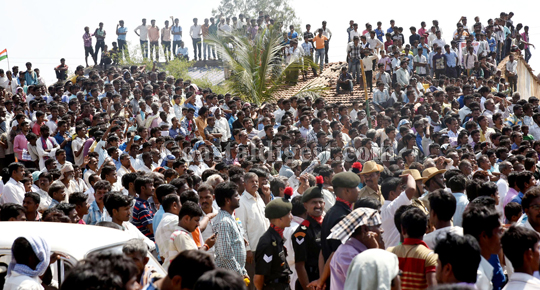
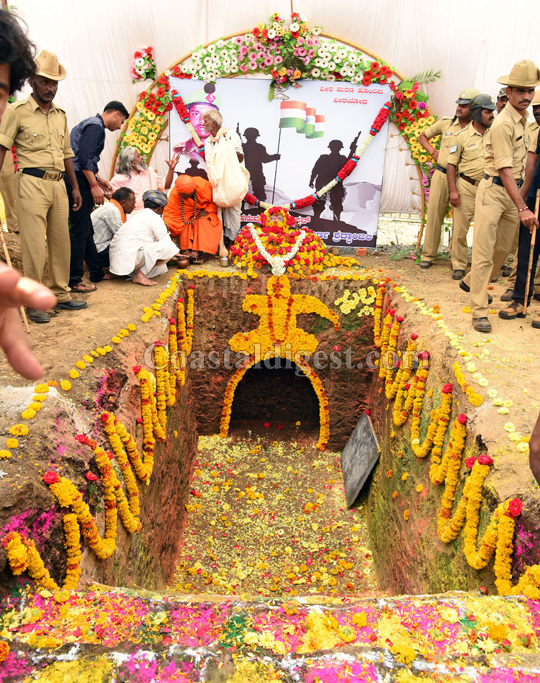
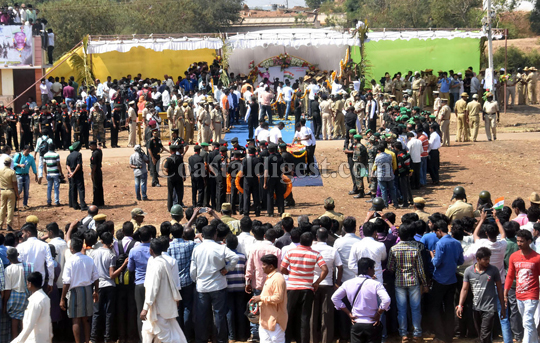
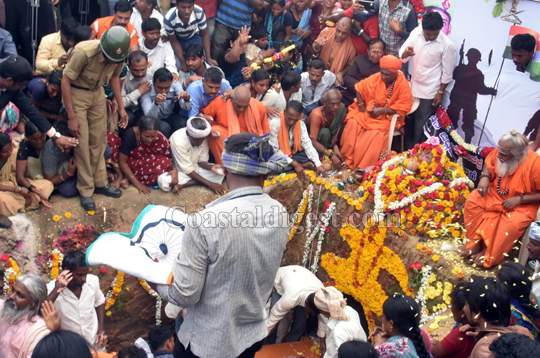
Dharwad, Feb 12: The body of Lance Naik Hanumanthappa Koppad was laid to rest with full state honours, after thousands of people bid an emotional farewell to the Siachen braveheart at his native village of Betadur in Dharwad district of north Karnataka today.

hanumantappa 1

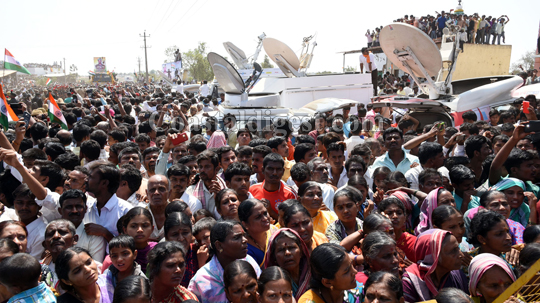
Full throated chants of "Hanumanthappa amar rahe" and patriotic slogans rent the air as the mortal remains of Hanumanthappa was buried at a land adjacent to the Gram Panchayat office, with thousands of people from the village and nearby areas cutting across age, in attendance.

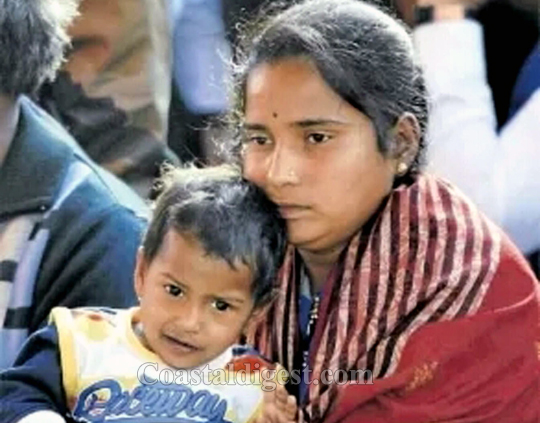
The last rites were performed according to Lingayat community rituals. The scene of Hanumanthappa's wife, mother and two-year-old daughter paying their last respects at the High School ground in Betadur touched the chord of hundreds of people, who had gathered there, leaving many teary-eyed.

An air of melancholy hung in the air as the family of Hanumanthappa was inconsolable, and at one point of time, his wife Mahadevi even fainted and was consoled by members of the family, the military and police.

The village was in sorrow ever since yesterday as hope and prayers gave way to gloom with the death of Hanumanthappa, a resident of Betadur who had joined the army 13 years ago, chasing his dream even after being rejected earlier at some army recruitment rallies.

Earlier, Hanumanthappa's body that was kept at KIMS Hospital in Hubballi last night was shifted to Nehru Ground in the city, where hundreds of people arrived in an unending stream and paid their homage. Chief Minister Siddaramaiah, Union Minister Ananth Kumar, Home Minister G Parameshwara, several state ministers and leaders of political parties paid their last respects.

The body was brought to Betadur village in Kundagol taluk of Dharwad district in a procession in its final journey. Siddaramaiah visited Betadur to meet Hanumanthappa's family members and consoled them.

The body of 33-year-old Hanumanthappa,who epitomised grit and determination having survived miraculously under 30 feet of ice and snow under which he was buried for six days, was brought to Hubballi last night from Delhi where he breathed his last after a valiant battle for life.

The Chief Minister had yesterday announced an ex-gratia of Rs 25 lakh for the bereaved family. He had also announced a site, land, job for Hanamanthappa's wife and memorial for the brave heart. Karnataka government has said that similar compensation will be given to two other soldiers from the state- Mahesh from Mysuru, Nagesh from Hassan who have died in the Siachen tragedy.
hanumantappa 2

hanumantappa 3

hanumantappa 4

hanumantappa 5

hanumantappa 6

hanumantappa 7

Comments

abdul
 - 
Saturday, 13 Feb 2016

It is better to vacate siachin,where niether india nor pakistan will benifit from these frozen lands.instead of losing humans valuable life,it is time to vacate these useless places and give full security where human beings can live.Instead of posting to those places it is time to withdraw military from frozen land and respect their life and hard earned tax payers money. after paying so much money what is the necessity of keeping those lands ?

Knowledge to
 - 
Saturday, 13 Feb 2016

Allah created Man & fashioned him for set tasks. In the same manner He created plants & animals. But if man or animals die. Surely Allah is able to give them life as surely as He created them in the first instance.
We Muslims know Allah is the creator and can recreate us, bcos if one can do something he has the ability to do it again.
Allah is able to give life to the dead cos it is He who created them in the beginning. Allah can surely give life to the dead. He judges them on their deeds. On Ressurection day He will recreate the dead for judgement and then allow the doer of Good to enter paradise but cast the evil doer to Hell.
REcognise your lord & do good deeds & help others..

saritha
 - 
Saturday, 13 Feb 2016

Braveheart... Sallute.

lavina
 - 
Saturday, 13 Feb 2016

May ur soul rest in peace

Ram
 - 
Friday, 12 Feb 2016

Big salute to Hanumanthappa

rajiv
 - 
Friday, 12 Feb 2016

May his soul rest in peace

Add new comment

  • Coastaldigest.com reserves the right to delete or block any comments.
  • Coastaldigset.com is not responsible for its readers’ comments.
  • Comments that are abusive, incendiary or irrelevant are strictly prohibited.
  • Please use a genuine email ID and provide your name to avoid reject.
News Network
May 4,2020

Davanagere, May 3: Karnataka's Davanagere district on Sunday reported 21 COVID-19 positive cases, said Mahantesh Beelagi, Deputy Commissioner.

The number of COVID-19 patients has suddenly taken a giant leap in the district.

"We had sent 94 samples on May 1, on May 2 we sent 72 samples. Today we sent 164 samples for testing. In the last two days, 21 samples have tested positive for coronavirus, we are tracing to know how did all of them came in contact with COVID-19 infected person," said Mahantesh Beelagi.

"Our surveillance team and police team have started tracing the primary and secondary contacts of all 21 people," he added.
Davanagere is currently in the Green Zone.

Meanwhile, 13 new COVID-19 positive cases were reported in Karnataka till 5 pm on Sunday, taking the total number of cases in the state to 614, according to the State Health Department.

Comments

Add new comment

  • Coastaldigest.com reserves the right to delete or block any comments.
  • Coastaldigset.com is not responsible for its readers’ comments.
  • Comments that are abusive, incendiary or irrelevant are strictly prohibited.
  • Please use a genuine email ID and provide your name to avoid reject.
Agencies
May 8,2020

Washington D.C., May 8: The prime time for brain development in a child's life is the first year, where the infant spends most of the time asleep. It is the time when neural connections form and sensory memories are encoded.

However, when sleep is disrupted, as occurs more often among children with autism, brain development may be affected, too.

New research led by the University of Washington finds that sleep problems in a baby's first 12 months may not only precede an autism diagnosis but also may be associated with altered growth trajectory in a key part of the brain, the hippocampus.

The study, which was published in the American Journal of Psychiatry, researchers report that in a sample of more than 400 taken of 6- to 12-month-old infants, those who were later diagnosed with autism were more likely to have had difficulty falling asleep.

It also states that this sleep difficulty was associated with altered growth trajectories in the hippocampus.

"The hippocampus is critical for learning and memory, and changes in the size of the hippocampus have been associated with poor sleep in adults and older children.

As many as 80 per cent of the children with autism spectrum disorder have sleep problems," said Annette Estes, director of the UW Autism Center and senior author of the study.

"In our clinical experience, parents have a lot of concerns about their children's sleep, and in our work on early autism intervention, we observed that sleep problems were holding children and families back," added Estes, who is also a UW professor of speech and hearing sciences.

"It could be that altered sleep is part-and-parcel of autism for some children. One clue is that behavioural interventions to improve sleep don't work for all children with autism, even when their parents are doing everything just right. This suggests that there may be a biological component to sleep problems for some children with autism," said Estes.

To consider links among sleep, brain development, and autism, researchers at the IBIS Network looked at MRI scans of 432 infants, surveyed parents about sleep patterns, and measured cognitive functioning using a standardized assessment.

At the outset of the study, infants were classified according to their risk for developing autism: Those who were at higher risk of developing autism -- about two-thirds of the study sample -- had an older sibling who had already been diagnosed.

Infant siblings of children with autism have a 20 per cent chance of developing autism spectrum disorder -- a much higher risk than children in the general population.

In the current study, 127 of the 432 infants were identified as "low risk" at the time the MRI scans were taken because they had no family history of autism.

They later evaluated all the participants at 24 months of age to determine whether they had developed autism. Of the roughly 300 children originally considered "high familial risk," 71 were diagnosed with autism spectrum disorder at that age.

Problems with sleep were more common among the infants later diagnosed with an autism spectrum disorder, as were larger hippocampi. No other subcortical brain structures were affected, including the amygdala, which is responsible for certain emotions and aspects of memory, or the thalamus, a signal transmitter from the spinal cord to the cerebral cortex.

The authors note that while parents reported more sleep difficulties among infants who developed autism compared to those who did not, the differences were very subtle and only observed when looking at group averages across hundreds of infants.

Sleep patterns in the first years of life change rapidly as infants transition from sleeping around the clock to a more adult-like sleep/wake cycle. Until further research is completed, Estes said, it is not possible to interpret challenges with sleep as an early sign of increased risk for autism.

Comments

Add new comment

  • Coastaldigest.com reserves the right to delete or block any comments.
  • Coastaldigset.com is not responsible for its readers’ comments.
  • Comments that are abusive, incendiary or irrelevant are strictly prohibited.
  • Please use a genuine email ID and provide your name to avoid reject.
News Network
April 19,2020

Bengaluru, Apr 19: A recent government order prohibiting congregations, Ramadan prayers is discriminatory and needs to be withdrawn, JD(S) MLC B M Farookh has demanded.

In a letter to the chief secretary, Farookh pointed out that the order contained certain conditions such as restriction of the use of public address system and delivering Azan in low decibels, which had nothing to do with the prevention of Covid-19 disease.

“These days, Azan includes a call for the community to pray at home and does not offer namaz at mosque. The order also prohibits preparation and distribution of porridge, which has always been taken up in the interest of the poor. The High Court has noted that the relief distribution by NGOs or individuals should not be prevented and the state machinery has to coordinate the same by ensuring social distancing. The ban on distribution of porridge by mosques amounts to discrimination. The order needs to be withdrawn or revisited,” he wrote in his letter.

Further, observing that a religious fair was conducted in Kalaburagi recently, in violation of the government’s social distancing norms, Farookh sought the government to ensure that social distancing norms are enforced with regard to festivals of all communities without discrimination.

Comments

Add new comment

  • Coastaldigest.com reserves the right to delete or block any comments.
  • Coastaldigset.com is not responsible for its readers’ comments.
  • Comments that are abusive, incendiary or irrelevant are strictly prohibited.
  • Please use a genuine email ID and provide your name to avoid reject.