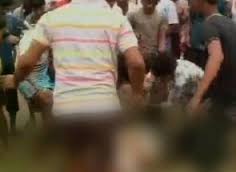
Three held for beating murder accused to death after tying him to tree

February 29, 2016

Mangaluru, Feb 29: Three residents of Totadday village near Belthangady have been arrested on the charge of murdering 38-year-old Peter M.J., who was involved in cases of murder and theft.

beatenThe police have arrested M.A. Thomas (54), Saju Thomas (38) and Antony (54) for allegedly beating Peter to death.

On February 15, 2016 Peter was reportedly caught by the people along with four bags of areca-nut that had been allegedly stolen from another house. The people tied him to a tree and called the Belthangady police.

Before the police arrived, the village residents thrashed Peter black and blue. The arrested three have been accused of assaulting Peter. Peter died before the police could reach the spot.

The police said that Peter was involved in another case of theft of are-canut.

He was also involved in a case of double murder in Belthangady, the police said.

Also Read: Mangaluru: Habitual offender tied to tree, beaten to death by villagers

Comments

student union
 - 
Monday, 29 Feb 2016

nobody can stop us !!!!

Sameerulla
 - 
Monday, 29 Feb 2016

nobody can take law in hand, this is totally wrong.

Menaka
 - 
Monday, 29 Feb 2016

Rightly done very good job. if this people handed over him to police, they will release him in week because 50% of theft shares police will get.

Wahid
 - 
Monday, 29 Feb 2016

who r these people to punish him, all the culprit must be punished by law.

Mohan
 - 
Monday, 29 Feb 2016

nobody can take law on hand, everyone must be punished for making crime.

Add new comment

  • Coastaldigest.com reserves the right to delete or block any comments.
  • Coastaldigset.com is not responsible for its readers’ comments.
  • Comments that are abusive, incendiary or irrelevant are strictly prohibited.
  • Please use a genuine email ID and provide your name to avoid reject.
News Network
April 3,2020

Bengaluru, Apr 3: Four people, including three who attended the Tablighi Jamat meet in Delhi, tested positive for coronavirus on Friday, taking the total number of the affected in the state to 128, the Health department said here.

The three men from Belagavi had attended the Tablighi- Jamaat congregation from March 13 to 18 at Delhi, while the other case was that of a 75-year-old man, who is a resident of Bagalkote.

A detailed investigation was underway to ascertain how he got infected, the department said in a bulletin.

It said that till date, 128 COVID-19 positive cases have been confirmed in the state, including three deaths and 11 discharges.

"With 128 cases we are in ninth position in the country in number of cases.Today four new cases were confirmed, of which three were those who attended Tablighi-Jamaat congregation," Primary and Secondary Education Minister Suresh Kumar told reporters, giving details about the bulletin.

He said 187 of the total of 288 samples collected from those who attended the congregation had tested negative and only 13 had turned positive so far.

"Out of 288 samples collected, we have got report for only 200 cases and are awaiting reports for 88," he added.

Though Kumar did not give any figures on the total number of people who went from Karnataka to attend theDelhi meet, the health department on Thursday had said nearly 1,000 people (including 19 foreigners) linked to Tablighi Jamat had been screened and swab samples of more than 200 people had been collected, while efforts are on to find out others.

Chief Minister B S Yediyurappa on Friday held a meeting with Muslim leaders and MLAs even as the government stepped up efforts to track those who might have travelled to the state after taking part in the meet in Delhi last month, which has turned out to be the hotbed of COVID-19 spread in the country.

After the meeting, the Chief Minister said Muslim MLAs agreed to provide details of those who attended the Jamaat's congregation to the government and also convince them to undergo COVID-19 tests, along with quarantining themselves.

Out of total of 114 active cases in the state so far, 111 patients (including 1 pregnant woman) are in isolation at designated hospitals and are stable, while three are in ICU (one on oxygen and two on Ventilators).

Seven of the 128 cases detected and confirmed were transit passengers of Kerala, who landed at airports in Karnataka and are being treated in the state.

Among the 128 positive cases, 51 were reported from Bengaluru, 21 from Mysuru, 10 from Bidar, nine from Dakshina Kannada, eight from Uttara Kannada, seven from Chikkaballapur, five from Kalaburgai, four from Ballari, three each from Davangere, Belagavi and Udupi, and one each from Kodagu, Tumakuru, Bagalkote and Dharwad.

Those discharged include nine patients from Bengaluru and two from Kalaburagi and among the deceased are one each are reported from Kalaburgari, Bengaluru and Tumakuru.

The Chief Minister held a series of meetings to review the measures taken to control the spread of COVID-19 and implementation of lockdown in the state.

He asked the labour department to deposit an additional Rs 1,000 from the Construction Workers Welfare Fund to the accounts of 15 lakh labourers in the sector.

The government has already deposited Rs 1000 to their accounts (amounting about Rs 150 crore) in the first round.

During the meeting the shortage of Personal Protective Equipment (PPE) Kits for Doctors and health care professionals was discussed.

"Work order has been issued for 1 lakh PPE kits, and the Chief Minister has issued directions for the supply of 2 lakh more PPE kits," Kumar said.

Yediyurappa also chaired a meeting with Ministers from Bengaluru on steps to be taken to control spread of COVID-19, as the city has more than half the confirmed cases in the state.

He also decided to covene a meeting of city legislators in this regard on Saturday morning.

Kumar said it was also decided not to provide food free of cost at the state run Indira Canteens as concerns were raised about the quality and misuse that was happening during the Chief Minister's meeting with ministers today.

"We have decided to stop free food supply...we are providing foodgrains to poor through ration already," he said.

However, the Canteens will continue to provide subsidized food- breakfast at Rs 5 and lunch and dinner at Rs 10.

The government last month had decided that Indira Canteens would provide food packets free of cost to the poor and needy in the wake of the lockdown.

Meanwhile, in view of COVID-19, emergency Additional Chief Secretary, H&FW Department ordered extension ofservices of Medical and Para-medical staff, Clinical and Nonclinical staff retiring in April and May this year, to June 30.

Amid reports of lack of co-ordination between Medical Education Minister K Sudhakar and Health and Family Welfare Minister B Sriramulu, Chief Minister Yediyurappa has tasked Suresh Kumar to brief the media on COVID-19 related daily bulletins, official sources said.


Comments

Add new comment

  • Coastaldigest.com reserves the right to delete or block any comments.
  • Coastaldigset.com is not responsible for its readers’ comments.
  • Comments that are abusive, incendiary or irrelevant are strictly prohibited.
  • Please use a genuine email ID and provide your name to avoid reject.
News Network
March 28,2020

Bengaluru, Mar 28: Sun Tsu, in 'The Art of War' speaks of a skilful general who can subdue his enemy without any fighting. This constitutes the ultimate triumph which is referred to as stratagem. Today, we would need one such when we are faced with the '21-day corona challenge' for India.
Nearly four weeks back, Dr Jyothsna Rao, Dr Gururaj Rao and I sat across the OPD in the afternoon at HCG Bengaluru discussing our ongoing cancer immunology research. While on this topic, we drifted into the discussion on the coronavirus. During this engaging discussion, we wondered the similarity of the enigma between the virus and cancer. I paused to ask Dr Jyothsna and Dr Guru - how we wish we could do something against this virus.
Dr Jyothsna is a PhD from NCBS and had worked under Dr Ralph Steinman, physician and researcher from Rockefeller University, who won the Nobel Prize for his discovery of the dendritic cell and its role in adaptive immunity in 2011. Dr Gururaj is a molecular and cell biologist who did his PhD at the Chapel Hill, University of North Carolina and is the Director of iCrest.
Jyothsna while hearing our perplexing conversation on the covid intervened, "Yes, surely. I think we should take a break from cancer and focus on the innate and adaptive immunity role in COVID-19."
Thus began this sincere attempt to relook the human immune system from the eyes of the COVID-19.
We have 10 types of immune cells at the least which are widely dispersed in millions across the body. When our body is invaded by a foreign organism (bacteria, fungi or virus), these cells work with each other to destroy the invader.
Now, the question is - how do the immune cells talk to each other? They use small-molecule substances called cytokines (cyto means cells; kine means movement). There are many cytokines that are involved in work on the immune system. The most relevant for viruses are interferons.
Interferons (IFN) as the name reflects have an ability to interfere with the viral activity and stop their multiplication. These specialised signal proteins are released by our cells in response to a viral attack to forewarn other cells. They help build the antiviral proteins within the cells to kill the virus as it tries to invade the new cells.
Historically, interferons are a group of cytokines known to be potent antiviral agents against viruses and a hallmark cytokine induced by the host upon viral infections. Interferons possess unique immunoregulatory activities and are signature cytokines released by (TH1) T immune cells, which are crucial in viral infections.
As the outbreak of COVID-19 grapples us, an urgent need for finding strategies to combat the virus is growing. Coronaviruses (CoVs) are a group of RNA viruses. In patients infected with coronavirus, it was indicated that the activation of the IFN does not occur until 48 hours post-infection. Thus the delayed IFN-related antiviral response by the healthy cells leads to coronavirus evade the immune response.
Numerous studies have presented the success in defeating CoVs by the direct administration of IFNs. In a combination as a concoction, it was shown to synergistically inhibit the virus replication in vitro.
Moreover, it is understood that the earlier induction of IFNs in children although they have a less developed immune system could be the reason behind the children being least affected.
The key to success in reducing the disease fatality might be the stimulation of the immune responses to trigger IFN production at the very early stages of the disease, which might be done through the administration of IFN. Despite the evidence for the efficacy of IFNs in treating CoV-induced infections, the proper dosing and ideal timing for such interventions needs to be verified in clinical trials.
For the later stages of the diseases in advance stages where patients are on ventilator and have developed respiratory distress, we propose to utilise the mesenchymal cells derived from donor bone marrow that have been known to treat acute respiratory syndrome. Mesenchymal cells are known to possess anti-inflammatory activity and thus used often in autoimmune diseases.
With this scientific background, we have activated T cells from healthy donors, in a cGMP facility at iCrest - HCG hospital with an enriched cocktail of cytokines rich in Interferons. Injections of this cocktail we believe will result in a surge of cytokines in the body of the infected person and will boost his ability to fight the virus in the early phases. We are in the initial phases of this study and hope to be ready in the coming weeks with meaningful data on its potential utility.
Currently, it awaits government approvals (Union and state) and we have applied to central drugs authority for their initial evaluation and further directions.
As my Guru often expounded the philosophy of 'Seva' - the goal of education is knowledge, the end goal of knowledge is service. In this attempt to serve our fellow humans at this brink of unprecedented crisis, medical fraternity stands with you and promises to do our best for your safety.
We assure to exhaust every bit of our spirit in this fight against coronavirus. We have lost the sight of shores and travelled thus far, but that is the mandatory first step to cross the ocean. Are we going to succeed in this battle, is something only time will answer. 

Comments

Add new comment

  • Coastaldigest.com reserves the right to delete or block any comments.
  • Coastaldigset.com is not responsible for its readers’ comments.
  • Comments that are abusive, incendiary or irrelevant are strictly prohibited.
  • Please use a genuine email ID and provide your name to avoid reject.
News Network
May 27,2020

Bengaluru, May 27: Amid uncertainty caused by the Covid-19 pandemic, which has disrupted school education in Karnataka, the state government is seeking the help of the Union Ministry of Information and Broadcasting to televise classes, a state minister said on Tuesday.

"We request you to provide minimum three channels on the Doordarshan network exclusively for the Department of Public Instruction, Government of Karnataka," Primary and Secondary Education Minister Suresh Kumar said in a letter to Union I&B Minister Prakash Javadekar.

Suggesting co-branding the channels under DD and the state education department, he asked for the channels to be mandatorily transmitted by the cable and DTH operators under the Cable Act.

The state education department has already discussed with Prasar Bharti officials, who, according Kumar, have assured 3+3 hours of timeslots on the education channel Chandana on cost basis.

"We have also made all the necessary arrangements for content creation by the teachers," he said.

Meanwhile, the minister has revealed that television is the best medium for the students as a home learning mode in these challenging times.

"The department of public instruction reviewed various technological options and considered TV as one of the best means for home learning," Kumar said.

In a survey conducted by the education department, it was found out that 95 per cent households had television sets.

Kumar said the state operates government schools in nine languages, including Kannada, English and Urdu.

"To cater to all the students, and considering a long-term strategy to run schools by maintaining social distancing, we are in immediate need of minimum three exclusive channels to teach through TV," he said.

According to Kumar, the Karnataka government is facing hardships to meet the capital expenditure requirements, hence, it is seeking help from the I&B Ministry.

Comments

Add new comment

  • Coastaldigest.com reserves the right to delete or block any comments.
  • Coastaldigset.com is not responsible for its readers’ comments.
  • Comments that are abusive, incendiary or irrelevant are strictly prohibited.
  • Please use a genuine email ID and provide your name to avoid reject.