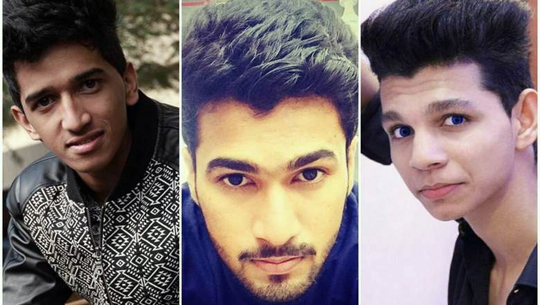
Three NRI students killed in Sharjah car crash

March 12, 2016

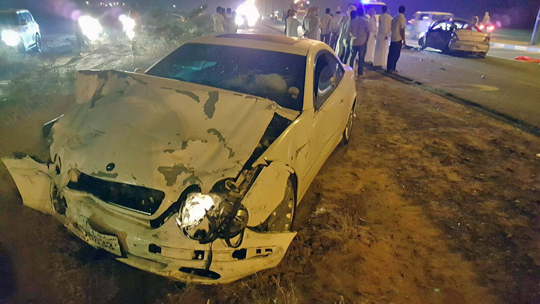
Sharjah, Mar 12: Three Indian students died on the spot in a horrific accident that occurred in Al Madam-Al Sameed road in Sharjah.

nriacci 1

The deceased have been identified as Ashmid Ashraf (20) from Kozhikkode; Shifaam Musthafa (20) from Panoor, Kannur; and Mohammed Sunoon (21) from Kozhikkode.

The youths were returning after visiting a friend's house when the horrific accident took place in Sharjah's Madam area around 1.30am. The driver of the youths' car tried to take a U-turn from an unauthorised area on the road, when another speeding car crashed into theirs.

The three youths were killed on the spot, while the driver of the other car - a 25-year-old Yemeni - sustained minor injuries.

Meanwhile, the Middlesex University has expressed deep condolences to the families of the boys.

"Middlesex University Dubai Students and Staff mourn the loss of Ashmid Ashraf, Muhammed Shifam and Mohammed Sunoon in a tragic accident. Our deepest sympathies and condolences to their families," reads the Facebook post of the university.

nriacci 3

nriacci 2

nriacci 4

Comments

Ajaz Hussain
 - 
Sunday, 13 Mar 2016

\\"\"Innalillahi Wa innailaihi rajioon\"\"\"\""

ahmed ali K.
 - 
Saturday, 12 Mar 2016

Inna Lillahi Wa Inna Ilaihi Rajihoon

Add new comment

  • Coastaldigest.com reserves the right to delete or block any comments.
  • Coastaldigset.com is not responsible for its readers’ comments.
  • Comments that are abusive, incendiary or irrelevant are strictly prohibited.
  • Please use a genuine email ID and provide your name to avoid reject.
Agencies
May 8,2020

Washington D.C., May 8: The prime time for brain development in a child's life is the first year, where the infant spends most of the time asleep. It is the time when neural connections form and sensory memories are encoded.

However, when sleep is disrupted, as occurs more often among children with autism, brain development may be affected, too.

New research led by the University of Washington finds that sleep problems in a baby's first 12 months may not only precede an autism diagnosis but also may be associated with altered growth trajectory in a key part of the brain, the hippocampus.

The study, which was published in the American Journal of Psychiatry, researchers report that in a sample of more than 400 taken of 6- to 12-month-old infants, those who were later diagnosed with autism were more likely to have had difficulty falling asleep.

It also states that this sleep difficulty was associated with altered growth trajectories in the hippocampus.

"The hippocampus is critical for learning and memory, and changes in the size of the hippocampus have been associated with poor sleep in adults and older children.

As many as 80 per cent of the children with autism spectrum disorder have sleep problems," said Annette Estes, director of the UW Autism Center and senior author of the study.

"In our clinical experience, parents have a lot of concerns about their children's sleep, and in our work on early autism intervention, we observed that sleep problems were holding children and families back," added Estes, who is also a UW professor of speech and hearing sciences.

"It could be that altered sleep is part-and-parcel of autism for some children. One clue is that behavioural interventions to improve sleep don't work for all children with autism, even when their parents are doing everything just right. This suggests that there may be a biological component to sleep problems for some children with autism," said Estes.

To consider links among sleep, brain development, and autism, researchers at the IBIS Network looked at MRI scans of 432 infants, surveyed parents about sleep patterns, and measured cognitive functioning using a standardized assessment.

At the outset of the study, infants were classified according to their risk for developing autism: Those who were at higher risk of developing autism -- about two-thirds of the study sample -- had an older sibling who had already been diagnosed.

Infant siblings of children with autism have a 20 per cent chance of developing autism spectrum disorder -- a much higher risk than children in the general population.

In the current study, 127 of the 432 infants were identified as "low risk" at the time the MRI scans were taken because they had no family history of autism.

They later evaluated all the participants at 24 months of age to determine whether they had developed autism. Of the roughly 300 children originally considered "high familial risk," 71 were diagnosed with autism spectrum disorder at that age.

Problems with sleep were more common among the infants later diagnosed with an autism spectrum disorder, as were larger hippocampi. No other subcortical brain structures were affected, including the amygdala, which is responsible for certain emotions and aspects of memory, or the thalamus, a signal transmitter from the spinal cord to the cerebral cortex.

The authors note that while parents reported more sleep difficulties among infants who developed autism compared to those who did not, the differences were very subtle and only observed when looking at group averages across hundreds of infants.

Sleep patterns in the first years of life change rapidly as infants transition from sleeping around the clock to a more adult-like sleep/wake cycle. Until further research is completed, Estes said, it is not possible to interpret challenges with sleep as an early sign of increased risk for autism.


Comments

Add new comment

  • Coastaldigest.com reserves the right to delete or block any comments.
  • Coastaldigset.com is not responsible for its readers’ comments.
  • Comments that are abusive, incendiary or irrelevant are strictly prohibited.
  • Please use a genuine email ID and provide your name to avoid reject.
News Network
February 17,2020

Kasaragod, Feb 17: A Kerala Muslim couple conducted the wedding of their Hindu foster daughter at a Bhagavathi temple in Kerala, scripting another tale of communal harmony at Kasaragod.

The wedding ceremony was held on Sunday.

The woman Rajeshwari tied the knot with Vishnu Prasad in the presence of family and friends belonging to both Hindu and Muslim communities.

Abdulla and Khadeeja adopted Rajeshwari after her father who worked at Abdulla's farm died. Rajeshwari's mother also passed away when she was a child.

Rajeshwari grew up alongside Abdulla and Khadeeja's three sons- Shameem, Najeeb and Shereef.

Earlier in January this year, cutting across the lines of religion, a mosque in Kerala's Kayamkulam hosted a Hindu marriage ceremony.

Comments

Add new comment

  • Coastaldigest.com reserves the right to delete or block any comments.
  • Coastaldigset.com is not responsible for its readers’ comments.
  • Comments that are abusive, incendiary or irrelevant are strictly prohibited.
  • Please use a genuine email ID and provide your name to avoid reject.
News Network
January 25,2020

Bengaluru, Jan 25: Several women have completed a 24-hour protest here against the Citizenship Amendment Act (CAA) and are going strong to stretch it to 48 hours.

"More than a thousand women gathered on the Masjid Road at Frazer Town to denounce the CAA and National Register of Citizens (NRC)," participant and Mount Carmel College student Noor Zahira told IANS.

The women protesters extended their support to the students in Jamia Millia Islamia, the Aligarh Muslim University, the Jawaharlal Nehru University and others who were recently roughed up allegedly by police and masked goons.

Zahira, 20, said the women's protest was planned only for 24 hours but is continuing to touch 48 hours.

Starting 3pm on Thursday, the women, several of them in burqas, niqabs and hijabs, are sitting on the road just outside the Haji Sait mosque in Frazer Town in a flash protest. Though they have informed the police, they did not wait for the permission. Around 11 pm, police arrived and shut off the protesters' loud speakers.

Zahira said already four such women's anti-CAA protests were taken out in Bengaluru. Women from all ages groups have joined the protest and are sloganeering.

As the women are protesting on the road, men are guarding them standing on the opposite road, ensuring all supplies such as food and others to them, she added.

"Muslim women were not alone in denouncing the CAA... we were joined by the transgenders, Hindu women, Christian women, Dalits and others, " she said.

Some of the protesters also indulged in creative work such as composing songs against the CAA and making placards.

Though four anti-CAA women's protests happened at the Town Hall and other landmarks in Bengaluru, they were only a few hours long.

The protesting women are also showing support to women protesters at Shaheen Bagh in Delhi who were accused of demonstrating for Rs 500. However, the protest did not align anti-CAA demonstration with any political party, keeping it apolitical.

Comments

Add new comment

  • Coastaldigest.com reserves the right to delete or block any comments.
  • Coastaldigset.com is not responsible for its readers’ comments.
  • Comments that are abusive, incendiary or irrelevant are strictly prohibited.
  • Please use a genuine email ID and provide your name to avoid reject.