Thumbay Moideen among top Indian leaders in Arab world listed by Forbes

[email protected] (CD Network)
May 4, 2016

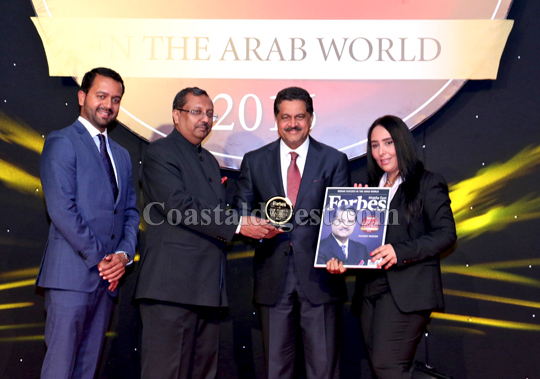
Dubai, May 4: Thumbay Moideen, the Founder President of Thumbay Group has been included in the Forbes' list of Top Indian Leaders in the Arab World' for the second consecutive year.

moideen 1

The prestigious award was presented to Mr. Moideen at a glittering event held at Waldorf Astoria, Dubai Palm Jumeirah at 7:00 pm on Tuesday, 3rd May 2016, to celebrate the most successful and groundbreaking Indian leaders in the Middle East.

His Excellency Mr. T.P. Seetharam, Ambassador of India to the UAE delivered the keynote speech at the event. This year's event was the fourth edition of the awards which recognize the most powerful and prosperous of Indian heads in the Arab world who have set up some of the most successful companies in the Middle East, using their vision, ingenuity and formidable leadership to bring capital to their shareholders and investment into the economies of the region.

moideen 2

After receiving the award, Mr. Moideen said that he was honored to figure in the list of top Indian leaders in the Arab world for the second consecutive year. “We take pride in these honors and recognitions, which motivate us further and add more responsibility to what we do.

While thanking Forbes for this prestigious recognition, I also thank my dedicated team for their hard work and commitment. I would also like to acknowledge the support of the Rulers of this great country, for their constant encouragement for our endeavors,” he added.

Founded by Mr. Thumbay Moideen in 1998, Thumbay Group is an international business conglomerate headquartered in DIFC - Dubai. The Group has successfully diversified into 14 different sectors in a span of just 17 years.

The Group today employs more than 3500 people, which will rise to 6000 with the completion of ongoing projects in the next two years, and to 15,000 employees by the end of 2020.

The Gulf Medical University, the leading private medical university in the region owned and operated by Thumbay Group has a student cohort of over 73 nationalities and faculty and staff from over 22 countries.

The Thumbay chain of hospitals, the constituent teaching hospitals of the Gulf Medical University, is one of the largest healthcare services provider in the UAE, serving over 2500 patients daily, from more than 175 countries. Apart from being an acknowledged leader in the health sector, Thumbay Group operates a reputed pharmacy chain, diagnostic centres, multi-brand retail outlets, world-class wellness centres, a prestigious chain of coffee shops, restaurants, popular health & lifestyle publication, etc.

moideen 3

Comments

Yaseen Baig
 - 
Wednesday, 4 May 2016

Congratulations sir, we are proud of you.

Yaseen Baig
 - 
Wednesday, 4 May 2016

Congratulations sir, we are proud of you.

Yaseen Baig
 - 
Wednesday, 4 May 2016

Congratulations sir, we are proud of you.

Prof.M.Abubake…
 - 
Wednesday, 4 May 2016

CONGRATULATIONS SIR.

AbdurRahman Thumbe
 - 
Wednesday, 4 May 2016

Entire Thumbe village is proud of you sir.

Add new comment

  • Coastaldigest.com reserves the right to delete or block any comments.
  • Coastaldigset.com is not responsible for its readers’ comments.
  • Comments that are abusive, incendiary or irrelevant are strictly prohibited.
  • Please use a genuine email ID and provide your name to avoid reject.
News Network
March 30,2020

New Delhi, Mar 30: A Muslim woman from Jammu and Kashmir has donated her savings of Rs 5 lakh, meant for the Hajj pilgrimage, to the RSS-affiliated 'Sewa Bharati' after apparently being "impressed with the welfare work" done by the outfit amid the lockdown due to the novel coronavirus pandemic.

Khalida Begum, 87, who saved Rs 5 lakh for Hajj, was forced to defer her plans for the pilgrimage due to the lockdown.

Hajj is the annual Islamic pilgrimage to Mecca in Saudi Arabia, the holiest city of Muslims.

"Khalida Begum ji was impressed with the welfare work done by the Sewa Bharati in Jammu and Kashmir during the tough time the country is passing through due to sudden outbreak of COVID-19 and decided to donate Rs 5 lakh to the organisation," Arun Anand, head of RSS media wing Indraprastha Vishwa Samvad Kendra (IVSK), said.

The woman wants that this money should be used by the community service organisation Sewa Bharati for the poor and the needy in Jammu and Kashmir. She had saved this amount for performing Hajj, plans for which she deferred due to the present situation, Anand said.

"Khalida Begum ji was among the first few women in Jammu and Kashmir who got educated in a convent. She is the daughter-in-law of Colonel Peer Mohd Khan, who was president of the Jana Sangh," he said.

Jana Sangh was also an associate of RSS and later became the Bharatiya Janata Party.

Anand said despite her age, she had been very active in welfare works for the women and the downtrodden in Jammu and Kashmir. Her son, Farooq Khan, a retired IPS officer, is presently serving as an adviser to the Jammu and Kashmir Lieutenant Governor.

Meanwhile, since the lockdown was announced, Sewa Bharati volunteers across the country have been providing food and other essential items to the needy. The Sangh-affiliate's volunteers were seen on Saturday managing crowd and providing food to them at the Anand Vihar bus terminal in Delhi.

Comments

Add new comment

  • Coastaldigest.com reserves the right to delete or block any comments.
  • Coastaldigset.com is not responsible for its readers’ comments.
  • Comments that are abusive, incendiary or irrelevant are strictly prohibited.
  • Please use a genuine email ID and provide your name to avoid reject.
Ram Puniyani
January 14,2020

In the beginning of January 2020 two very disturbing events were reported from Pakistan. One was the attack on Nankana Sahib, the holy shrine where Sant Guru Nanak was born. While one report said that the place has been desecrated, the other stated that it was a fight between two Muslim groups. Prime Minister of Pakistan Imran Khan condemned the incident and the main accused Imran Chisti was arrested. The matter related to abduction and conversion of a Sikh girl Jagjit Kaur, daughter of Pathi (One who reads Holy Guru Granth Sahib in Gurudwara) of the Gurudwara. In another incident one Sikh youth Ravinder Singh, who was out on shopping for his marriage, was shot dead in Peshawar.

While these condemnable attacks took place on the Sikh minority in Pakistan, BJP was quick enough to jump to state that it is events like this which justify the Citizenship Amendment Act (CAA). Incidentally CAA is the Act which is discriminatory and relates to citizenship with Religion, which is not as per the norms of Indian constitution. There are constant debates and propaganda that population of Hindus has come down drastically in Pakistan and Bangla Desh. Amit Shah, the Home minister stated that in Pakistan the population of Hindus has come down from 23% at the time of partition to 3.7% at present. And in Bangla Desh it has come down from 22% to present 8%.

While not denying the fact that the religious minorities are getting a rough deal in both these countries, the figures which are presented are totally off the mark. These figures don’t take into consideration the painful migrations, which took place at the time of partition and formation of Bangla Desh later. Pakistan census figures tell a different tale. Their first census was held in 1951. As per this census the overall percentage of Non Muslim in Pakistan (East and West together) was 14.2%, of this in West Pakistan (Now Pakistan) it was 3.44 and in Eat Pakistan it was 23.2. In the census held in Pakistan 1998 it became 3.72%. As far as Bangla Desh is concerned the share of Non Muslims has gone down from 23.2 (1951) to 9.6% in 2011.

The largest minority of Pakistan is Ahmadis, (https://minorityrights.org/country/pakistan/) who are close to 4 Million and are not recognised as Muslims in Pakistan. In Bangla Desh the major migrations of Hindus from Bangla Desh took place in the backdrop of Pakistan army’s atrocities in the then East Pakistan.

As far as UN data on refugees in India it went up by 17% between 2016-2019 and largest numbers were from Tibet and Sri Lanka.  (https://www.un.org/en/development/desa/population/migration/publication…)

The state of minorities is in a way the index of strength of democracy. Most South Asian Countries have not been able to sustain democratic values properly. In Pakistan, the Republic began with Jinnah’s classic speech where secularism was to be central credo of Pakistan. This 11th August speech was in a way what the state policy should be, as per which people of all faiths are free to practice their religion. Soon enough the logic of ‘Two Nation theory” and formation of Pakistan, a separate state for Muslim took over. Army stepped in and dictatorship was to reign there intermittently. Democratic elements were suppressed and the worst came when Zia Ul Haq Islamized the state in collusion with Maulanas. The army was already a strong presence in Pakistan. The popular formulation for Pakistan was that it is ruled by three A’s, Army, America and Allah (Mullah).

Bangla Desh had a different trajectory. Its very formation was a nail in the coffin of ‘two nation theory’; that religion can be the basis of a state. Bangla Desh did begin as a secular republic but communal forces and secular forces kept struggling for their dominance and in 1988 it also became Islamic republic. At another level Myanmar, in the grip of military dictatorship, with democratic elements trying to retain their presence is also seeing a hard battle. Democracy or not, the army and Sanghas (Buddhist Sang has) are strong, in Myanmar as well. The most visible result is persecution of Rohingya Muslims.

Similar phenomenon is dominating in Sri Lanka also where Budhhist Sanghas and army have strong say in the political affairs, irrespective of which Government is ruling. Muslim and Christian minorities are a big victim there, while Tamils (Hindus, Christians etc.) suffered the biggest damage as ethnic and religious minorities. India had the best prospect of democracy, pluralism and secularism flourishing here. The secular constitution, the outcome of India’s freedom struggle, the leadership of Gandhi and Nehru did ensure the rooting of democracy and secularism in a strong way.

India so far had best democratic credentials amongst all the south Asian countries. Despite that though the population of minorities rose mainly due to poverty and illiteracy, their overall marginalisation was order of the day, it went on worsening with the rise of communal forces, with communal forces resorting to identity issues, and indulging in propaganda against minorities.

While other South Asian countries should had followed India to focus more on infrastructure and political culture of liberalism, today India is following the footsteps of Pakistan. The retrograde march of India is most visible in the issues which have dominated the political space during last few years. Issues like Ram Temple, Ghar Wapasi, Love Jihad, Beef-Cow are now finding their peak in CAA.

India’s reversal towards a polity with religion’s identity dominating the political scene was nicely presented by the late Pakistani poetess Fahmida Riaz in her poem, Tum bhi Hum Jaise Nikle (You also turned out to be like us). While trying to resist communal forces has been an arduous task, it is becoming more difficult by the day. This phenomenon has been variously called, Fundamentalism, Communalism or religious nationalism among others. Surely it has nothing to do with the religion as practiced by the great Saint and Sufi traditions of India; it resorts mainly to political mobilization by using religion as a tool.


Comments

Ashi
 - 
Tuesday, 14 Jan 2020

If Malaysia implement similar NRC/CAA, India and China are the loser.

Add new comment

  • Coastaldigest.com reserves the right to delete or block any comments.
  • Coastaldigset.com is not responsible for its readers’ comments.
  • Comments that are abusive, incendiary or irrelevant are strictly prohibited.
  • Please use a genuine email ID and provide your name to avoid reject.
coastaldigest.com web desk
May 23,2020

The decision of the Indian government to ease the coronavirus-linked global travel restrictions imposed on those having OCI cards has given a big relief to many stranded overseas citizens of India across the world.

OCI card is issued to people of Indian origin globally which gives them almost all the privileges of an Indian national except for the right to vote, government service and buying agricultural land. The OCI card gives them a visa-free travel to India.

On Friday, the central government allowed certain categories of OCI card holders, who are stranded abroad, to come to the country. Earlier, according to the regulations issued by the Indian government in April, visas of foreign nationals and OCI cards were suspended as part of the new international travel restrictions following the COVID-19 pandemic.

This privilege of visa free travel to India was causing distress among a large number of people of Indian-origin and Indian citizens in countries like the US whose children were OCI card holders as they were born in this country.

Many Indian parents, several of whom lost their jobs as a result of the economic crisis due to coronavirus pandemic, but were not allowed to take the special evacuation flights of Air India from various US cities, took to social media and urged the Indian leaders to allow them to travel to India.

“This is a big relief for the OCI card holders. It was a humanitarian crisis in the making. I am pleased that the Indian Government listened to their voices,” said social activist Prem Bhandari, chairman of Jaipur Foot USA, who has been taking up the cause of the OCI card holders.

Dr Arathi Krishna, former deputy chairperson of NRI Forum of Karnataka government, who had been demanding this relaxation, many of the thousands of stranded OCI card holders in defferent parts of the world were in pursuading her to exert pressure on the authorities concerned for this much needed relaxation.

The restrictions on traveling of OCI card holders to India was issued by govt of India on March 13 in the wake of global outbreak of coronavirus pandemic. 

She said: "Many parents who are Indian nationals could not travel for emergency purpose to India after repatriation flights started due to their minor children being OCI card holders. Many children who were OCI card holders could not travel to India to perform last rites when there was death in their family due to these restrictions"

"I was constantly pressurising and bringing these issues to the attention of ministry officials in External Affairs and Home Affairs departments. I was following up with Mr Dammu Ravi who is heading the COVID task force  task firce in the ministry of overseas Indian affairs who took interest in solving this problem through his consistent efforts with MHA. Iam thankful to Fireign Secretary too for his efforts and concern and to MHA for making it easier now for OCI card holders to travel in repatriation flights with emergency reasons," she said.

Comments

Add new comment

  • Coastaldigest.com reserves the right to delete or block any comments.
  • Coastaldigset.com is not responsible for its readers’ comments.
  • Comments that are abusive, incendiary or irrelevant are strictly prohibited.
  • Please use a genuine email ID and provide your name to avoid reject.