


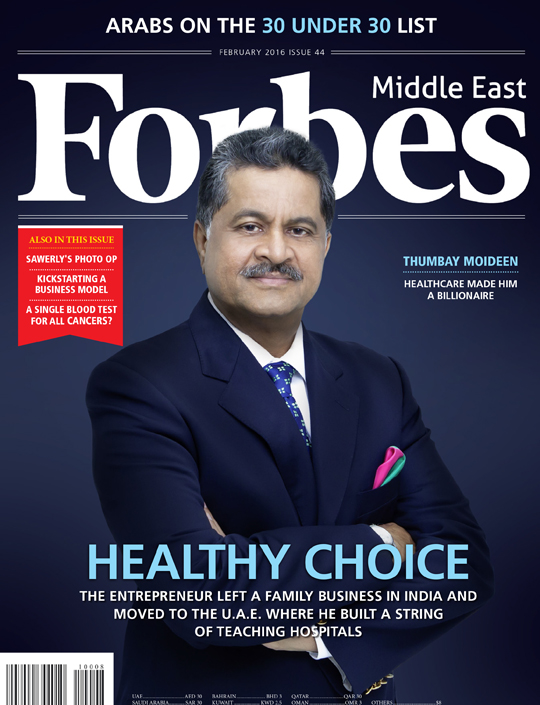
Thumbay Moideen featured on the cover of Forbes Middle East

[email protected] (CD Network)
February 4, 2016

Dubai, Feb 4: Mr. Thumbay Moideen, the Founder President of the UAE-based Thumbay Group has been featured on the cover of ‘Forbes Middle East’, one of the top finance and business magazines in the Middle East region. The cover story, titled “Healthy Choice” traces Mr. Thumbay Moideen’s business journey in the UAE starting from setting up the Gulf Medical University (GMU) in Ajman, to emerging as a prominent name in healthcare and medical education by establishing the leading network of academic hospitals in the country and making GMU one of the highest-in-demand private medical universities in the region.
Forbes

The cover story is a detailed account of how Mr. Moideen’s business acumen and confidence leads GMU and the Thumbay network of hospitals on the continuous path of growth and excellence. Forbes Middle East estimates his fortunes at $1.8 billion.

According to the article, GMU gets around 6000 student applications for just around 270 spots, every year. Since 2003, over 2000 students have graduated from GMU and presently, the student body is made up of 36% Arabs, 32% Asians and 22% Africans and the rest from Europe and Asia. It also has 162 faculty members from 22 countries, says the article. 22% of GMU graduates are admitted to US medical schools for further training. “GMU is part of a network of four pioneering teaching hospitals that now train 19% of doctors in the country and treat nearly 1,800 patients a day,” it says.

Mr. Moideen’s foray into healthcare, says the article, started with the setting up of a 200-bed teaching hospital in Ajman, in 2002. Two 60-bed hospitals, one each in Fujairah and Sharjah in 2011, and a 150-bed hospital in Dubai in 2015 followed. The Thumbay Hospital network reached several notches higher with the prestigious JCI accreditation it received in 2013.

The article also talks about Thumbay Group’s future plans such as the upcoming medical school project in Ghana, which is expected to open by 2017. Mentioning the opening of Thumbay Hospital in Hyderabad – India last year, the article goes on to say that Mr. Moideen plans to build hospitals in Saudi Arabia, Qatar, Mumbai and Bengaluru, next year. “He’s become a billionaire with plans to expand elsewhere in the Gulf and Africa,” it says. The article also features Mr. Akbar Moideen Thumbay, his elder son who manages the Healthcare Division of the Group as its Vice-President, while his younger son Mr. Akram Moideen Thumbay is the Director Operations of the Construction & Renovation Division.

From humble beginnings in 1998 when Mr. Thumbay Moideen migrated to the UAE from India, almost two decades since its inception, today, the Thumbay Group under his Presidency has grown into an international business conglomerate headquartered at DIFC-Dubai. Not only has he made a mark as a pioneer in his flagship businesses: education, healthcare and research, but he has also diversified his business across 13 different sectors and has established global presence. With the completion of the ongoing projects, the Group will employ 6000 people in the next two years, which will reach 15,000 employees by the end of 2020.

Comments

Abdul Hameed U…
 - 
Thursday, 4 Feb 2016

Feel proud of Mr.Muhyiddeen Thumbay.

Prof.M.Abubake…
 - 
Thursday, 4 Feb 2016

Congratulations. Sir. May Almighty Allah keep you and your family members with the best health and long life. ameen.

Brother
 - 
Thursday, 4 Feb 2016

Humble Request... to our Rich Thumbay Moideen...
CAN U Visit the POOR of Mangalore & improve the lives of the POOR muslims and non muslims. Who expect U to follow the teachings of Prophet Muhammad to look after the poor just like the rich Sahabas did ? without business purpose. May Allah reward U more.

Add new comment

  • Coastaldigest.com reserves the right to delete or block any comments.
  • Coastaldigset.com is not responsible for its readers’ comments.
  • Comments that are abusive, incendiary or irrelevant are strictly prohibited.
  • Please use a genuine email ID and provide your name to avoid reject.
News Network
January 21,2020

Bengaluru, Jan 21: A massive protest against the Citizenship Amendment Act (CAA), National Register of Citizens (NRC), and National Population Register (NPR) was witnessed at Shivajinagar's Chandni Chowk area on Tuesday.

Scores of people came together carrying national flags and placards to register their protest in the city.

Speaking to ANI, a protester said, "People of all religious community have assembled here in Chandni Chowk to protest against CAA, NRC, and NPR. We the people of India are against this law."

Terming the law as anti-constitutional, he said that we support all the states who oppose the CAA. We demand the revocation of CAA and the government should remove conditions in NPR which lead to NRC.

CAA grants citizenship to Hindu, Sikh, Jain, Parsi, Buddhist and Christian communities fleeing religious persecution from Pakistan, Afghanistan, and Bangladesh and who came to India on or before December 31, 2014.

Comments

Danny
 - 
Tuesday, 21 Jan 2020

What if the Caa was implemented by congress which was earlier planned by dr mnmohan singh and even Gandhiji said this that minorities of Pak amd Bangladesh can come india. Go check facts. Domt trust ur whstapp knowledge. 

abdulla
 - 
Tuesday, 21 Jan 2020

Unfortunately Hitler brother is our HM who is deaf, dumb and blind.   He has shit in his brain.   He is unfit to be called as human being.  He is thinking that he has no death.   I am sure that he will meet a miserable end. 

Add new comment

  • Coastaldigest.com reserves the right to delete or block any comments.
  • Coastaldigset.com is not responsible for its readers’ comments.
  • Comments that are abusive, incendiary or irrelevant are strictly prohibited.
  • Please use a genuine email ID and provide your name to avoid reject.
News Network
July 3,2020

Mangaluru, Jul 3: Four central crime branch (CCB) police personnel tested positive for coronavirus on Friday in Dakshina Kannada district in Karnataka.

So far, eighteen police personnel, including an official of the ACP rank and 12 from Ullal police station, have tested positive for Covid-19 in the district in the last few days, police sources said.

A policeman from Mangaluru Rural station and another from Puttur station have also been infected.

All the personnel who tested positive have been admitted to the designated Covid-19 hospitals.

City police commissioner Vikash Kumar Vikash said adequate protection has been provided to police personnel who were fighting the pandemic and the members of their families.

As of Thursday, the total coronavirus cases in the district stood at 923 and the toll 18 while the state's infection count has crossed the 18,000 mark with 272 deaths.

Comments

Add new comment

  • Coastaldigest.com reserves the right to delete or block any comments.
  • Coastaldigset.com is not responsible for its readers’ comments.
  • Comments that are abusive, incendiary or irrelevant are strictly prohibited.
  • Please use a genuine email ID and provide your name to avoid reject.
Media Release
February 14,2020

Veteran journalist P. Sainath has said that the nation is in a crisis. And this crisis is not limited to just the rural area. It has become a national crisis at various areas such as agriculture, education, economy, job creation etc.

He was delivering the endowment lecture on the topic ‘Indian democracy at the post-liberalization and post-truth era’ at Media Manthan 2020 organized by the PG department of journalism and mass communication at St Aloysius College (Autonomous). 

Mr Sainath said that the many policies adopted in the 90s led to India becoming unusually unequal. Referring to the speech Ambedkar had made at the Constituent Assembly while handing over the draft of the Constitution, Mr Sainath said, “Ambedkar had warned about the weakness of Indian democracy that liberty without equality allows the supremacy of a few over the multitude. Liberty, equality and fraternity must be kept together as we cannot have one without the other.” 

Mr Sainath stated that the agrarian crisis was no longer about the loss of productivity, employment or about farmer suicide; it was a societal, civilizational crisis. Commenting on the lopsided policies such as cow-slaughter ban, he explained how cow slaughter ban had adversely affected many industries due to their interdependency. While Muslims who slaughtered cows were rendered helpless, the cattle traders who were mostly OBCs lost their earnings as the cattle prices crashed. An important industry like Kolhapur sandals industry in Maharashtra went bankrupt as a result of the cow slaughter ban in Maharashtra. He said the policymakers had no idea how the rural industries were interconnected. Demonetisation too devastated the rural economy as 98 percent of rural transactions happen through cash. 

Mr Sainath also spoke about the crisis of inequality which affects the Dalits and the Adivasis far more than anyone else as 90 percent of the rural households take home less than Rs 10,000/- per month. “Women are yet another group whose labour is never counted in the gross domestic product. Women and girls globally do unpaid work which amounts to about 12.5 billion working hours per year. Monetarily speaking, this is worth 10.8 trillion dollars,” Mr Sainath added. 

Speaking about the crisis of jobs Mr Sainath said that major companies were laying off employees just to create more profits for the investors and the adoption of artificial intelligence in the industry would further destroy millions of jobs.

Rector of St Aloysius College Institutions Fr Dionysius Vaz SJ, Principal Dr (Fr) Praveen Martis SJ, HOD of Journalism and Mass Communication department Dr (Fr) Melwyn Pinto SJ were present.

‘Veerappan and Vijay Mallya’s business models are interesting!’

Addressing the gathering during his endowment lecture on Friday, Mr Sainath made an interesting comment on the so called ‘revenue model’. “Whenever I visit IIMs and IITs for lectures on my PARI project, the students there ask me what my revenue model for my project is. I tell them that I do not have a revenue model. In fact, journalism does not begin with a revenue model. Gandhiji, Ambedkar, Bhagat Singh were all great journalists. But they did not have a revenue model,” Mr Sainath said.

On a lighter note, he said that the best revenue model that he liked was that of forest brigand Veerappan and liquor baron Vijay Mallya. “Veerappan ruled the forest for forty years and from the top ministers to the villagers he could dictate terms and liver royally. Similarly, Mallya’s revenue model was to steal the banks and run away abroad and live like a king,” Mr Sainath added.

Journalism is not and can never be a business. It is a calling, he opined. While newspaper can be a business, television can be a business, journalism per se cannot be reduced to a business. “Unfortunately today, journalists are recruited on a contract basis and they have no bargaining power; and there are no unions to fight for their cause. Hence, they are at the mercy of the corporate media houses for their survival and are made to write stories that cannot be called journalism,” Mr Sainath said.

Answering a question as to the pressures he faced as a journalist, he said that external pressures from the government or others could be very well handled. It is the internal pressures from once own media house that journalists find it difficult to manage.


Comments

Add new comment

  • Coastaldigest.com reserves the right to delete or block any comments.
  • Coastaldigset.com is not responsible for its readers’ comments.
  • Comments that are abusive, incendiary or irrelevant are strictly prohibited.
  • Please use a genuine email ID and provide your name to avoid reject.