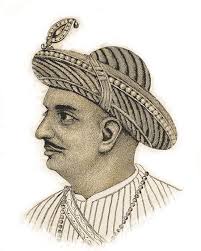
Tipu Sultan’s legacy continues to endure

[email protected] (The Hindu)
May 5, 2015

Mysuru, May 5: The death of Tipu Sultan on May 4, 1799, brought to close a fascinating chapter in Indian history; but his legacy continues to endure notwithstanding the controversy surrounding him in the present times.

tipuThough it has been 216 years since the death of Tipu Sultan, historians are unanimous in pointing out that his initiatives in the socio-economic fields have continued to endure, though these were fast fading from public memory.

The expansion of sericulture in the Mysuru region has been credited to Tipu Sultan. The Mysore Gazetteer notes that Tipu secured the know-how from Bengal and introduced mulberry cultivation in 21 centres. In what could be described as a step to encourage local industry, he banned the export of cotton to ensure that local weavers were not denied the raw material.

The introduction of sugarcane on a large scale has also been attributed to Tipu Sultan for which he secured the assistance of Chinese experts, according to the Gazetteer, which notes that quality sugar and candy were produced with their assistance.

During the pause between the various wars he fought, Tipu Sultan took some reformatory measures including a ban on alcohol. Cattle being closely linked to agriculture, Tipu Sultan encouraged livestock breeding. Hallikar and Amrit Mahal breeds are believed to be products of this initiative.

Rocket technology

Modern day historians also credit Hyder Ali and Tipu Sultan with an elementary knowledge of missile or rocket technology, which is considered to be the prototype of present-day missiles and rockets. They were put to full use during the wars with the British. Some of these have been preserved at the Royal Artillery Museum in England. The paintings at Dariya Daulat, the summer palace of Tipu Sultan at Srirangapatana, are a clear indicator of the use of these missiles in wars.

A courtyard within the ruins of the Srirangapatana Fort was identified by archaeologists as the possible spot from where the missiles were launched. Scientists from DRDO have also visited the spot on many occasions in a bid to ensure better maintenance. Plans for a ‘missile museum’ are yet to materialise.

Rally, tributes mark death anniversary

Rallies were held and tributes offered to mark the 216th death anniversary of eighteenth-c entury warrior king Tipu Sultan in Mysuru and his erstwhile capital Srirangapatna near here on Monday.

While Congress leaders gathered at the office of the Mysuru City (District) Congress Committee on Sayyaji Rao Road in the morning and garlanded the portrait of Tipu Sultan on his ‘Shaheed Diwas’, large number of people paid tributes to Tipu Sultan at Srirangapatna.

Rallyists led by Kannada protagonist Vatal Nagaraj, who arrived in Srirangapatna from Bengaluru, offered floral tributes at the site near the northern fringe of the fort, where Tipu’s body was found in 1799, and Gumbaz, where his mortal remains are buried. Activists of the Kannada Chaluvali Vatal Paksha (KCVP) from Bengaluru accompanied Mr. Nagaraj, who made stop-overs at Ramanagaram and Mandya enroute to Srirangapatna to address the public.

Mr. Nagaraj said the commitment of Tipu Sultan, known as the Tiger of Mysore, was so strong for his land that he even pledged his children for the sake of the country and its people. “A statue of Tipu should be built in front of Parliament. I will speak to the Lok Sabha Speaker and leaders of other political parties in this regard,” he said.

Mr. Nagaraj also demanded that the road leading to Devanahalli, Tipu’s birthplace, be named after him. He also urged the State Government to build a memorial for Tipu Sultan on 500 acres of land in Bengaluru.

Comments

Sandra
 - 
Friday, 4 Mar 2016

Thanks for finally writing about >Tipu Sultan’s legacy continues to endure

Add new comment

  • Coastaldigest.com reserves the right to delete or block any comments.
  • Coastaldigset.com is not responsible for its readers’ comments.
  • Comments that are abusive, incendiary or irrelevant are strictly prohibited.
  • Please use a genuine email ID and provide your name to avoid reject.
Media Release
January 23,2020

Mangaluru, Jan 23: With the results of Joint Entrance Examination (JEE-Main) out, it is celebration time at CFAL (Centre for Advanced Learning), Mangalore’s top training institute as 12 of its students have secured above 99 percentile, out of 120 students who appeared at the prestigious national examination held in January this year. The students are: Kaustubh Rao (99.79), Ujwal Kumar (99.77), Dheeraj Kamath (99.74), Pramod Rao (99.68), Santhosh M (99.59), Mohan Nayak (99.49), Rihan D’silva (99.43), Rishan D’silva (99.41), Pranav Rao (99.41), Aamod BK (99.29), Anmol J Shetty (99.22) and Madhura Sabhahit (99.083).

Apart from the above students, 8 students have scored above 98 percentile, the details of the students are: D.K. Goutham (98.67), Tejah S.S. (98.49), Akash Shetty (98.4), Tejas Bhat K (98.34), Ninaad PS (98.31), Shreepoorna Rao (98.3), K. Annapoorna Prabhu (98.3) and Rakshith Sajjan (98.2). The results of many more students are awaited.

A total of 8,69,010 students had appeared in the said exam from across India. The students who have attempted the JEE Main exam in January can attempt the exams again in April to better their percentile. Students who clear JEE Main qualify for JEE Advanced and are eligible for seats at the NIT’s and other top institutions of the country.

JEE – The most challenging undergraduate admission test

Joint Entrance Examination (JEE) conducted this year by National Testing Agency (NTA) is a national level examination for students to qualify and pursue engineering degree at under graduate level. Paper 1 is held for BE/B.Tech admissions and Paper 2 for B. Arch/B. Planning. JEE Main is a critical criterion for admission in India’s most prestigious and elite universities like IITs and NIT’s.

Those students who clear JEE Main can take the JEE advanced – which is a pre-requisite requirement for admission in the Indian Institute of Technology and Indian School of Mines (Dhanbad)

CFAL – The first name in training

The training at CFAL consists of defined hours of classes, tests and mock exams, unique course material, experienced professors and hence is the first choice for students appearing for STEM examinations including JEE, NTSE, KYPY, OLYMPIADS etc.  The centre was established with the intention of giving students of Mangalore information, guidance and tools required to qualify the competitive exams. However, the main aim of CFAL is to inculcate passion for Math and Science learning among students and to encourage research and innovation in the subjects.

Comments

Add new comment

  • Coastaldigest.com reserves the right to delete or block any comments.
  • Coastaldigset.com is not responsible for its readers’ comments.
  • Comments that are abusive, incendiary or irrelevant are strictly prohibited.
  • Please use a genuine email ID and provide your name to avoid reject.
News Network
June 8,2020

Bengaluru, Jun 8: Veteran Congress leader Mallikarjun Kharge on Monday filed his nomination as the party's candidate for the June 19 Rajya Sabha polls from Karnataka.

The former union minister filed his nomination in the presence of KPCC President D K Shivakumar, Leader of Opposition Siddaramaiah and other senior party leaders at the office of Legislative Assembly Secretary M K Vishalakshi, who is the returning officer for the polls.

Ahead of filing of nomination, the Congress Legislature Party meeting was held under the leadership of Siddaramaiah, after which Shivakumar issued "B-form" to Kharge.

The Congress high command on June 5 had announced Kharge as the party's candidate for the Rajya Sabha polls.

The election is scheduled on June 19 to fill four Rajya Sabha seats from Karnataka represented by Rajeev Gowda and BK Hariprasad of the Congress, Prabhakar Kore of the BJP and D Kupendra Reddy of the JD(S) that will fall vacant on June 25, with their retirement.

June 9 is the last date for filing nominations.

Congress with 68 MLAs in the assembly can win one of the four seats easily on its own, so Kharge's victory is said to be certain.

This will be the first stint in Rajya Sabha for Kharge, who has always got elected directly by the people in his political career spanning over four decades.

The leader, earlier popularly known as "solillada Saradara", (a leader without defeat), faced his first electoral loss in his political life against BJP's Umesh Jadhav in Gulbarga by a margin of 95,452 votes during the 2019 Lok Sabha polls.

A nine-time MLA and two-term Lok Sabha member, he had served as Congress floor leader in the previous Lok Sabha, and also as Union Railway and Labour Minister during the UPA government.

Kharge, who is 77-years-old, has also served as minister during several Congress governments in the state, and as KPCC President and Leader of Opposition in the Karnataka Assembly in the past.

His son, Priyank Kharge, is currently MLA representing Chittapur constituency and had served as minister during the previous Congress and coalition governments.

JD(S) patriarch and former Prime Minister HD Deve Gowda is the JD(S) candidate.

The regional party that has 34 seats in the assembly is not in a position to win a seat in Rajya Sabha on its own, and will need the support from the Congress with its surplus votes.

A minimum of 44 votes are required for candidates to win.

BJP with 117 members in the assembly (including Speaker), can ensure easy victory in two seats.

The BJP's central leadership on Monday sprang a surprise by fielding Eranna Kadadi and Ashok Gasti as its candidates for the Rajya Sabha election ignoring the recommendations of the state BJP unit.

Comments

Add new comment

  • Coastaldigest.com reserves the right to delete or block any comments.
  • Coastaldigset.com is not responsible for its readers’ comments.
  • Comments that are abusive, incendiary or irrelevant are strictly prohibited.
  • Please use a genuine email ID and provide your name to avoid reject.
Muhammad Abdullah Javed
May 20,2020

One of the distinguish features of the Noble Quran is that it presents different sorts of classifications. It is quite evident as one of the names of the Quran is Furqan that is it differentiates between things through its unique style of classification. The Quran openly proclaims the difference between right and wrong, truth and falsehood, literate and illiterate, light and darkness and so on. The system of Quranic taxonomy has a pivotal element with regard to ranking of human beings. It classifies them into two groups, one, who is honorable in the sight of their Creator and the second, disliked by Him.

This Quranic approach of classification is quite genuine, void of all sorts of bias. Since humans have no say in their birth, color or region, therefore the Quran doesn’t recognize these parameters to classify two groups of people.

The crux of Quranic taxonomy rests with the human ability which has been equally distributed among all humans. In terms of abilities to perform, barring those tasks performed with exceptional talents, all humans are equal. This is where Quran draws a line and specify who is most honorable in the sight of their Creator, it says:

 O mankind, We created you from one man and one woman, and then divided you into nations and tribes so that you may recognize one another. Indeed, the most honorable among you in the sight of Allah is he who is the most pious of you. Surely, Allah is All-knowing, All-Wise. (Chapter 49, Verse 13).

Criterion of judgement

To be most righteous in the sight of God, one has to be of pious nature. The Quran uses term Taqwa (a sense of distinguishing between right and wrong, piety) to exemplify the pious nature. It further specifies that the source of pious nature - Taqwa is an inherent quality of human beings. Along with the faculties of hearing, seeing and speaking they have been bestowed with (Taqwa) the criterion of distinguishing between virtues and vices, it has been mentioned in the Quran as:

And by the human self and by Him Who balanced it, then inspired it with its wickedness and piety (Chapter 91, Verses 7 & 8).

Good deeds and human nature

With the advent of human race on earth, the equation has been set in simple terms. Humans have to be obedient to their Creator by means of using their intellect, smart enough to use their ability to judge between right and wrong and spend their lives in performing good deeds. For this very reason God has created life and death:

Who created death and life that He may try you to see which of you is best in deeds, and He is All-Mighty as well as All-Forgiving (Chapter 67, Verse 2)

Since life is all about performing good deeds, the ability to perform any good action has been made as natural as recognizing any color with naked eyes. It is within the reach of a person to identify the difference between colors, so is his criterion of judgement that tells what to perform and what to refrain from?

Good actions have been synchronized with human nature whereas evil deeds are quite detrimental, that’s why there is a universal consensus over the conception of virtues and vices. No one can dare to differ with virtues like truth, justice and honesty etc, and no one appreciates vices like falsehood, violations and corruption. With this inherent ability of humans to identify good and bad, the concept of virtues and vices has been described with the same bent of human intellect, there is no philosophical and ideological kind of description to tell what truth and falsehood are, it is as simple as this:

Prophet Muhammad (peace be upon him) said: Give up what is doubtful to you for that which is not doubtful; for truth is peace of mind and falsehood is doubt (Tirmidhi)

Highway of actions

The Quran presents a highway of actions for everyone who believes in it and intend to be most honorable in the sight of the Creator. For each and every day, there is a definite plan of action to go ahead with it to please the Creator. Again, for every week and month, there are clear specifications with regard to individual and collective actions. So no place for claims and reservations, no place for any excuse either, things have been made clear. For a person to be honored, he has to be man of deeds, that’s it. Every person has fair chances of performing better, as the life has been given, criterion of judgement between right and wrong has been given, and plan of action has been provided with. Now one has to energize himself for everyday action and try to set right the intention.

Difference in human efficiencies

No doubt there are differences in human abilities and efficiencies, one may argue about the quality and magnitude of actions. Those who are of high efficiency may perform well and those who are inefficient may not? True, to convince what Quran emphasizes is, God doesn’t look at the magnitude of an action, rather He sees with what intention in what circumstances it has been performed? If any person keep fast in scorching heat for more than 16 hours a day will get high rewards compare to the one who fast less than 10 hours a day at a cold place. Again, if the intention is to please the God, than every action, no matter how small or big it is in its scale, will fetch rich dividends. A poor’s donation of few rupees will be equal in rewards as compare to what a millionaire gets by donating thousands of rupees from his enormous wealth. The act of charity has demanded sacrifice; both of them have sacrificed in accordance with their capacities. Therefore upon asking whose charity is noble in the sight of God, the Prophet Muhammad (pbuh) said: The charity of poor person who tries hard to get few rupees from his hard earn money to donate in the way of God (NasaiBook of Hadith).

The Quranic taxonomy of human is quite justifiable as every human bear testimony to its genuine and unbiased classification through what we term as actions. Therefore the world has to witness a race between men and women to see who can compete with others in order to please their Creator?

Whosoever acts righteously – whether a man or a woman and embraces belief, We will surely grant him a good life; and will surely grant such persons their reward according to the best of their deeds. (Chapter 16, Verse 97)

God-oriented actions, privilege for the Humanity

It’s very unpleasant to notice that in today’s world the parameters like statuses, resources and wealth have been regarded as privilege and honor for both humans and their societies. No doubt they are, but not at the cost of losing the very essence of human nature and sacrificing its interest. Today’s advancements speak of this dark phase where the height of inventions and discoveries touching the skies while the dignity and honor of humans have gone to the lowest of the low. The ever increasing poverty, hunger, untimely deaths, different forms of corruption in the land, violation of human rights are just to remind a few. The presence of rich and poor, highs and lows in the society speaks of disparity of actions, lack of selfless service and hearts void of God’s love and fear.

The beauty of humanity is to remain in the service of God and always stand on the toes to help those who are in need. This God-oriented action enables every doer to be dear to his God as the classification of good and the bad is purely based on the actions performed for the sake of the Creator:

Everyone is assigned a rank according to his deed. Your Lord is not heedless of what they do (Chapter 6, Verse 132).


Muhammad Abdullah Javed is the Director of AJ Academy for Research & Development. He can be reached at [email protected]

Comments

Add new comment

  • Coastaldigest.com reserves the right to delete or block any comments.
  • Coastaldigset.com is not responsible for its readers’ comments.
  • Comments that are abusive, incendiary or irrelevant are strictly prohibited.
  • Please use a genuine email ID and provide your name to avoid reject.