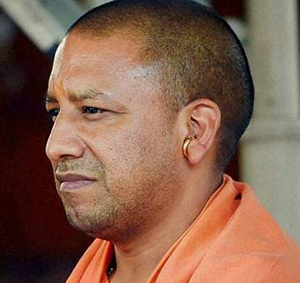
Tribal woman files case against Yogi for sharing her nude pic on social media

Agencies
June 21, 2017

New Delhi, Jun 21: A tribal woman in Assam's Biswanath district has filed a case against Uttar Pradesh Chief Minister Yogi Aditynath and Assam Lok Sabha MP Ram Prasad Sarma for sharing her nude photo on social media.yogi

The photograph was taken 10 years ago during a protest in Guwahati.

Laxmi Orang has filed a complaint in the court of sub-divisional judicial magistrate under various sections of the Indian Penal Code (IPC) the Information Technology Act.

"Yogi Adityanath, without knowing any fact, commented in the social media that the rally was on behalf of the BJP and the Congress workers attacked it," Orang said referring to her participating in an agitation in Guwahati in 2007.

"When Prime Minister Narendra Modi is campaigning for Beti Bachao, Beti Padhao at the same time his party Chief Minister (Adityanath) is doing this type of work. Is this democracy?" she questioned.

Want justice for her: MP Ram Prasad Sarma

When contacted, Sarma said "it (the stripping) was a fact and a true incident during that time. I shared it so that people know that an unfortunate girl was a victim and no justice has been given to her till now.

"I have not given any comment with the shared post," Sarma said adding he had asked Assam Chief Minister Sarbananda Sonowal a few days ago to reopen her case so that she gets justice.

Comments

Stranger
 - 
Wednesday, 21 Jun 2017

Ella Kalla Swamigalu...........
Showing public one face and other face is bathroom....
All from Goondaism party... ie. RSS/BJP

zinga
 - 
Thursday, 22 Jun 2017

oddu olage haakbegu intha ... thu ivana janmakke

Add new comment

  • Coastaldigest.com reserves the right to delete or block any comments.
  • Coastaldigset.com is not responsible for its readers’ comments.
  • Comments that are abusive, incendiary or irrelevant are strictly prohibited.
  • Please use a genuine email ID and provide your name to avoid reject.
coastaldigest.com news network
January 28,2020

Mangaluru, Jan 28: Amidst nationwide agitation by ‘We, the People of India’ against contentious CAA, NRC, the women of Manglauru have decided to hold satyagrah and form a human chain in front of the office of the Deputy Commissioner in the heart of the city on January 30.

This was announced in a press conference today by activists Sajida Momin, Vidya Dinker, Terry Pais, Maria Ferandes and Suhasini Babbukatte.

The event will mark the 73rd anniversary of the martyrdom of the original Satyagrahi Mahatma Gandhi, who was assassinated by saffronite terrorist Nathuram Godse.

Ms Momin told media persons that the Satyagrah will commence at 10 a.m. to safeguard the constitution. At 4:30 p.m. a human chain will be formed.

“At 5.17p.m. when the father of the nation was gunned down 72 years ago during his evening prayer at Birla House by Godse, we will convey Gandhi’s message of unity against violence,” she said.

Comments

Add new comment

  • Coastaldigest.com reserves the right to delete or block any comments.
  • Coastaldigset.com is not responsible for its readers’ comments.
  • Comments that are abusive, incendiary or irrelevant are strictly prohibited.
  • Please use a genuine email ID and provide your name to avoid reject.
Agencies
February 20,2020

India ranked 77th on a sustainability index that takes into account per capita carbon emissions and ability of children in a nation to live healthy lives and secures 131st spot on a flourishing ranking that measures the best chance at survival and well-being for children, according to a UN-backed report.

The report was released on Wednesday by a commission of over 40 child and adolescent health experts from around the world. It was commissioned by the World Health Organization (WHO), UN Children's Fund (UNICEF) and The Lancet medical journal.

In the report assessing the capacity of 180 countries to ensure that their youngsters can survive and thrive, India ranks 77th on the Sustainability Index and 131 on the Flourishing Index, it said.

Flourishing is the geometric mean of Surviving and Thriving. For Surviving, the authors selected maternal survival, survival in children younger than 5 years old, suicide, access to maternal and child health services, basic hygiene and sanitation, and lack of extreme poverty.

For Thriving, the domains were educational achievement, growth and nutrition, reproductive freedom, and protection from violence.

Under the Sustainability Index, the authors noted that promoting today's national conditions for children to survive and thrive must not come at the cost of eroding future global conditions for children's ability to flourish.

The Sustainability Index ranks countries on excess carbon emissions compared with the 2030 target. This provides a convenient and available proxy for a country's contribution to sustainability in future.

The report noted that under realistic assumptions about possible trajectories towards sustainable greenhouse gas emissions, models predict that global carbon emissions need to be reduced from 39·7 giga­ tonnes to 22·8 gigatonnes per year by 2030 to maintain even a 66 per cent chance of keeping global warming below 1·5°C.

It said that the world's survival depended on children being able to flourish, but no country is doing enough to give them a sustainable future.

"No country in the world is currently providing the conditions we need to support every child to grow up and have a healthy future," said Anthony Costello, Professor of Global Health and Sustainability at University College London, one of the lead authors of the report.

"Especially, they're under immediate threat from climate change and from commercial marketing, which has grown hugely in the last decade," said Costello – former WHO Director of Mother, Child and Adolescent health.

Norway leads the table for survival, health, education and nutrition rates - followed by South Korea and the Netherlands. Central African Republic, Chad and Somalia come at the bottom.

However, when taking into account per capita CO2 emissions, these top countries trail behind, with Norway 156th, the Republic of Korea 166th and the Netherlands 160th.

Each of the three emits 210 per cent more CO2 per capita than their 2030 target, the data shows, while the US, Australia, and Saudi Arabia are among the 10 worst emitters. The lowest emitters are Burundi, Chad and Somalia.

According to the report, the only countries on track to beat CO2 emission per capita targets by 2030, while also performing fairly – within the top 70 – on child flourishing measures are: Albania, Armenia, Grenada, Jordan, Moldova, Sri Lanka, Tunisia, Uruguay and Vietnam.

"More than 2 billion people live in countries where development is hampered by humanitarian crises, conflicts, and natural disasters, problems increasingly linked with climate change," said Minister Awa Coll-Seck from Senegal, Co-Chair of the commission.

The report also highlights the distinct threat posed to children from harmful marketing.

Evidence suggests that children in some countries see as many as 30,000 advertisements on television alone in a single year, while youth exposure to vaping (e-cigarettes) advertisements increased by more than 250 per cent in the US over two years, reaching more than 24 million young people.

Studies in Australia, Canada, Mexico, New Zealand and the US – among many others – have shown that self-regulation has not hampered commercial ability to advertise to children.

Children's exposure to commercial marketing of junk food and sugary beverages is associated with purchase of unhealthy foods and overweight and obesity, linking predatory marketing to the alarming rise in childhood obesity, it said.

The number of obese children and adolescents increased from 11 million in 1975 to 124 million in 2016 – an 11-fold increase, with dire individual and societal costs, the report said.

To protect children, the authors call for a new global movement driven by and for children.

Specific recommendations include stopping CO2 emissions with the utmost urgency, to ensure children have a future on this planet; placing children and adolescents at the centre of global efforts to achieve sustainable development, the report said.

New policies and investment in all sectors to work towards child health and rights; incorporating children's voices into policy decisions and tightening national regulation of harmful commercial marketing, supported by a new Optional Protocol to the UN Convention on the Rights of the Child, it said.


Comments

Add new comment

  • Coastaldigest.com reserves the right to delete or block any comments.
  • Coastaldigset.com is not responsible for its readers’ comments.
  • Comments that are abusive, incendiary or irrelevant are strictly prohibited.
  • Please use a genuine email ID and provide your name to avoid reject.
News Network
February 22,2020

Bengaluru, Feb 22: President Ram Nath Kovind on Saturday said an ideal trade-off needs to be reached between new media -- which is fast and popular -- and traditional media which has developed skills to authenticate a news report, which is a costly operation.

Addressing the fourth edition of ‘the Huddle’ – the annual thought conclave of the Hindu here, he asserted that the internet and social media had democratised journalism and revitalised democracy, but had also led to many anxieties.

While the new media was fast and popular and people could choose what they wanted to watch, hear or read, traditional media would have to introspect on its role in society and find ways to earn the reader’s full trust again as "the project of democracy was incomplete without informed citizens – which means, without unbiased journalism."

Debate and discussion were internalised in India’s social psyche to arrive at truth since time immemorial, he said.

"There is no doubt that perception of truth is conditioned by circumstances. The conditions that cloud the truth’s positions are effectively dispelled by a contestation of ideas through debate, discussion and scientific temper. Prejudices and violence vitiate the search for truth."

Expressing happiness to attend ‘The Huddle’ organised by The Hindu, he said the Hindu group of publications had been relentlessly aiming to capture the essence of this great country through its responsible and ethical journalism. He commended them for their insistence on sticking to the five basic principles of journalism – truth-telling, freedom and independence, justice, humaneness and contributing to the social good, an official release here said.

Mr Kovind said dogmas and personal prejudices distorted the truth. In the 150th year of Gandhiji’s birth, he asked all to ponder over this question: "will it not be proper to pursue truth itself as the ideology? Gandhiji has shown us the path by walking ceaselessly in search of truth which would ultimately encompass every positive attribute that enriches the universe."

Comments

Add new comment

  • Coastaldigest.com reserves the right to delete or block any comments.
  • Coastaldigset.com is not responsible for its readers’ comments.
  • Comments that are abusive, incendiary or irrelevant are strictly prohibited.
  • Please use a genuine email ID and provide your name to avoid reject.