


Triple talaq: Uniform Civil Code 'not good for nation', says Muslim Board

[email protected] (CD Network)
October 13, 2016

New Delhi, Oct 13: The Muslim Personal Law Board said on Thursday that a Law Commission questionnaire, to gauge public opinion on triple talaq and some other practices across religions, is a "fraud", that it will boycott it and that a uniform civil code is not good for India.
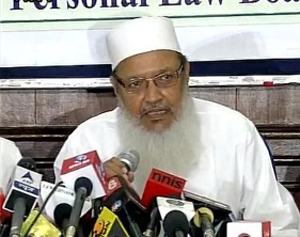
mlbThe Muslim Law Board also said that the law commission isn't acting independently and is instead acting at the behest of the Centre, which last week opposed the practice of triple talaq in the Supreme Court and said it can't be regarded as an essential part of religion.

"A uniform civil code is not good for this nation. There're so many cultures in this nation, (they) have to be respected. India can't impose a single ideology," said the Board's Hazrat Maulana Wali Rahmani at a press briefing today.

The Commission in its questionnaire asks whether triple talaq - which according to Islamic law based on the Koran permits a husband to pronounce talaq three times to instantly divorce his wife - should be abolished altogether, retained only in customs without legal sanctity, or retained with suitable amendments.

The Muslim Law Board has consistently said that triple talaq is a 'personal law' and hence cannot be modified by the Centre.

"We are living in this country with an agreement held by the constitution. The constitution has made us live and practice our religion. In America everyone follows their personal laws and identity, how come our nation doesn't want to follow their steps in this matter?" Rahmani said.

The Centre has countered the claim of the Muslim Law Board and said, "practices of triple talaq, polygamy and nikah halala cannot be regarded as essential part of religion and hence get no protection under fundamental right to religion."

Rahmani and other Board officials today also indicated that they feel Muslims are discriminated against.

"Muslims equally participated in India's freedom struggle, but their participation is always underestimated," a Board official said.

The Commission, though, said its questionnaire asks for opinion on practices across religions - not just Islam - that many call anti-women, Justice BS Chauhan, chairman of the Law Commission, said earlier.

For example, while one question on the list of 16 is about triple talaq, another is asking the public what steps are needed to "ensure that Hindu women are better able to exercise their right to property, which is often bequeathed to sons under customary practices".

Justice B S Chauhan, chairman of the Law Commission, said that formulating the questions was an elaborate affair involving several meetings of the Commission, in addition to consultations with numerous experts in the field.

"It took us two months to frame the questions keeping in mind prevailing customs and practices in different religions to elicit meaningful responses from the public," he said.

Comments

Naren kotian
 - 
Thursday, 13 Oct 2016

Accept the rule of land or just migrate where u r so called divine rule is followed ...our govt is in right direction ..so they don't care for these threats ...becoz bjp doesn't neeed people who think religion above constitution .one thing for sure ...our Shri Shri modiji ...our supreme thailava will ensure everybody sings vande mataram and say bharata mata ki jai ....yenu beda PDS and bhagyas kodolla andre mugithu ...haha....bholo bharat mata ki jai ...Vande mataram ..

Abdullla
 - 
Thursday, 13 Oct 2016

Without knowledge many people are challenging the divine Law...
and Muslim are giving you this knowledge... But many are HEEDLESS.
its their IGNORANCE that they did not go thru from the proper Source...

To get a little back ground on triple talaq... please watch below YT video and increase your knowledge before judging and interfering the DIVINE LAW ... it will be better for those who use their intellect as well as the society.

(MAJHA VISHESH: Aurangabad: Discussion on Ban Muslim Triple Talaq Law)

Or Please see how Br. Imran answers this question posed by an ADVOCATE...
(Br.Imran Answering About Triple Talaq To A Non Muslim Sister.)

Add new comment

  • Coastaldigest.com reserves the right to delete or block any comments.
  • Coastaldigset.com is not responsible for its readers’ comments.
  • Comments that are abusive, incendiary or irrelevant are strictly prohibited.
  • Please use a genuine email ID and provide your name to avoid reject.
Agencies
June 12,2020

Bengaluru, Jun 12: The Central government has identified Karnataka's Udupi and Yadgir among the "emerging districts of concern" for COVID-19 in the country. Confirming the development, a top official of the state health department said, "they (centre) had reviewed these two districts a few days back...there was a sudden spurt of cases due to Maharashtra returnees turning positive." Sources said union cabinet secretary Rajiv Gauba, during a recent video conference with state chief secretaries and health secretaries, had shared his thoughts on the issue.

According to the information shared, districts with more than 400 cases, half of which was reported post-May 18 lockdown relaxation, have been identified as "emerging districts of concern." They are concentrated in the seven states/union territories of Maharashtra, Rajasthan, Tamil Nadu, West Bengal, Karnataka, Jammu and Kashmir and Haryana. "Udupi and Yadgir from Karnataka, along with Gurugram in Haryana and Kolhapur in Maharashtra have 90 per cent of the cases recorded after May 18," they said.

As on June 11 evening, Udupi had a total of 969 positive cases, out of which 619 are active, while 735 positive cases have been reported in Yadgir, out of which 626 are active. The two districts had reported a total of only 11 cases each as on May 18. While Udupi till last evening had seen 349 discharges, it was 108 in Yadgir.

Both districts have reported one COVID related fatality so far. As of June 11 evening, cumulatively 6,245 COVID-19 positive cases were confirmed in the state, which included 72 deaths and 2,976 discharges.

Comments

Add new comment

  • Coastaldigest.com reserves the right to delete or block any comments.
  • Coastaldigset.com is not responsible for its readers’ comments.
  • Comments that are abusive, incendiary or irrelevant are strictly prohibited.
  • Please use a genuine email ID and provide your name to avoid reject.
News Network
April 25,2020

Mangaluru, Apr 25: Heavy rain lashed Mangaluru and surrounding areas on Saturday, providing the people respite from the sweltering heat, which they have been experiencing for the last few weeks. 

The rain, which started around 10.30 pm on Friday, lashed heavily after 2 am. Later, there was drizzle for sometime before it stopped raining around 8 am. 

People were seen walking towards the market to purchase essential commodities holding an umbrella and wearing a raincoat.

Comments

Add new comment

  • Coastaldigest.com reserves the right to delete or block any comments.
  • Coastaldigset.com is not responsible for its readers’ comments.
  • Comments that are abusive, incendiary or irrelevant are strictly prohibited.
  • Please use a genuine email ID and provide your name to avoid reject.
Media Release
February 14,2020

Veteran journalist P. Sainath has said that the nation is in a crisis. And this crisis is not limited to just the rural area. It has become a national crisis at various areas such as agriculture, education, economy, job creation etc.

He was delivering the endowment lecture on the topic ‘Indian democracy at the post-liberalization and post-truth era’ at Media Manthan 2020 organized by the PG department of journalism and mass communication at St Aloysius College (Autonomous). 

Mr Sainath said that the many policies adopted in the 90s led to India becoming unusually unequal. Referring to the speech Ambedkar had made at the Constituent Assembly while handing over the draft of the Constitution, Mr Sainath said, “Ambedkar had warned about the weakness of Indian democracy that liberty without equality allows the supremacy of a few over the multitude. Liberty, equality and fraternity must be kept together as we cannot have one without the other.” 

Mr Sainath stated that the agrarian crisis was no longer about the loss of productivity, employment or about farmer suicide; it was a societal, civilizational crisis. Commenting on the lopsided policies such as cow-slaughter ban, he explained how cow slaughter ban had adversely affected many industries due to their interdependency. While Muslims who slaughtered cows were rendered helpless, the cattle traders who were mostly OBCs lost their earnings as the cattle prices crashed. An important industry like Kolhapur sandals industry in Maharashtra went bankrupt as a result of the cow slaughter ban in Maharashtra. He said the policymakers had no idea how the rural industries were interconnected. Demonetisation too devastated the rural economy as 98 percent of rural transactions happen through cash. 

Mr Sainath also spoke about the crisis of inequality which affects the Dalits and the Adivasis far more than anyone else as 90 percent of the rural households take home less than Rs 10,000/- per month. “Women are yet another group whose labour is never counted in the gross domestic product. Women and girls globally do unpaid work which amounts to about 12.5 billion working hours per year. Monetarily speaking, this is worth 10.8 trillion dollars,” Mr Sainath added. 

Speaking about the crisis of jobs Mr Sainath said that major companies were laying off employees just to create more profits for the investors and the adoption of artificial intelligence in the industry would further destroy millions of jobs.

Rector of St Aloysius College Institutions Fr Dionysius Vaz SJ, Principal Dr (Fr) Praveen Martis SJ, HOD of Journalism and Mass Communication department Dr (Fr) Melwyn Pinto SJ were present.

‘Veerappan and Vijay Mallya’s business models are interesting!’

Addressing the gathering during his endowment lecture on Friday, Mr Sainath made an interesting comment on the so called ‘revenue model’. “Whenever I visit IIMs and IITs for lectures on my PARI project, the students there ask me what my revenue model for my project is. I tell them that I do not have a revenue model. In fact, journalism does not begin with a revenue model. Gandhiji, Ambedkar, Bhagat Singh were all great journalists. But they did not have a revenue model,” Mr Sainath said.

On a lighter note, he said that the best revenue model that he liked was that of forest brigand Veerappan and liquor baron Vijay Mallya. “Veerappan ruled the forest for forty years and from the top ministers to the villagers he could dictate terms and liver royally. Similarly, Mallya’s revenue model was to steal the banks and run away abroad and live like a king,” Mr Sainath added.

Journalism is not and can never be a business. It is a calling, he opined. While newspaper can be a business, television can be a business, journalism per se cannot be reduced to a business. “Unfortunately today, journalists are recruited on a contract basis and they have no bargaining power; and there are no unions to fight for their cause. Hence, they are at the mercy of the corporate media houses for their survival and are made to write stories that cannot be called journalism,” Mr Sainath said.

Answering a question as to the pressures he faced as a journalist, he said that external pressures from the government or others could be very well handled. It is the internal pressures from once own media house that journalists find it difficult to manage.


Comments

Add new comment

  • Coastaldigest.com reserves the right to delete or block any comments.
  • Coastaldigset.com is not responsible for its readers’ comments.
  • Comments that are abusive, incendiary or irrelevant are strictly prohibited.
  • Please use a genuine email ID and provide your name to avoid reject.