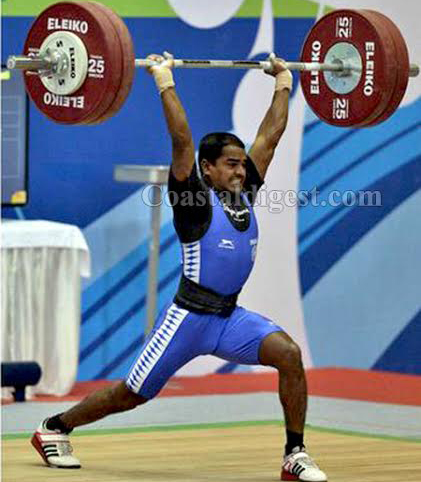
Truck driver’s son from Udupi strikes gold at South Asian Games

[email protected] (CD Network)
February 7, 2016

Udupi, Feb 7: An atmosphere of celebration prevailed in a poor household of Chittoo village in Kundapur taluk of Udupi district after 24-year-old Gururaja won a gold medal at the 12th South Asian Games in Guwahati on Saturday.

gururaj

This son of a truck driver made it to the top due to sheer hard work and dedication, despite all the financial hardships the family faced in the village.

He is the fifth among six sons of Mahabala and Paddu Poojary. The entire family was ecstatic after hearing the news of Gururaja winning gold in the 56 kg weightlifting category.

“Gururaja was only interested in sports since his childhood, so we encouraged him. Though sometimes it was difficult to get the money, I somehow managed,” said his father.

Gururaja did his schooling at the Sri Mookambika Temple School and PU College in Kollur. During his PU days, he was interested in wrestling, and learnt it under his coach Sukesh Shetty in Kollur.

The turning point came when he joined the SDM College in Ujire, Dakshina Kannada, for his graduation. It was his coach Rajendra Prasad M. who encouraged him in weight lifting.

“Gururaja used to practise two hours in the morning and two hours in the evening. During competitions, he used to put in two additional hours,” he said. Mr. Prasad coached him for five years until Gururaja got selected for the post of aircraft-man in the Indian Air Force under sports quota. He has been undergoing training in Belagavi for six months.

Gururaja, who spoke over the telephone from Guwahati, said he owed his success to the unstinting support of his parents, and his coach Mr. Prasad.

Comments

A. Mangalore
 - 
Sunday, 7 Feb 2016

He has made our Mangalore proud. Congratulations Dear.There are lots of youths are their like Gururaja. Unfortunately without proper education , finance and proper guidance they could not achieve anything.
Most of them are under the fold of Sangha Pariwar, where their rich leaders sends there own children abroad for education and they use these boys for goondasm in Mangalore.

Suresh kamke
 - 
Sunday, 7 Feb 2016

nice lift, hardwork came to like a fruit.

Manjuran
 - 
Sunday, 7 Feb 2016

really great, working for indian airforce only a big achievement,. clubbing to that he took gold medal in weight lifting, proud to be mangalorean.

Manish Sisodia
 - 
Sunday, 7 Feb 2016

parents really lucky to have this kid, god bless u all

Mahesh
 - 
Sunday, 7 Feb 2016

awesome lift, deserve the golden medal,

Ahmed
 - 
Sunday, 7 Feb 2016

Congratulation Mr. Gururaj... Good Luck ...

Goodman
 - 
Sunday, 7 Feb 2016

Not only a Tuck driver, even a lowest in the man made caste system cam also participate and they are also a human being.
He is in the open society. He can dream and accomplish it.

The constitution is secular, but the people of some sects are making polarization.
The God has not made such division.

Saleem Baigh
 - 
Sunday, 7 Feb 2016

Parents must be proud of him, did a very good achievement.

Koli Fayaz
 - 
Sunday, 7 Feb 2016

excellent, well done all the best keep up the winning movement.

Anwar
 - 
Sunday, 7 Feb 2016

Congrats Gururaj,U have made the country proud.All the best for Olympics.

Rich Muslim Fathers Son(Father in Gulf,Father big business in Mlore) from Mangalore roams in City Center/Forum...hahaha...Wa avasthe marre.Care ijji.

Marali schoolige alla...dakshina kannadada makkalige bekirudu Shale/Colleginalli sari daarige/100% markige.

Just go and see Aloysius/Milagris muslim students mark....hahaha...lagadi pother matha....ONLY JOLLY.

keshava Poojary
 - 
Sunday, 7 Feb 2016

live example for poor family kids, if someone want to get success they dont need anybody, hardwork make them success.

Mahabala
 - 
Sunday, 7 Feb 2016

we are proud of you, a national salute to the brave boy.

Vinith Poojary
 - 
Sunday, 7 Feb 2016

well done boy, keep it up and congratulation.

Add new comment

  • Coastaldigest.com reserves the right to delete or block any comments.
  • Coastaldigset.com is not responsible for its readers’ comments.
  • Comments that are abusive, incendiary or irrelevant are strictly prohibited.
  • Please use a genuine email ID and provide your name to avoid reject.
News Network
June 9,2020

Bengaluru, Jun 9: A 24-year-old who wanted to experience the feeling of death lost his life after consuming pesticide — he recorded it all on TikTok — in Koratagere taluk of Tumakuru district on Saturday evening.

Chided by his mother for not earning money, Dhananjaya, a resident of Gouraganahalli, on Saturday evening bought pesticide from a shop and shot a 15-second TikTok video, saying, “I want to experience the feeling of what death would be like. I will try to kill myself.”

Locals rushed Dhananjaya to a nearby hospital where he breathed his last the next morning. Koratagere police registered a case of unnatural death.

According to police, Dhananjaya had in the past rammed his Bajaj Pulsar bike into a tree to ‘experience’ death but had survived with minor injuries. Villagers and family members had advised him to not to take such risks. But he continued to do so as he was obsessed with death and posted his opinion regularly on TikTok, where he had 431 followers.

He tied the knot four months ago and was running an autorickshaw on rent. However, his earnings reduced to zero during the lockdown and he wasn’t mentally stable, claimed villagers.

Investigators said Dhananjaya wanted to scare his mother with his suicide threat and wanted to ‘experience’ death. He consumed poison near a farm but later panicked thinking he would die. However, he was not in a position to ride back home. He called his friend, who visited the spot and shifted him to hospital on Saturday night, police said.

Comments

Add new comment

  • Coastaldigest.com reserves the right to delete or block any comments.
  • Coastaldigset.com is not responsible for its readers’ comments.
  • Comments that are abusive, incendiary or irrelevant are strictly prohibited.
  • Please use a genuine email ID and provide your name to avoid reject.
Ram Puniyani
February 10,2020

Noam Chomsky is one of the leading peace workers in the world. In the wake of America’s attack on Vietnam, he brought out his classic formulation, ‘manufacturing consent’. The phrase explains the state manipulating public opinion to have the public approve of it policies—in this case, the attack of the American state on Vietnam, which was then struggling to free itself from French colonial rule.

In India, we are witness to manufactured hate against religious minorities. This hatred serves to enhance polarisation in society, which undermines India’s democracy and Constitution and promotes support for a Hindu nation. Hate is being manufactured through multiple mechanisms. For example, it manifests in violence against religious minorities. Some recent ghastly expressions of this manufactured hate was the massive communal violence witnessed in Mumbai (1992-93), Gujarat (2002), Kandhamal (2008) and Muzaffarnagar (2013). Its other manifestation was in the form of lynching of those accused of having killed a cow or consumed beef. A parallel phenomenon is the brutal flogging, often to death, of Dalits who deal with animal carcasses or leather.

Yet another form of this was seen when Shambhulal Regar, indoctrinated by the propaganda of Hindu nationalists, burned alive Afrazul Khan and shot the video of the heinous act. For his brutality, he was praised by many. Regar was incited into the act by the propaganda around love jihad. Lately, we have the same phenomenon of manufactured hate taking on even more dastardly proportions as youth related to Hindu nationalist organisations have been caught using pistols, while police authorities look on.

Anurag Thakur, a BJP minster in the central government recently incited a crowd in Delhi to complete his chant of what should happen to ‘traitors of the country...” with a “they should be shot”. Just two days later, a youth brought a pistol to the site of a protest at Jamia Millia Islamia university and shouted “take Azaadi!” and fired it. One bullet hit a student of Jamia. This happened on 30 January, the day Nathuram Godse had shot Mahatma Gandhi in 1948. A few days later, another youth fired near the site of protests against the CAA and NRC at Shaheen Bagh. Soon after, he said that in India, “only Hindus will rule”.

What is very obvious is that the shootings by those associated with Hindu nationalist organisations are the culmination of a long campaign of spreading hate against religious minorities in India in general and against Muslims in particular. The present phase is the outcome of a long and sustained hate campaign, the beginning of which lies in nationalism in the name of religion; Muslim nationalism and Hindu nationalism. This sectarian nationalism picked up the communal view of history and the communal historiography which the British introduced in order to pursue their ‘divide and rule’ policy.

In India what became part of “social common sense” was that Muslim kings had destroyed Hindu temples, that Islam was spread by force, and that it is a foreign religion, and so on. Campaigns, such as the one for a temple dedicated to the Hindu god Rama to be built at the site where the Babri masjid once stood, further deepened the idea of a Muslim as a “temple-destroyer”. Aurangzeb, Tipu Sultan and other Muslim kings were tarnished as the ones who spread Islam by force in the subcontinent. The tragic Partition, which was primarily due to British policies, and was well-supported by communal streams also, was entirely attributed to Muslims. The Kashmir conflict, which is the outcome of regional, ethnic and other historical issues, coupled with the American policy of supporting Pakistan’s ambitions of regional hegemony, (which also fostered the birth of Al-Qaeda), was also attributed to the Muslims.

With recurring incidents of communal violence, these falsehoods went on going deeper into the social thinking. Violence itself led to ghettoisation of Muslims and further broke inter-community social bonds. On the one hand, a ghettoised community is cut off from others and on the other hand the victims come to be presented as culprits. The percolation of this hate through word-of-mouth propaganda, media and re-writing of school curricula, had a strong impact on social attitudes towards the minorities.

In the last couple of decades, the process of manufacturing hate has been intensified by the social media platforms which are being cleverly used by the communal forces. Swati Chaturvedi’s book, I Am a Troll: Inside the Secret World of the BJP’s Digital Army, tells us how the BJP used social media to spread hate. Whatapp University became the source of understanding for large sections of society and hate for the ‘Other’, went up by leaps and bounds. To add on to this process, the phenomenon of fake news was shrewdly deployed to intensify divisiveness.

Currently, the Shaheen Bagh movement is a big uniting force for the country; but it is being demonised as a gathering of ‘anti-nationals’. Another BJP leader has said that these protesters will indulge in crimes like rape. This has intensified the prevalent hate.

While there is a general dominance of hate, the likes of Shambhulal Regar and the Jamia shooter do get taken in by the incitement and act out the violence that is constantly hinted at. The deeper issue involved is the prevalence of hate, misconceptions and biases, which have become the part of social thinking.

These misconceptions are undoing the amity between different religious communities which was built during the freedom movement. They are undoing the fraternity which emerged with the process of India as a nation in the making. The processes which brought these communities together broadly drew from Gandhi, Bhagat Singh and Ambedkar. It is these values which need to be rooted again in the society. The communal forces have resorted to false propaganda against the minorities, and that needs to be undone with sincerity.

Combating those foundational misconceptions which create hatred is a massive task which needs to be taken up by the social organisations and political parties which have faith in the Indian Constitution and values of freedom movement. It needs to be done right away as a priority issue in with a focus on cultivating Indian fraternity yet again.

Comments

Add new comment

  • Coastaldigest.com reserves the right to delete or block any comments.
  • Coastaldigset.com is not responsible for its readers’ comments.
  • Comments that are abusive, incendiary or irrelevant are strictly prohibited.
  • Please use a genuine email ID and provide your name to avoid reject.
Agencies
June 26,2020

New Delhi, Jun 26: With looming uncertainty and no likelihood of an early economic recovery in sight, the bull run in gold prices is here to stay. Analysts expect domestic futures to touch ₹ 52,000 per 10 grams in the next few months, till Diwali.

Experts also predict that with the current trend, gold may reach historic levels around ₹ 65,000 per 10 grams in two years time.

Futures of the yellow metal have touched new highs in India off late. On Wednesday, the August contract of gold futures on the Multi-Commodity Exchange (MCX) touched an all-time high of Rs 48,589 per 10 grams.

It has, however corrected since and is currently trading at ₹ 48,057 on the MCX, higher by ₹ 116 or 0.24 per cent from its previous close.

Market experts are of the view that both domestic and international gold prices are yet not done breaching records and will touch new highs in days to come.

The resurgence in the number of new cases of coronavirus infection across the globe has added to the uncertainty and fears.

Speaking to media persons, Anuj Gupta, DVP for Commodities and Currencies Research at Angel Broking, noted: "In short term we are expecting it to reach ₹ 48,800-49,000 and for long term, we are expecting ₹ 51,000-Rs 52,000 till Diwali."

On the prices in the international market, he said that it may reach around $1,790 per ounce in the near term from the current levels of $1,762 and the long term, it is likely to be around $1,820-1,850 per ounce.

Gupta noted that with International Monetary Fund's (IMF) latest downward revision of economic outlook, both global and of India, and the rising number of cases and high demand by gold exchange traded funds (ETF) have led to this record breaking rise in gold prices.

Covid-19 battered India's economy is projected to contract by 4.5 per cent this fiscal, according to the IMF and the global output is projected to decline by 4.9 per cent in 2020, 1.9 percentage points below the IMF's April forecast.

Hareesh V, Head of Commodity Research at Geojit Financial Services, said that gold's safe haven appeal will remain on the higher side as there is little hope of a quick global economic recovery amid rising virus cases across the world.

"Increased geopolitical instability and an under-performing dollar also lift the metal's sentiments," he added.

According to Prathamesh Mallya, AVP Research, Non-Agro Commodities & Currencies at Angel Broking, said that with the global output to contract and the economies in a deeper recession than most anticipate, gold as an asset class is a safe bet for investors across the globe.

"Although, the physical demand has declined drastically due to the restrictions and lockdowns, the activity of global central banks and their net purchases of gold signal that uncertainty will continue for most of 2020," he said.

He was also of the view that in the international market price of the metal may move towards $1,850 per ounce and in the domestic market it is likely to move higher towards Rs 50,000 per 10 grams.

"The investment demand as seen in the net additions of ETF holdings also signals that gold will shine for a much longer time even if the pandemic is under control. Till then, keep buying gold, if not in physical form, but in digital form," Mallya added.

Industry insiders like Aditya Pethe, Director, WHP Jewellers said: "I basically feel that the current trend for the gold is bullish and for the coming next 2 years, it is likely to move upwards. No one can predict the exact price as currently the trend is on rise but it might change after 6 months. In general for the coming 6 months to one year, the gold prices are likely to cross $2,000 which comes to roughly Rs 55,000. For a temporary moment it may reduce, basically fluctuate as well but overall trend of gold is going to be bullish."

On his part, Ishu Datwani, Founder, Anmol Jewellers said: "Yes - it's very likely that the gold price could easily go up to Rs 60,000-Rs 65,000 in the next two years. There is also a possibility of it going up even more."

"A lot of banks have been buying gold and there is also a possibility that the Indian rupee will depreciate against the dollar. This and geopolitical reasons will cause bullishness in gold."


Comments

Add new comment

  • Coastaldigest.com reserves the right to delete or block any comments.
  • Coastaldigset.com is not responsible for its readers’ comments.
  • Comments that are abusive, incendiary or irrelevant are strictly prohibited.
  • Please use a genuine email ID and provide your name to avoid reject.