



‘Trump acknowledges Russia's role in US election hacking'

January 9, 2017

Washington, Jan 9: President-elect Donald Trump accepts the U.S. intelligence community's conclusion that Russia engaged in cyber attacks during the U.S. presidential election and may take action in response, his incoming chief of staff said on Sunday.
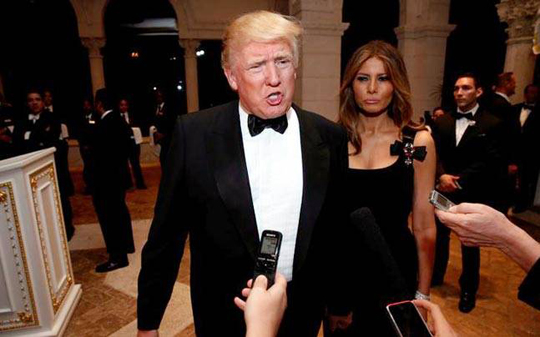
trump

Reince Priebus said Trump believed Russia was behind the intrusions into the Democratic Party organizations, although Priebus did not clarify whether the president-elect agreed that the hacks were directed by Russian President Vladimir Putin.

"He accepts the fact that this particular case was entities in Russia, so that's not the issue," Priebus said on an American news show.

It was the first acknowledgement from a senior member of the Republican president-elect's team that Trump had accepted that Russia directed the hacking and subsequent disclosure of Democratic emails during the 2016 presidential election.

Trump had rebuffed allegations that Russia was behind the hacks or was trying to help him win, saying the intrusions could have been carried out by China or a 400-pound hacker on his bed.

With less than two weeks until his January 20 inauguration, Trump has come under increasing pressure from fellow Republicans to accept intelligence community findings on Russian hacking and other attempts by Moscow to influence the November 8 election. A crucial test of Republican support for Trump comes this week with the first confirmation hearings for his Cabinet picks.

A US intelligence report last week said Putin directed a sophisticated influence campaign including cyber attacks to denigrate Democratic presidential candidate Hillary Clinton and support Trump.

The report, commissioned by Democratic President Barack Obama in December, concluded vote tallies were not affected by Russian interference, but did not assess whether it influenced the outcome of the vote in other ways.

'ACTION MAY BE TAKEN'

After receiving a briefing on Friday from leaders of the US intelligence agencies, Trump did not refer specifically to Russia's role in the presidential campaign.

In a statement, he acknowledged that "Russia, China, other countries, outside groups and people are consistently trying to break through the cyber infrastructure of our governmental institutions, businesses and organizations including the Democrat(ic) National Committee."

Trump spokesman Sean Spicer said that the president-elect's conclusions remained the same and that Priebus' comments were in line with Friday's statement.

Priebus' wording did not appear to foreshadow the dramatic reversal of Trump's apparent Russia policy that experts say would be required to deter further cyber attacks.

"It will take a lot more than what we heard on television today to make Putin cool it," the expert added. "In fact, there may not be anything that can deter Putin from pursuing a course he's bet his future and Russia's on," said a US intelligence expert on Russia, speaking on condition of anonymity.

The expert added that Putin's "multifaceted campaign of cyber attacks and espionage, propaganda, financial leverage, fake news and traditional espionage" had expanded in the United States since the election, "and it will be a shock if it does not escalate in France, Germany and elsewhere this year."

Priebus, the former Republican National Committee chairman Trump tapped as White House chief of staff, said Trump planned to order the intelligence community to make recommendations as to what should be done. "Action may be taken," he said, adding there was nothing wrong with trying to have a good relationship with Russia and other countries.

On Saturday, Trump wrote on Twitter that having a better relationship with Russia was a "good thing."

Comments

Add new comment

  • Coastaldigest.com reserves the right to delete or block any comments.
  • Coastaldigset.com is not responsible for its readers’ comments.
  • Comments that are abusive, incendiary or irrelevant are strictly prohibited.
  • Please use a genuine email ID and provide your name to avoid reject.
News Network
April 26,2020

Apr 26: The Chinese city of Wuhan, where the global coronavirus pandemic began, now has no remaining cases in its hospitals, a health official told reporters on Sunday.

"The latest news is that by April 26, the number of new coronavirus patients in Wuhan was at zero, thanks to the joint efforts of Wuhan and medical staff from around the country," National Health Commission spokesman Mi Feng said at a briefing.

The city had reported 46,452 cases, 56% of the national total. It saw 3,869 fatalities, or 84% of China's total.

Comments

Add new comment

  • Coastaldigest.com reserves the right to delete or block any comments.
  • Coastaldigset.com is not responsible for its readers’ comments.
  • Comments that are abusive, incendiary or irrelevant are strictly prohibited.
  • Please use a genuine email ID and provide your name to avoid reject.
News Network
April 15,2020

Wuhan, Apr 15: In the six days after top Chinese officials secretly determined they likely were facing a pandemic from a new coronavirus, the city of Wuhan at the epicenter of the disease hosted a mass banquet for tens of thousands of people; millions began traveling through for Lunar New Year celebrations.

President Xi Jinping warned the public on the seventh day, Janaury 20. But by that time, more than 3,000 people had been infected during almost a week of public silence, according to internal documents obtained by The Associated Press and expert estimates based on retrospective infection data.

That delay from Jan 14 to Jan. 20 was neither the first mistake made by Chinese officials at all levels in confronting the outbreak, nor the longest lag, as governments around the world have dragged their feet for weeks and even months in addressing the virus.

But the delay by the first country to face the new coronavirus came at a critical time — the beginning of the outbreak. China's attempt to walk a line between alerting the public and avoiding panic set the stage for a pandemic that has infected almost 2 million people and taken more than 126,000 lives.

A This is tremendous, a said Zuo-Feng Zhang, an epidemiologist at the University of California, Los Angeles. If they took action six days earlier, there would have been much fewer patients and medical facilities would have been sufficient. We might have avoided the collapse of Wuhan's medical system.

Other experts noted that the Chinese government may have waited on warning the public to stave off hysteria, and that it did act quickly in private during that time.

But the six-day delay by China's leaders in Beijing came on top of almost two weeks during which the national Center for Disease Control did not register any cases from local officials, internal bulletins obtained by the AP confirm. Yet during that time, from Jan 5 to Jan 17, hundreds of patients were appearing in hospitals not just in Wuhan but across the country.

It's uncertain whether it was local officials who failed to report cases or national officials who failed to record them. It's also not clear exactly what officials knew at the time in Wuhan, which only opened back up last week with restrictions after its quarantine.

But what is clear, experts say, is that China's rigid controls on information, bureaucratic hurdles and a reluctance to send bad news up the chain of command muffled early warnings. The punishment of eight doctors for rumor-mongering, broadcast on national television on Jan. 2, sent a chill through the city's hospitals.

Doctors in Wuhan were afraid, said Dali Yang, a professor of Chinese politics at the University of Chicago. It was truly intimidation of an entire profession. Without these internal reports, it took the first case outside China, in Thailand on Jan 13, to galvanize leaders in Beijing into recognising the possible pandemic before them. It was only then that they launched a nationwide plan to find cases distributing CDC-sanctioned test kits, easing the criteria for confirming cases and ordering health officials to screen patients, all without telling the public.

The Chinese government has repeatedly denied suppressing information in the early days, saying it immediately reported the outbreak to the World Health Organization.

Allegations of a cover-up or lack of transparency in China are groundless, said foreign ministry spokesman Zhao Lijian at a Thursday press conference.

The documents show that the head of China's National Health Commission, Ma Xiaowei, laid out a grim assessment of the situation on Jan. 14 in a confidential teleconference with provincial health officials.

A memo states that the teleconference was held to convey instructions on the coronavirus from President Xi Jinping, Premier Li Keqiang and Vice Premier Sun Chunlan, but does not specify what those instructions were.

The epidemic situation is still severe and complex, the most severe challenge since SARS in 2003, and is likely to develop into a major public health event, the memo cites Ma as saying.

The National Health Commission is the top medical agency in the country. In a faxed statement, the Commission said it had organised the teleconference because of the case reported in Thailand and the possibility of the virus spreading during New Year travel. It added that China had published information on the outbreak in an open, transparent, responsible and timely manner," in accordance with important instructions repeatedly issued by President Xi.

The documents come from an anonymous source in the medical field who did not want to be named for fear of retribution. The AP confirmed the contents with two other sources in public health familiar with the teleconference. Some of the memo's contents also appeared in a public notice about the teleconference, stripped of key details and published in February.

Under a section titled sober understanding of the situation, the memo said that clustered cases suggest that human-to-human transmission is possible. It singled out the case in Thailand, saying that the situation had changed significantly because of the possible spread of the virus abroad.

With the coming of the Spring Festival, many people will be traveling, and the risk of transmission and spread is high, the memo continued.

Comments

Add new comment

  • Coastaldigest.com reserves the right to delete or block any comments.
  • Coastaldigset.com is not responsible for its readers’ comments.
  • Comments that are abusive, incendiary or irrelevant are strictly prohibited.
  • Please use a genuine email ID and provide your name to avoid reject.
News Network
January 23,2020

Jan 23: Hundreds of Central Americans trying to reach the United States were stuck at the Mexico-Guatemala border on Wednesday after the Mexican government beefed up security to meet US demands to contain migrant flows.

Under sustained pressure from President Donald Trump, Mexico's government has adopted tougher measures to reduce the number of people heading towards the U.S. border.

Migrants in Tecun Uman, on the Guatemalan side of the border, were taken by surprise.

"We thought we'd be allowed through just like with the October caravan when they reached Tijuana," said Honduran migrant Ritzy Anabel, who did not give her surname.

"People from Mexico and Guatemala treated them well. But now it's changed because Mexicans don't want (us) to enter."

Many Central Americans migrants heading north are fleeing economic hardship and violence at home. A large caravan of migrants crossed into Mexico and went north in October 2018. Migrants crossing into Mexico earlier this week faced tear gas from security forces, who delivered a firmer response than in previous mass movements at the border.

Even so, about 1,000 migrants, most of them from Honduras, managed to reach Mexican soil on Tuesday. Mexican Foreign Minister Marcelo Ebrard said several hundred of the new arrivals were immediately deported on planes and buses.

On Wednesday, Mexican authorities said that 460 Honduran migrants were deported throughout the day. Other migrants from the group, including families traveling with children, were pondering their next moves.

Honduran Carlos Amador said that while some of his compatriots were returning home, others were hoping for positive news.

Trump has repeatedly threatened to punish Mexico and Central American countries if they fail to clamp down on the migrant flows. That has resulted in a series of agreements aimed at delivering on Trump's campaign promises to curb immigration.

Department of Homeland Security Acting Secretary Chad Wolf called the measures put in place by the Mexican National Guard "effective", adding that dozens of his personnel was on the ground in Central America assisting local immigration and security officials. Trump tweeted: "Sorry, if you come you will be immediately sent back!"

Comments

Add new comment

  • Coastaldigest.com reserves the right to delete or block any comments.
  • Coastaldigset.com is not responsible for its readers’ comments.
  • Comments that are abusive, incendiary or irrelevant are strictly prohibited.
  • Please use a genuine email ID and provide your name to avoid reject.