


Trump fires chief US lawyer who defied him on migrant ban

January 31, 2017

Washington, Jan 31: US President Donald Trump on Monday fired the acting attorney general, a holdover from the Obama administration, after she ordered Justice Department attorneys not to defend his controversial immigration orders.
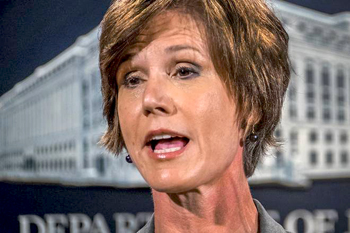
SallyIn a sharply worded statement, the White House called Sally Yates "weak on borders and very weak on illegal immigration" and also criticized Democrats for not yet confirming the appointment of attorney general-designate Jeff Sessions.

"The acting attorney general, Sally Yates, has betrayed the Department of Justice by refusing to enforce a legal order designed to protect the citizens of the United States," the White House said in a statement.

"This order was approved as to form and legality by the Department of Justice Office of Legal Counsel," it said.

"Tonight, President Trump relieved Ms Yates of her duties."

Federal prosecutor Dana Boente will serve as acting attorney general "until Senator Jeff Sessions is finally confirmed by the Senate, where he is being wrongly held up by Democrat senators for strictly political reasons," it said.

With Trump's White House facing multiple lawsuits and worldwide opprobrium over an order banning migrants from seven Muslim nations, Yates had whipped the rug from under her boss in a defiant and damaging parting shot.

In a memo to Department of Justice staff, Yates -- a career government lawyer promoted by Barack Obama -- expressed doubts about the legality and morality of Trump's decree, which has prompted mass protests.

"My responsibility is to ensure that the position of the Department of Justice is not only legally defensible, but is informed by our best view of what the law is," Yates wrote.

"I am not convinced that the defense of the executive order is consistent with these responsibilities nor am I convinced that the executive order is lawful," she added.

"For as long as I am the acting attorney general, the Department of Justice will not present arguments in defense of the executive order, unless and until I become convinced that it is appropriate to do so."

Yates's directive means that the US government, at least for now, has no authorized courtroom representation in the lawsuits.

It was a remarkable act of defiance against a tough-talking president who has showed little sign of brooking insubordination.

Sessions has not yet been confirmed by Congress. He faces a vote on the Senate Judiciary Committee Tuesday and must then be confirmed by the full Senate.

If confirmed, Sessions would almost certainly reverse course.

But Democratic lawmakers have vociferously opposed Trump's order and Republicans are privately seething over the way his White House has handled the issue.

The order signed on Friday suspended the arrival of all refugees for a minimum of 120 days, Syrian refugees indefinitely and bars citizens from Iran, Iraq, Libya, Somalia, Sudan, Syria and Yemen for 90 days.

Several federal judges have since filed temporary stays.

Firing Yates has uncomfortable echoes of President Richard Nixon's "Saturday night massacre" during the Watergate scandal.

Then, Nixon fired the Watergate special prosecutor, prompting the departures of his attorney general and deputy attorney general. The events catalyzed Nixon's impeachment.

On Sunday, attorneys general from 16 US states, including California and New York, condemned Trump's directive as "unconstitutional" and vowed to fight it.

Comments

PedoMhdFkdAmna
 - 
Tuesday, 31 Jan 2017

I hope all western countries ban Muslims forever

shaji
 - 
Tuesday, 31 Jan 2017

This shows the frustration of Trump and hope he will get more frustrations in the days to come for his unwise / illegal decisions which will effect US on all grounds. I hope public anger and disappoint towards Trump will grow day by day.

Add new comment

  • Coastaldigest.com reserves the right to delete or block any comments.
  • Coastaldigset.com is not responsible for its readers’ comments.
  • Comments that are abusive, incendiary or irrelevant are strictly prohibited.
  • Please use a genuine email ID and provide your name to avoid reject.
News Network
May 29,2020

Karachi, May 29: Investigators and rescue officials have found around Rs 3 crore in cash in the wreckage of the Pakistan International Airlines' aircraft that crashed wth 99 people on board, killing 97 people, including nine children.

Flight PK-8303 from Lahore to Karachi crashed in a residential area near Karachi International Airport on Friday, with only two passengers miraculously surviving the crash.

Investigators and rescue officials have found currencies of different countries and denominations worth around Rs 30 million from the aircraft's wreckage, an official said on Thursday.

"An investigation has been ordered into how such a huge amount of cash got through airport security and baggage scanners and found its way into the ill-fated flight," the official said.

He said that the amount was recovered from two bags in the wreckage.

"The process of identifying the bodies and their luggage which will be handed over to their families and relatives is going on," he said.

A total of 97 people including the aircraft crew died in the crash, one of the most catastrophic aviation disasters in Pakistan's history.

A government official said on Thursday that the identification of 47 bodies had been completed, while 43 bodies were handed over for burial.

Friday's accident was the first major aircraft crash in Pakistan after December 7, 2016 when a PIA ATR-42 aircraft from Chitral to Islamabad crashed midway. The crash claimed the lives of all 48 passengers and crew, including singer-cum-evangelist Junaid Jamshed.

Comments

Add new comment

  • Coastaldigest.com reserves the right to delete or block any comments.
  • Coastaldigset.com is not responsible for its readers’ comments.
  • Comments that are abusive, incendiary or irrelevant are strictly prohibited.
  • Please use a genuine email ID and provide your name to avoid reject.
News Network
April 26,2020

Islamabad, Apr 26: Pakistan Prime Minister Imran Khan has been trumped by the country's powerful military yet again, this time over his government's inadequate steps and its poor response in curbing the coronavirus outbreak in the country, even as cases soared over 12,500.

In his address to the nation on March 22, Khan explained the reasons for not imposing a countrywide lockdown, asserting that millions would lose their jobs and affect families, who are below the poverty line, struggling to find enough food to eat. However, less than 24 hours later, Pakistan Army spokesperson Major General Babar Iftikhar announced the implementation of lockdown in the country having a population of over 200 million, contradicting the statements made by Imran Khan.

As lockdown was imposed, the military has deployed troops across Pakistan and is orchestrating the COVID-19 response through the National Core Committee, a body set up to coordinate policy between the national and provincial governments.

"The government left a big gap in its handling of the coronavirus. The army has tried to fill that gap, there was no choice," an unnamed retired general was quoted by Financial Times as saying.

The virus crisis in Pakistan has once again made things crystal clear about who is calling the shots -- the military, widely believed to bring Imran Khan to power in 2018.

The armymen have taken over the COVID-19 crisis as an opportunity to prove their competency in contrast to Imran Khan, who was mocked after urging youth to come forward and join Corona Relief Tigers Force, a volunteer body to wage "jihad" against the virus.

According to analysts, the military's seizure of the coronavirus response marks yet another policy failure for Imran Khan in the eyes of the generals, as per the Financial Times report.

The 67-year-old cricketer-turned-politician has repeatedly failed to gain international traction over the Kashmir issue and has struggled to convince the Financial Action Task Force (FATF) in getting his country removed from 'grey list' for terror funding.

In times of emergency, one has to take clear decisions and take them through. You can't dither. The whole world is advising strong lockdown. If the prime minister does not show that he is decisive, somebody else will," said Nafisa Shah, a Member of Parliament from the opposition Pakistan Peoples Party (PPP).

Even after the lockdown was imposed, Imran Khan continued to question the need for its implementation, raising eyebrows over the country's response in tackling the virus, as cases continue to rise. This comes even as such drastic measures are in place in many countries across the world, including neighbouring India.

According to The Dawn, the country has 12,657 confirmed cases of COVID-19, which includes 2,755 recoveries and 265 deaths. Punjab has the highest number of cases -- 5,326 --, followed by 4,232 in Sindh.

However, experts suggest that the actual numbers could be more given the low testing rates and inadequate supply of testing kits.

Doctors and nurses across the country have staged protests over the lack of personal protective equipment, as increasing numbers of health workers contract COVID-19.

"Because of the lack of resources, there is chaos among the doctors and healthcare workers. They know people are dying, they know the severity of the illness and they have to work without PPE," Shoaib Hasan Tarar, a doctor working in Rawalpindi, was quoted as saying.

As the coronavirus crisis continues to ravage Pakistan, the country's overwhelming health infrastructure has put a toll on its already floundering economy. The IMF said that the GDP will shrink 1.5 per cent in 2020. The cash-strapped nation is set to be the first major emerging economy to apply to a G-20 initiative to request debt repayment relief, according to Financial Times.

In early March, Pakistan saw a surge in coronavirus cases, when infected pilgrims and workers crossed the border from Qom, a religious city in Iran, which is a hotspot.

Pakistan's limited resources were exposed when quarantined pilgrims agitated against unhealthy conditions at Taftan camp on Pakistan-Iran border, where five people were living in a tent with no access to toilets.

While the lockdown is in place, authorities have been confronted by hardline clerics who have defied social distancing terms and downplayed the threat of the virus. During Friday prayers every week, worshippers violate the restrictions by gathering at various mosques.

Last week, Islamabad inked an agreement allowing mosques to stay open for Ramzan. It stipulated that people should follow 20 rules, including maintaining a six feet distance from each other.

"There is little consistency in terms of how the lockdown is being approached. Coronavirus has shown the disconnect between the national government, regional governments and the military. Imran Khan has been left behind as the cheerleader for keeping Pakistan's morale high. I think people are starting to ask, 'How long is he going to last?'", said Sajjan Gohel, South Asia expert and guest teacher at the London School of Economics.

Comments

Add new comment

  • Coastaldigest.com reserves the right to delete or block any comments.
  • Coastaldigset.com is not responsible for its readers’ comments.
  • Comments that are abusive, incendiary or irrelevant are strictly prohibited.
  • Please use a genuine email ID and provide your name to avoid reject.
Agencies
June 16,2020

India continues to remain ranked 43rd on an annual World Competitiveness Index compiled by Institute for Management Development (IMD) with some traditional weaknesses like poor infrastructure and insufficient education investment keeping its ranking low, the international business school said on Tuesday.

Singapore has retained its top position on the 63-nation list.

Denmark has moved up to the second position (from 8th last year), Switzerland has gained one place to rank 3rd, the Netherlands has retained its 4th place and Hong Kong has slipped to the fifth place (from 2nd in 2019).

The US has moved down to 10th place (from 3rd last year), while China has also slipped from 14th to 20th place. Among the BRICS nations, India is ranked second after China, followed by Russia (50th), Brazil (56th) and South Africa (59th).

India was ranked 41st on the IMD World Competitiveness Ranking, being produced by the business school based in Switzerland and Singapore every year since 1989, but had slipped to 45th in 2017 before improving to 44th in 2018 and then to 43rd in 2019.

While its overall position has remained unchanged in the 2020 list, it has recorded improvements in areas like long-term employment growth, current account balance, high-tech exports, foreign currency reserves, public expenditure on education, political stability and overall productivity, the IMD said.

However, it has moved down in areas like exchange rate stability, real GDP growth, competition legislation and taxes.

Arturo Bris, Head of Competitiveness Center at IMD Business School, said India continues to struggle on the list and the recent country rating downgrade by Moody’s reflects the uncertainties regarding the economy’s future.

"In our ranking this year, we again emphasize the traditional weaknesses of India -- poor infrastructure, an important deficit in education investment, and a health system that does not reach everybody. For India to follow the path of China, it must stress its intangible infrastructure," Bris said.

"In a less global world, with China, USA, and Europe looking inwards, currencies like the rupee (and the Brazilian real for instance) are going to suffer and display high volatilities.

"Moody’s has threatened the country with a downgrade to junk and that would put India in a terrible position to attract foreign capital. So the urgency for the government should be to fix the short-term problems—and this requires to improve the credibility of the government itself," Bris added.

With the exception of Singapore, the Philippines, Taiwan and the Korean Republic, most Asian economies dropped in rankings this year, the IMD said.

The reason for the Asian economies’ less stellar performance as a region, this year is partly the result of the trade frictions between China and the US, particularly because these economies are highly dependent on trade with China.

About Singapore, which moved to the top rank last year, the IMD said its position is largely driven by the relative ease of setting up business, availability of skilled labour and its cutting-edge technological infrastructure.

The IMD said the impact of COVID-19 on the competitiveness ranking has partially been captured by executives’ opinions about the effectiveness of the different health systems.

In the ASEAN countries included in the survey, only Singapore and Thailand have a positive performance in the effectiveness of the health infrastructure.

Comments

Add new comment

  • Coastaldigest.com reserves the right to delete or block any comments.
  • Coastaldigset.com is not responsible for its readers’ comments.
  • Comments that are abusive, incendiary or irrelevant are strictly prohibited.
  • Please use a genuine email ID and provide your name to avoid reject.