


Trump fires chief US lawyer who defied him on migrant ban

January 31, 2017

Washington, Jan 31: US President Donald Trump on Monday fired the acting attorney general, a holdover from the Obama administration, after she ordered Justice Department attorneys not to defend his controversial immigration orders.
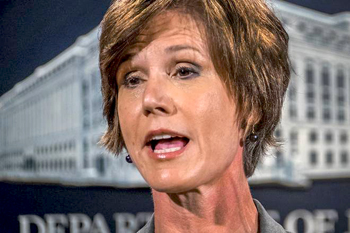
SallyIn a sharply worded statement, the White House called Sally Yates "weak on borders and very weak on illegal immigration" and also criticized Democrats for not yet confirming the appointment of attorney general-designate Jeff Sessions.

"The acting attorney general, Sally Yates, has betrayed the Department of Justice by refusing to enforce a legal order designed to protect the citizens of the United States," the White House said in a statement.

"This order was approved as to form and legality by the Department of Justice Office of Legal Counsel," it said.

"Tonight, President Trump relieved Ms Yates of her duties."

Federal prosecutor Dana Boente will serve as acting attorney general "until Senator Jeff Sessions is finally confirmed by the Senate, where he is being wrongly held up by Democrat senators for strictly political reasons," it said.

With Trump's White House facing multiple lawsuits and worldwide opprobrium over an order banning migrants from seven Muslim nations, Yates had whipped the rug from under her boss in a defiant and damaging parting shot.

In a memo to Department of Justice staff, Yates -- a career government lawyer promoted by Barack Obama -- expressed doubts about the legality and morality of Trump's decree, which has prompted mass protests.

"My responsibility is to ensure that the position of the Department of Justice is not only legally defensible, but is informed by our best view of what the law is," Yates wrote.

"I am not convinced that the defense of the executive order is consistent with these responsibilities nor am I convinced that the executive order is lawful," she added.

"For as long as I am the acting attorney general, the Department of Justice will not present arguments in defense of the executive order, unless and until I become convinced that it is appropriate to do so."

Yates's directive means that the US government, at least for now, has no authorized courtroom representation in the lawsuits.

It was a remarkable act of defiance against a tough-talking president who has showed little sign of brooking insubordination.

Sessions has not yet been confirmed by Congress. He faces a vote on the Senate Judiciary Committee Tuesday and must then be confirmed by the full Senate.

If confirmed, Sessions would almost certainly reverse course.

But Democratic lawmakers have vociferously opposed Trump's order and Republicans are privately seething over the way his White House has handled the issue.

The order signed on Friday suspended the arrival of all refugees for a minimum of 120 days, Syrian refugees indefinitely and bars citizens from Iran, Iraq, Libya, Somalia, Sudan, Syria and Yemen for 90 days.

Several federal judges have since filed temporary stays.

Firing Yates has uncomfortable echoes of President Richard Nixon's "Saturday night massacre" during the Watergate scandal.

Then, Nixon fired the Watergate special prosecutor, prompting the departures of his attorney general and deputy attorney general. The events catalyzed Nixon's impeachment.

On Sunday, attorneys general from 16 US states, including California and New York, condemned Trump's directive as "unconstitutional" and vowed to fight it.

Comments

PedoMhdFkdAmna
 - 
Tuesday, 31 Jan 2017

I hope all western countries ban Muslims forever

shaji
 - 
Tuesday, 31 Jan 2017

This shows the frustration of Trump and hope he will get more frustrations in the days to come for his unwise / illegal decisions which will effect US on all grounds. I hope public anger and disappoint towards Trump will grow day by day.

Add new comment

  • Coastaldigest.com reserves the right to delete or block any comments.
  • Coastaldigset.com is not responsible for its readers’ comments.
  • Comments that are abusive, incendiary or irrelevant are strictly prohibited.
  • Please use a genuine email ID and provide your name to avoid reject.
News Network
February 5,2020

Feb 5: Pakistan will buy more palm oil from Malaysia, Prime Minister Imran Khan said on Tuesday, aiming to help offset lost sales after top buyer India put curbs on Malaysian imports last month amid a diplomatic row.

India imposed restrictions on refined palm oil imports and informally asked traders to stop buying from Malaysia, the world's biggest producer of the edible oil. Sources said the move was in retaliation for Malaysia's criticism of India's policy on Kashmir.

Malaysian Prime Minister Mahathir Mohamad said on Tuesday that he discussed palm oil with Khan who was on a visit to Malaysia and that Pakistan had indicated it would import more from Malaysia.

"That's right, especially since we noticed India threatened Malaysia for supporting the Kashmir cause, threatened to cut palm oil imports," Khan told a joint news conference, referring to India's Muslim-majority region of Kashmir.

"Pakistan will do its best to compensate for that."

India is a Hindu-majority country while Malaysia and Pakistan are mainly Muslim. India and Pakistan have been mostly hostile to each other since the partition of British India in 1947, and have fought two of their three wars over competing territorial claims in Kashmir.

Pakistan may have bought around 135,000 tonnes of Malaysian palm oil last month, a record high, India-based dealers who track such shipments told Reuters on condition of anonymity.

The figure is close to estimates of 141,500 tonnes from Refinitiv, which show sales to India in January may have plunged 80% from a year earlier to 40,400 tonnes.

Malaysia will release official export data on Monday.

Pakistan bought 1.1 million tonnes of palm oil from Malaysia last year, while India bought 4.4 million tonnes, according to the Malaysian Palm Oil Council.

Malaysian palm oil futures rose on Tuesday after Khan's comments and on expectations of a steep drop in production in January.

STRONG TIES

India has repeatedly objected to Mahathir speaking out against its move last year to strip Kashmir's autonomy and make it easier for non-Muslims from neighbouring Muslim-majority Bangladesh, Pakistan and Afghanistan to gain citizenship.

At the news conference, Mahathir did not refer to Kashmir but Khan did.

"The way you, PM, have stood with us and spoken about this injustice going on, on behalf of Pakistan I really want to thank you," Khan said.

He also said he was sad he had been unable to attend a summit of Muslim leaders in Malaysia in December. Saudi Arabia did not attend the summit, saying it was the wrong forum to discuss matters affecting the world's Muslims and Khan belatedly pulled out.

Some Pakistani officials, unnamed because they were not authorised to speak to the media, said at the time that Khan pulled out under pressure from Saudi Arabia, a close ally, although local media reported his officials denied that was the reason for his absence.

"Unfortunately our friends, who are very close to Pakistan as well, felt that somehow the conference was going to divide the ummah," Khan said, using the Arabic word for the Muslim community but not mentioning Saudi Arabia by name.

"It is clearly a misconception, as that was not the purpose of the conference."

Comments

Add new comment

  • Coastaldigest.com reserves the right to delete or block any comments.
  • Coastaldigset.com is not responsible for its readers’ comments.
  • Comments that are abusive, incendiary or irrelevant are strictly prohibited.
  • Please use a genuine email ID and provide your name to avoid reject.
News Network
May 6,2020

Washington, May 6: At a time when the coronavirus pandemic has squeezed them, multi-national companies in America are laying off workers while paying cash dividends to their shareholders. Thus making the workers bear the brunt of the sacrifices while the shareholders continue to collect.

The Washington Post said in one of its reports that five big American companies have paid a combined USD 700 million to shareholders while cutting jobs, closing plants and leaving thousands of their workers filing for unemployment benefits.

Since the pandemic was declared an emergency, Caterpillar has suspended operations at two plants and a foundry, Levi Strauss has closed stores, and toolmaker Stanley Black & Decker has been planning layoffs and furloughs.

Steelcase, an office furniture manufacturer, and World Wrestling Entertainment have also shed employees.

Executives of those companies told the Post that the layoffs support the long-term health of their companies, and often the executives are giving up a piece of their salaries. Furloughed workers can apply for unemployment benefits.

But distributing millions of dollars to shareholders while leaving many workers without a paycheck is unfair, critics argue, and belies the repeated statements from executives about their concern for employees' welfare during the coronavirus crisis.

Caterpillar, for example, announced a USD 500 million distribution to shareholders April 8, about two weeks after indicating that operations at some plants would stop. The company however declined to divulge how many workers are affected.

"We are taking a variety of actions globally, but we aren't going to discuss the number of impacted people," spokeswoman of the company, Kate Kenny, said in a reply to an email by the Post.

This spate of dividends is also likely to revive long-standing debates about economic rewards.

"There are no hard-and-fast rules about this," said Amy Borrus, deputy director of the Council of Institutional Investors, a group that argues for shareholder rights and represents pension funds and other long-term investors.

Many large US companies choose to issue a regular, quarterly dividend to shareholders, often increasing it, and they boast about these payments because they help keep the share price higher than it might otherwise be. Those companies might be reluctant to announce that they are cutting or suspending their dividend during a crisis, Borrus was further quoted as saying.

But "companies have to be mindful of the optics of paying dividends if they're laying off thousands of workers," she added.

On March 26, Caterpillar had announced that because of the pandemic, it was "temporarily suspending operations at certain facilities." Two plants, in East Peoria, Ill., and Lafayette, Ind., were coming to a halt, as well as a foundry in Mapleton, Ill., according to news reports.

"We are taking a variety of actions at our global facilities to reduce production due to weaker customer demand, potential supply constraints and the spread of the covid-19 pandemic and related government actions," Kenny said via email.

"These actions include temporary facility shutdowns, indefinite or temporary layoffs," she added.

Similarly, Levi Strauss announced April 7 that the company would stop paying store workers, and about 4,000 are now on furlough. On the same day, the company announced that it was returning USD 32 million to shareholders.

"As this human and economic tragedy unfolds globally over the coming months, we are taking swift and decisive action that will ensure we remain a winner in our industry," Chip Bergh, president and chief executive of the company, also told the Post.

Stanley Black & Decker announced on April 2 that it was planning furloughs and layoffs because of the pandemic. Two weeks later, it issued a dividend to shareholders of about USD 106 million.

The notion that a company's primary purpose is to serve shareholders gained prominence in the 1980s but has come under attack in recent years, even from business executives, the newspaper reported.

Corporate decisions to suspend dividends and buybacks are complex, however, and it is difficult to know whether these suspensions of dividend and buyback programs were motivated by a desire to conserve cash in anticipation of bad times, and how much they are prompted by a sense of obligation to employees.

Over recent decades, the mandate to "maximize shareholder value" has become orthodoxy, for many, and it is often unclear what motivates companies to pare dividends or buybacks for shareholders, said William Lazonick, an emeritus economics professor at the University of Massachusetts at Lowell, who has been one of the leading critics of companies that distribute cash to shareholders through stock buybacks and dividends rather than reinvesting the profits into employees, innovation and production.

Comments

Add new comment

  • Coastaldigest.com reserves the right to delete or block any comments.
  • Coastaldigset.com is not responsible for its readers’ comments.
  • Comments that are abusive, incendiary or irrelevant are strictly prohibited.
  • Please use a genuine email ID and provide your name to avoid reject.
News Network
April 6,2020

New Delhi, April 6: The United States has donated $2.9 million assistance package for India to help the Narendra Modi government brace itself against the coronavirus as countries across the world are coming together to combat the outbreak.

On March 28, the US government, via US Agency for International Development, announced $2.9 million to support India in its response to COVID-19.

"It builds on a foundation of over $1.4 billion in health assistance and nearly $3 billion in total assistance that the US provided to India over the last 20 years," the US Embassy in India said in a statement.

"These new funds will support two organisations, including $2.4 million for USAID's health strengthening project, implemented by Jhpiego, an international non-profit health organisation affiliated with Johns Hopkins University and $500,000 for the World Health Organization (WHO)," the statement said.

The funds will also help India combat the spread of COVID-19, provide care for the affected and support local communities with the tools needed to contain the disease, it added.

Moreover, being a global leader in health and humanitarian response to COVID-19, the US has provided approximately $18.3 million assistance package to ASEAN member countries to fight the contagion.

The funds will be used to prepare laboratories for large-scale testing for the lethal virus, infection prevention and control, enable risk communication, implement public-health emergency plans for border points of entry, activate case-finding and event-based surveillance for influenza-like illnesses, train and equip rapid-responders in investigation and contact-tracing and update training materials for health workers.

Comments

Add new comment

  • Coastaldigest.com reserves the right to delete or block any comments.
  • Coastaldigset.com is not responsible for its readers’ comments.
  • Comments that are abusive, incendiary or irrelevant are strictly prohibited.
  • Please use a genuine email ID and provide your name to avoid reject.