


Trump fires chief US lawyer who defied him on migrant ban

January 31, 2017

Washington, Jan 31: US President Donald Trump on Monday fired the acting attorney general, a holdover from the Obama administration, after she ordered Justice Department attorneys not to defend his controversial immigration orders.
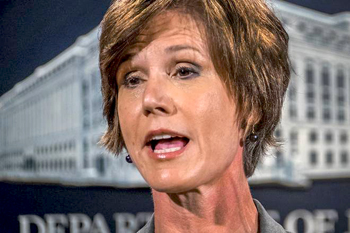
SallyIn a sharply worded statement, the White House called Sally Yates "weak on borders and very weak on illegal immigration" and also criticized Democrats for not yet confirming the appointment of attorney general-designate Jeff Sessions.

"The acting attorney general, Sally Yates, has betrayed the Department of Justice by refusing to enforce a legal order designed to protect the citizens of the United States," the White House said in a statement.

"This order was approved as to form and legality by the Department of Justice Office of Legal Counsel," it said.

"Tonight, President Trump relieved Ms Yates of her duties."

Federal prosecutor Dana Boente will serve as acting attorney general "until Senator Jeff Sessions is finally confirmed by the Senate, where he is being wrongly held up by Democrat senators for strictly political reasons," it said.

With Trump's White House facing multiple lawsuits and worldwide opprobrium over an order banning migrants from seven Muslim nations, Yates had whipped the rug from under her boss in a defiant and damaging parting shot.

In a memo to Department of Justice staff, Yates -- a career government lawyer promoted by Barack Obama -- expressed doubts about the legality and morality of Trump's decree, which has prompted mass protests.

"My responsibility is to ensure that the position of the Department of Justice is not only legally defensible, but is informed by our best view of what the law is," Yates wrote.

"I am not convinced that the defense of the executive order is consistent with these responsibilities nor am I convinced that the executive order is lawful," she added.

"For as long as I am the acting attorney general, the Department of Justice will not present arguments in defense of the executive order, unless and until I become convinced that it is appropriate to do so."

Yates's directive means that the US government, at least for now, has no authorized courtroom representation in the lawsuits.

It was a remarkable act of defiance against a tough-talking president who has showed little sign of brooking insubordination.

Sessions has not yet been confirmed by Congress. He faces a vote on the Senate Judiciary Committee Tuesday and must then be confirmed by the full Senate.

If confirmed, Sessions would almost certainly reverse course.

But Democratic lawmakers have vociferously opposed Trump's order and Republicans are privately seething over the way his White House has handled the issue.

The order signed on Friday suspended the arrival of all refugees for a minimum of 120 days, Syrian refugees indefinitely and bars citizens from Iran, Iraq, Libya, Somalia, Sudan, Syria and Yemen for 90 days.

Several federal judges have since filed temporary stays.

Firing Yates has uncomfortable echoes of President Richard Nixon's "Saturday night massacre" during the Watergate scandal.

Then, Nixon fired the Watergate special prosecutor, prompting the departures of his attorney general and deputy attorney general. The events catalyzed Nixon's impeachment.

On Sunday, attorneys general from 16 US states, including California and New York, condemned Trump's directive as "unconstitutional" and vowed to fight it.

Comments

PedoMhdFkdAmna
 - 
Tuesday, 31 Jan 2017

I hope all western countries ban Muslims forever

shaji
 - 
Tuesday, 31 Jan 2017

This shows the frustration of Trump and hope he will get more frustrations in the days to come for his unwise / illegal decisions which will effect US on all grounds. I hope public anger and disappoint towards Trump will grow day by day.

Add new comment

  • Coastaldigest.com reserves the right to delete or block any comments.
  • Coastaldigset.com is not responsible for its readers’ comments.
  • Comments that are abusive, incendiary or irrelevant are strictly prohibited.
  • Please use a genuine email ID and provide your name to avoid reject.
News Network
February 28,2020

Tehran, Feb 28: The coronavirus epidemic in Iran has cost 26 lives, the health ministry announced Thursday, with a vice president becoming the latest top official to be infected as the spread appeared to accelerate.

Health ministry spokesman Kianoush Jahanpour told a news conference that the tally of infections had risen to 245 with 106 more cases confirmed -- the highest number for a single day since Iran announced its first infections on February 19.

The Islamic republic has the highest death toll from the virus outside China, where COVID-19 first emerged.

Among the latest coronavirus sufferers is one of Iran's seven vice presidents, Massoumeh Ebtekar, who oversees women's affairs.

Ebtekar, a former spokeswoman for students who took 52 Americans hostage at the US embassy in Tehran in 1979, is being treated at home and members of her team have been tested, state news agency IRNA reported.

Mojtaba Zolnour, head of parliament's national security and foreign affairs committee, also contracted the virus, appearing in a video posted by Fars news agency saying he was in self-quarantine.

The cleric is a deputy for the Shiite holy city of Qom in central Iran where the country's first cases were detected.

According to media reports, among the deceased in Qom on Thursday was theologian Hadi Khroroshahi, who in 1981 was named Iran's first ambassador to the Vatican.

The announcement by Zolnour comes two days after another top official, deputy health minister Iraj Harirchi, head of the government's coronavirus task force, said he too had contracted the virus.

On Wednesday, Iranian authorities announced domestic travel restrictions for people with confirmed or suspected infections.

They also placed curbs on access to major Shiite pilgrimage sites, including the Imam Reza shrine in second city Mashhad and the Fatima Masumeh shrine in Qom.

Visitors to the shrines will be allowed to visit on condition they are provided "with hand-washing liquids, proper (health) information, masks", Health Minister Saeed Namaki said.

They must "not gather together in groups but just pray and leave", he said.

In a rare move, authorities announced the cancellation of the main Friday weekly prayers in Tehran, Qom and Mashhad as well as in the capitals of 22 of Iran's 31 provinces and other infected areas.

"All of these decisions are temporary and if the situation changes, we might intensify or ease them," Namaki said.

Comments

Add new comment

  • Coastaldigest.com reserves the right to delete or block any comments.
  • Coastaldigset.com is not responsible for its readers’ comments.
  • Comments that are abusive, incendiary or irrelevant are strictly prohibited.
  • Please use a genuine email ID and provide your name to avoid reject.
News Network
April 15,2020

Wuhan, Apr 15: In the six days after top Chinese officials secretly determined they likely were facing a pandemic from a new coronavirus, the city of Wuhan at the epicenter of the disease hosted a mass banquet for tens of thousands of people; millions began traveling through for Lunar New Year celebrations.

President Xi Jinping warned the public on the seventh day, Janaury 20. But by that time, more than 3,000 people had been infected during almost a week of public silence, according to internal documents obtained by The Associated Press and expert estimates based on retrospective infection data.

That delay from Jan 14 to Jan. 20 was neither the first mistake made by Chinese officials at all levels in confronting the outbreak, nor the longest lag, as governments around the world have dragged their feet for weeks and even months in addressing the virus.

But the delay by the first country to face the new coronavirus came at a critical time — the beginning of the outbreak. China's attempt to walk a line between alerting the public and avoiding panic set the stage for a pandemic that has infected almost 2 million people and taken more than 126,000 lives.

A This is tremendous, a said Zuo-Feng Zhang, an epidemiologist at the University of California, Los Angeles. If they took action six days earlier, there would have been much fewer patients and medical facilities would have been sufficient. We might have avoided the collapse of Wuhan's medical system.

Other experts noted that the Chinese government may have waited on warning the public to stave off hysteria, and that it did act quickly in private during that time.

But the six-day delay by China's leaders in Beijing came on top of almost two weeks during which the national Center for Disease Control did not register any cases from local officials, internal bulletins obtained by the AP confirm. Yet during that time, from Jan 5 to Jan 17, hundreds of patients were appearing in hospitals not just in Wuhan but across the country.

It's uncertain whether it was local officials who failed to report cases or national officials who failed to record them. It's also not clear exactly what officials knew at the time in Wuhan, which only opened back up last week with restrictions after its quarantine.

But what is clear, experts say, is that China's rigid controls on information, bureaucratic hurdles and a reluctance to send bad news up the chain of command muffled early warnings. The punishment of eight doctors for rumor-mongering, broadcast on national television on Jan. 2, sent a chill through the city's hospitals.

Doctors in Wuhan were afraid, said Dali Yang, a professor of Chinese politics at the University of Chicago. It was truly intimidation of an entire profession. Without these internal reports, it took the first case outside China, in Thailand on Jan 13, to galvanize leaders in Beijing into recognising the possible pandemic before them. It was only then that they launched a nationwide plan to find cases distributing CDC-sanctioned test kits, easing the criteria for confirming cases and ordering health officials to screen patients, all without telling the public.

The Chinese government has repeatedly denied suppressing information in the early days, saying it immediately reported the outbreak to the World Health Organization.

Allegations of a cover-up or lack of transparency in China are groundless, said foreign ministry spokesman Zhao Lijian at a Thursday press conference.

The documents show that the head of China's National Health Commission, Ma Xiaowei, laid out a grim assessment of the situation on Jan. 14 in a confidential teleconference with provincial health officials.

A memo states that the teleconference was held to convey instructions on the coronavirus from President Xi Jinping, Premier Li Keqiang and Vice Premier Sun Chunlan, but does not specify what those instructions were.

The epidemic situation is still severe and complex, the most severe challenge since SARS in 2003, and is likely to develop into a major public health event, the memo cites Ma as saying.

The National Health Commission is the top medical agency in the country. In a faxed statement, the Commission said it had organised the teleconference because of the case reported in Thailand and the possibility of the virus spreading during New Year travel. It added that China had published information on the outbreak in an open, transparent, responsible and timely manner," in accordance with important instructions repeatedly issued by President Xi.

The documents come from an anonymous source in the medical field who did not want to be named for fear of retribution. The AP confirmed the contents with two other sources in public health familiar with the teleconference. Some of the memo's contents also appeared in a public notice about the teleconference, stripped of key details and published in February.

Under a section titled sober understanding of the situation, the memo said that clustered cases suggest that human-to-human transmission is possible. It singled out the case in Thailand, saying that the situation had changed significantly because of the possible spread of the virus abroad.

With the coming of the Spring Festival, many people will be traveling, and the risk of transmission and spread is high, the memo continued.

Comments

Add new comment

  • Coastaldigest.com reserves the right to delete or block any comments.
  • Coastaldigset.com is not responsible for its readers’ comments.
  • Comments that are abusive, incendiary or irrelevant are strictly prohibited.
  • Please use a genuine email ID and provide your name to avoid reject.
Agencies
February 18,2020

British lawmaker Debbie Abrahams' e-Business visa was revoked as she was involved in anti-India activities and the cancellation was conveyed to her on February 14, government sources said on Tuesday.

Asserting that the grant, rejection or revocation of a visa or electronic travel authorisation is the sovereign right of a country, the sources said Abrahams was issued an e-Business visa on October 7 last year which was valid till October 5, 2020 for attending business meetings.

"Her e-Business visa was revoked on February 14, 2020 on account of her indulging in activities which went against India's national interest. The rejection of the e-Business visa was intimated to her on February 14," a source said.

Abrahams, who chairs a British parliamentary group on Kashmir, was denied entry into India upon her arrival at the New Delhi airport on Monday.

Government officials had said on Monday also that she was informed in advance that her e-visa had been cancelled.

Comments

Add new comment

  • Coastaldigest.com reserves the right to delete or block any comments.
  • Coastaldigset.com is not responsible for its readers’ comments.
  • Comments that are abusive, incendiary or irrelevant are strictly prohibited.
  • Please use a genuine email ID and provide your name to avoid reject.