


Trump fires chief US lawyer who defied him on migrant ban

January 31, 2017

Washington, Jan 31: US President Donald Trump on Monday fired the acting attorney general, a holdover from the Obama administration, after she ordered Justice Department attorneys not to defend his controversial immigration orders.
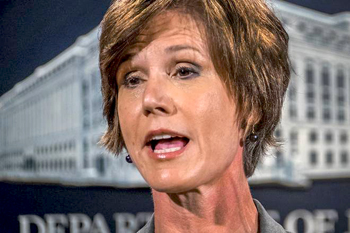
SallyIn a sharply worded statement, the White House called Sally Yates "weak on borders and very weak on illegal immigration" and also criticized Democrats for not yet confirming the appointment of attorney general-designate Jeff Sessions.

"The acting attorney general, Sally Yates, has betrayed the Department of Justice by refusing to enforce a legal order designed to protect the citizens of the United States," the White House said in a statement.

"This order was approved as to form and legality by the Department of Justice Office of Legal Counsel," it said.

"Tonight, President Trump relieved Ms Yates of her duties."

Federal prosecutor Dana Boente will serve as acting attorney general "until Senator Jeff Sessions is finally confirmed by the Senate, where he is being wrongly held up by Democrat senators for strictly political reasons," it said.

With Trump's White House facing multiple lawsuits and worldwide opprobrium over an order banning migrants from seven Muslim nations, Yates had whipped the rug from under her boss in a defiant and damaging parting shot.

In a memo to Department of Justice staff, Yates -- a career government lawyer promoted by Barack Obama -- expressed doubts about the legality and morality of Trump's decree, which has prompted mass protests.

"My responsibility is to ensure that the position of the Department of Justice is not only legally defensible, but is informed by our best view of what the law is," Yates wrote.

"I am not convinced that the defense of the executive order is consistent with these responsibilities nor am I convinced that the executive order is lawful," she added.

"For as long as I am the acting attorney general, the Department of Justice will not present arguments in defense of the executive order, unless and until I become convinced that it is appropriate to do so."

Yates's directive means that the US government, at least for now, has no authorized courtroom representation in the lawsuits.

It was a remarkable act of defiance against a tough-talking president who has showed little sign of brooking insubordination.

Sessions has not yet been confirmed by Congress. He faces a vote on the Senate Judiciary Committee Tuesday and must then be confirmed by the full Senate.

If confirmed, Sessions would almost certainly reverse course.

But Democratic lawmakers have vociferously opposed Trump's order and Republicans are privately seething over the way his White House has handled the issue.

The order signed on Friday suspended the arrival of all refugees for a minimum of 120 days, Syrian refugees indefinitely and bars citizens from Iran, Iraq, Libya, Somalia, Sudan, Syria and Yemen for 90 days.

Several federal judges have since filed temporary stays.

Firing Yates has uncomfortable echoes of President Richard Nixon's "Saturday night massacre" during the Watergate scandal.

Then, Nixon fired the Watergate special prosecutor, prompting the departures of his attorney general and deputy attorney general. The events catalyzed Nixon's impeachment.

On Sunday, attorneys general from 16 US states, including California and New York, condemned Trump's directive as "unconstitutional" and vowed to fight it.

Comments

PedoMhdFkdAmna
 - 
Tuesday, 31 Jan 2017

I hope all western countries ban Muslims forever

shaji
 - 
Tuesday, 31 Jan 2017

This shows the frustration of Trump and hope he will get more frustrations in the days to come for his unwise / illegal decisions which will effect US on all grounds. I hope public anger and disappoint towards Trump will grow day by day.

Add new comment

  • Coastaldigest.com reserves the right to delete or block any comments.
  • Coastaldigset.com is not responsible for its readers’ comments.
  • Comments that are abusive, incendiary or irrelevant are strictly prohibited.
  • Please use a genuine email ID and provide your name to avoid reject.
Agencies
August 3,2020

Manila, Aug 2: The number of COVID-19 cases in the Philippines has exceeded the 100,000 marks with a record 5,032 new infections registered on Sunday, the Health Ministry's data showed.

With the total cases now reaching 103,185, the spread of COVID-19 in the Southeast Asian nation is steeply rising. The daily growth rate just this Thursday set a record at over 3,800 cases, the next day there were nearly 4,000 new infections detected and on Saturday, over 4,800 cases were detected.

More than 65,000 people have recovered from the ailment, while 2,059 people have died.

The Philippines' epidemiological dynamic mirrors that of many Southeast Asian nations, where COVID-19 infections have only recently begun to climb. 

Most other nations in Europe and the Americas experienced an initial spread of the virus which later tailed off only to begin climbing again after easing of restrictions.

Comments

Add new comment

  • Coastaldigest.com reserves the right to delete or block any comments.
  • Coastaldigset.com is not responsible for its readers’ comments.
  • Comments that are abusive, incendiary or irrelevant are strictly prohibited.
  • Please use a genuine email ID and provide your name to avoid reject.
News Network
February 6,2020

Beijing, Feb 6: The number of confirmed fatalities from China's coronavirus outbreak rose to at least 560, after authorities in hardest-hit Hubei province reported 70 new deaths on February 6.

In its daily update, the health commission in Hubei also confirmed the number of confirmed infections in the outbreak has reached 28,018 nationwide with 3,694 new cases reported.

The epidemic, which has spiralled into a global health emergency, is believed to have emerged in December from a market that sold wild game in Hubei's capital Wuhan.

Hu Lishan, an official in Wuhan, warned Wednesday that despite building a hospital from scratch and converting public buildings to accommodate thousands of extra patients, there was still a "severe" lack of beds in the region.

There was also a shortage of "equipment and materials," he told reporters, adding that officials were looking to convert other hotels and schools in the city into treatment centres.

Authorities in several other cities in China have placed restrictions on the number of people allowed to leave their homes.

Global concerns have also risen about the virus, with cases confirmed in more than 20 countries.

Comments

Add new comment

  • Coastaldigest.com reserves the right to delete or block any comments.
  • Coastaldigset.com is not responsible for its readers’ comments.
  • Comments that are abusive, incendiary or irrelevant are strictly prohibited.
  • Please use a genuine email ID and provide your name to avoid reject.
News Network
March 3,2020

Mar 3: Just hours after the ending of a week-long “reduction” in violence that was crucial for Donald Trump’s peace deal in Afghanistan, the Taliban struck again: On Monday, they killed three people and injured about a dozen at a football match in Khost province. This resumption of violence will not surprise anyone actually invested in peace for that troubled country. The point of the U.S.-Taliban deal was never peace. It was to try and cover up an ignominious exit for the U.S., driven by an election-bound president who feels no responsibility toward that country or to the broader region.

Seen from South Asia, every point we know about in the agreement is a concession by Trump to the Taliban. Most importantly, it completes a long-term effort by the U.S. to delegitimize the elected government in Kabul — and, by extension, Afghanistan’s constitution. Afghanistan’s president is already balking at releasing 5,000 Taliban prisoners before intra-Afghan talks can begin — a provision that his government did not approve.

One particularly cringe-worthy aspect: The agreement refers to the Taliban throughout  as “the Islamic Emirate of Afghanistan that is not recognized by the United States as a state and is known as the Taliban.” This unwieldy nomenclature validates the Taliban’s claim to be a government equivalent to the one in Kabul, just not the one recognised at the moment by the U.S. When read together with the second part of the agreement, which binds the U.S. to not “intervene in [Afghanistan’s] domestic affairs,” the point is obvious: The Taliban is not interested in peace, but in ensuring that support for its rivals is forbidden, and its path to Kabul is cleared.

All that the U.S. has effectively gotten in return is the Taliban’s assurance that it will not allow the soil of Afghanistan to be used against the “U.S. and its allies.” True, the U.S. under Trump has shown a disturbing willingness to trust solemn assurances from autocrats; but its apparent belief in promises made by a murderous theocratic movement is even more ridiculous. Especially as the Taliban made much the same promise to an Assistant Secretary of State about Osama bin Laden while he was in the country plotting 9/11.

Nobody in the region is pleased with this agreement except for the Taliban and their backers in the Pakistani military. India has consistently held that the legitimate government in Kabul must be the basic anchor of any peace plan. Ordinary Afghans, unsurprisingly, long for peace — but they are, by all accounts, deeply skeptical about how this deal will get them there. The brave activists of the Afghan Women’s Network are worried that intra-Afghan talks will take place without adequate representation of the country’s women — who have, after all, the most to lose from a return to Taliban rule.

But the Pakistani military establishment is not hiding its glee. One retired general tweeted: “Big victory for Afghan Taliban as historic accord signed… Forced Americans to negotiate an accord from the position of parity. Setback for India.” Pakistan’s army, the Taliban’s biggest backer, longs to re-install a friendly Islamist regime in Kabul — and it has correctly estimated that, after being abandoned by Trump, the Afghan government will have sharply reduced bargaining power in any intra-Afghan peace talks. A deal with the Taliban that fails also to include its backers in the Pakistani military is meaningless.

India, meanwhile, will not see this deal as a positive for regional peace or its relationship with the U.S. It comes barely a week after Trump’s India visit, which made it painfully clear that shared strategic concerns are the only thing keeping the countries together. New Delhi remembers that India is not, on paper, a U.S. “ally.” In that respect, an intensification of terrorism targeting India, as happened the last time the U.S. withdrew from the region, would not even be a violation of Trump’s agreement. One possible outcome: Over time the government in New Delhi, which has resolutely sought to keep its ties with Kabul primarily political, may have to step up security cooperation. Nobody knows where that would lead.

The irresponsible concessions made by the U.S. in this agreement will likely disrupt South Asia for years to come, and endanger its own relationship with India going forward. But worst of all, this deal abandons those in Afghanistan who, under the shadow of war, tried to develop, for the first time, institutions that work for all Afghans. No amount of sanctimony about “ending America’s longest war” should obscure the danger and immorality of this sort of exit.

Comments

Add new comment

  • Coastaldigest.com reserves the right to delete or block any comments.
  • Coastaldigset.com is not responsible for its readers’ comments.
  • Comments that are abusive, incendiary or irrelevant are strictly prohibited.
  • Please use a genuine email ID and provide your name to avoid reject.