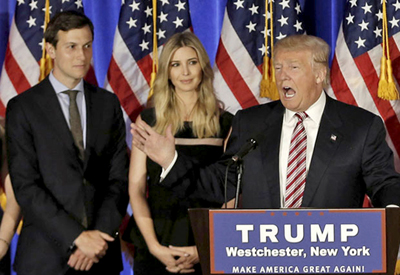
Trump names son-in-law as senior presidential advisor

January 10, 2017

New York, Jan 10: US President-elect Donald Trump announced that his son-in-law Jared Kushner, a property developer and publisher, will serve as senior White House advisor, flouting myriad legal and ethical concerns.

T advisorThe incoming Republican, who has never previously held elected office, said Kushner, who also has no political experience outside his father-in-law's campaign, would serve as "senior advisor to the president."

Kushner, whom Forbes estimates is worth USD 1.8 billion together with his parents and adult brother, will forego his salary while serving in the administration, said a statement from the transition team.

The 35-year-old will work closely with White House chief of staff Reince Priebus and chief strategist Steve Bannon to execute Trump's agenda, it added.

"Jared has been a tremendous asset and trusted advisor throughout the campaign and transition and I am proud to have him in a key leadership role in my administration," Trump announced yesterday.

"He has been incredibly successful, in both business and now politics. He will be an invaluable member of my team as I set and execute an ambitious agenda, putting the American people first," he added.

Priebus called Kushner "a visionary with a rare ability to communicate with and assemble broad coalitions of support" and said his "open mind, adaptability and keen intellect" would be a "great asset" to the team.

Kushner welcomed the appointment as "an honor" and said he was "humbled" by the opportunity to serve.

Comments

shaji
 - 
Tuesday, 10 Jan 2017

Good move by anogther Feku. Next he will appoint his sons as FBI chief, his sister in law as Home secretary, his Father in law as Bank of America chief, his mother in law as home minister etc etc. Good move. Keep going on dear and enjoy your stay as new President

Add new comment

  • Coastaldigest.com reserves the right to delete or block any comments.
  • Coastaldigset.com is not responsible for its readers’ comments.
  • Comments that are abusive, incendiary or irrelevant are strictly prohibited.
  • Please use a genuine email ID and provide your name to avoid reject.
News Network
January 30,2020

Jan 30: The death toll rose to 170 in the new virus outbreak in China on Thursday as foreign evacuees from the worst-hit region begin returning home under close observation and world health officials expressed “great concern” that the disease is starting to spread between people outside of China.

Thursday’s figures cover the previous 24 hours and represent an increase of 38 deaths and 1,737 cases for a total of 7,711. Of the new deaths, 37 were in the epicenter of the outbreak in Hubei province and one in the southwestern province of Sichuan.

The news comes as the 195 Americans evacuated from Wuhan, the Hubei province city of 11 million where the outbreak originated, are undergoing three days of testing and monitoring at a Southern California military base to make sure they do not show signs of the virus.

A group of 210 Japanese evacuees from Wuhan landed Thursday at Tokyo’s Haneda airport on a second government chartered flight, according to the foreign ministry. Reports said nine of those aboard the flight showed signs of cough and fever. Three of the 206 Japanese who returned on Wednesday tested positive for the new coronavirus, Prime Minister Shinzo Abe said during a parliamentary session. Two of them showed no symptoms of the disease.

France, New Zealand, Australia and other countries are also pulling out their citizens or making plans to do so.

The World Health Organization emergencies chief said the few cases of human-to-human spread of the virus outside China — in Japan, Germany, Canada and Vietnam — were of “great concern” and were part of the reason the U.N. health agency’s director-general was reconvening a committee of experts on Thursday to assess whether the outbreak should be declared a global emergency.

The new virus has now infected more people in China than were sickened there during the 2002-2003 SARS outbreak.

Dr. Michael Ryan spoke at a news conference in Geneva on Wednesday after returning from a trip to Beijing to meet with Chinese President Xi Jinping and other senior government leaders. He said China was taking “extraordinary measures in the face of an extraordinary challenge” posed by the outbreak.

To date, about 99% of the cases are in China. Ryan estimated the death rate of the new virus at 2%, but said the figure was very preliminary. With fluctuating numbers of cases and deaths, scientists are only able to produce a rough estimate of the fatality rate and it’s likely many milder cases of the virus are being missed.

In comparison, the SARS virus killed about 10% of people who caught it. The new virus is from the coronavirus family, which includes those that can cause the common cold as well as more serious illnesses such as SARS and MERS.

Scientists say there are many questions to be answered about the new virus, including just how easily it spreads and how severe it is.

In a report published Wednesday, Chinese researchers suggested that person-to-person spread among close contacts occurred as early as mid-December.

“Considerable efforts” will be needed to control the spread if this ratio holds up elsewhere, researchers wrote in the report, published in the New England Journal of Medicine.

More than half of the cases in which symptoms began before Jan. 1 were tied to a seafood market, but only 8% of cases after that have been, researchers found. They reported the average incubation period was five days.

Comments

Add new comment

  • Coastaldigest.com reserves the right to delete or block any comments.
  • Coastaldigset.com is not responsible for its readers’ comments.
  • Comments that are abusive, incendiary or irrelevant are strictly prohibited.
  • Please use a genuine email ID and provide your name to avoid reject.
News Network
February 26,2020

Feb 26: Looking out over the world’s largest cricket stadium, the seats jammed with more than 100,000 people, India’s prime minister heaped praise on his American visitor.

“The leadership of President Trump has served humanity,” Prime Minister Narendra Modi said Monday, highlighting Trump’s fight against terrorism and calling his 36-hour visit to India a watershed in India-U.S. relations.

The crowds cheered. Trump beamed.

“The ties between India and the U.S. are no longer just any other partnership,” Modi said. “It is a far greater and closer relationship.”

India, it seems, loves Donald Trump. It seemed obvious from the thousands who turned out to wave as his motorcade snaked through the city of Ahmedabad, and from the tens of thousands who filled the city’s new stadium. It seemed obvious from the hug that Modi gave Trump after he descended from Air Force One, and from the hundreds of billboards proclaiming Trump’s visit.

But it’s not so simple.

Because while Trump is genuinely popular in India, his clamorous and carefully choreographed welcome was also about Asian geopolitics, China’s growing power and a masterful Indian politician who gave his American visitor exactly what he wanted.

Modi “is doing this not necessarily because he loves Trump,” said Tanvi Madan, the director of the India Project at the Brookings Institution in Washington, D.C. “It’s very much about Trump as the leader of the U.S. and recognizing what it is that Trump himself likes.”

Trump likes crowds — big crowds — and the foot soldiers of India’s political parties have long known how to corral enough people to make any politician look popular. In a city like Ahmedabad, the capital of Modi’s home state of Gujarat and the center of his power base, it wouldn’t take much effort to fill a cavernous sports stadium. It was more surprising that a handful of seats remained empty, and that some in the stands had left even before Trump had finished his speech.

For India, good relations with the U.S. are deeply important: They signal that India is a serious global player, an issue that has long been important to New Delhi, and help cement an alliance that both nations see as a counterweight to China’s rise.

“For both countries, their biggest rival is China,” said John Echeverri-Gent, a professor at the University of Virginia whose research often focuses on India. “China is rapidly expanding its presence in the Indian Ocean, which India has long considered its backyard and its exclusive realm for security concerns.”

“It’s very clearly a major concern for both India and the United States,” he said.

Trump isn’t the first U.S. president that Modi has courted. In 2015, then-President Barack Obama was the first American chief guest at India’s Republic Day parade, a powerful symbolic gesture. Obama also got a Modi hug, and the media in both countries were soon writing about the two leaders’ “bromance.”

Trump is popular in India, even if some of that is simply because he’s the U.S. president. A 2019 Pew Research Center poll showed that 56% of Indians had confidence in Trump’s abilities in world affairs, one of only a handful of countries where he has that level of approval. But Obama was also popular: Before he left office, he had 58% approval in world affairs among Indians.

The Pew poll also indicated that Trump’s support was higher among supporters of Modi’s Hindu nationalist party.

That’s not surprising. Both men have fired up their nationalist bases with anti-Muslim rhetoric and government policies, from Trump’s travel bans to Modi’s crackdown in Kashmir, India’s only Muslim-majority state.

And Trump’s Indian support is far from universal. Protests against his trip roiled cities from New Delhi to Hyderabad to the far northeastern city of Gauhati, although those demonstrations were mostly overshadowed by protests over a new Indian citizenship law that Modi backs.

Modi, who is widely popular in India, has faced weeks of protests over the law, which provides fast track naturalization for some foreign-born religious minorities — but not Muslims. While Trump talked about ties with India on Tuesday, Hindus and Muslims fought in violent clashes that left at least 10 people dead over two days.

In some ways, Modi and Trump are powerful echoes of each other.

They have overlapping political styles. Both are populists who see themselves as brash, rule-breaking outsiders who disdain their countries’ traditional elites. Both are seen by their critics as having authoritarian leanings. Both surround themselves with officials who rarely question their decisions.

But are they friends?

Trump says yes. “Really, we feel very strongly about each other,” he said at a New Delhi press briefing.

But many observers aren’t so sure.

“The question is how much of this is real chemistry, as opposed to what I’d call planned chemistry” orchestrated for diplomatic reasons, said Madan. “It’s so hard to know if you’re not in the room.”

Certainly, Modi understands America’s importance to India. While the two countries continue to bicker about trade issues, the prime minister organized a welcome that impressed even India’s news media, which have watched countless choreographed mass political rallies.

“There is no other country for whose leader India would hold such an event, and for which an Indian prime minister would lavish such rhetoric,” the Hindustan Times said in an editorial.

“The spectacle and the sound were worth a thousand agreements.”

Comments

Add new comment

  • Coastaldigest.com reserves the right to delete or block any comments.
  • Coastaldigset.com is not responsible for its readers’ comments.
  • Comments that are abusive, incendiary or irrelevant are strictly prohibited.
  • Please use a genuine email ID and provide your name to avoid reject.
News Network
July 1,2020

Melbourne, July 1: Authorities will lock down around 300,000 people in suburbs north of Melbourne for a month from late on Wednesday to contain the risk of infection after two weeks of double-digit rises in new coronavirus cases in Australia's second-most populous state.

Australia has fared better than many countries in the pandemic, with around 7,830 cases and 104 deaths, but the recent surge has stoked fears of a second wave of COVID-19, echoing concerns expressed in other countries.

Globally, coronavirus cases exceeded 10 million on Sunday, a major milestone in the spread of a disease that has killed more than half a million people in seven months.

From midnight, more than 30 suburbs in Australia's second-biggest city will return to stage three restrictions, the third-strictest level in curbs to control the pandemic. That means residents will be confined to home except for grocery shopping, health appointments, work or caregiving, and exercise.

The restrictions will be accompanied by a testing blitz that authorities hope will extend to half the population of the area affected, and for which borders will be patrolled, authorities said. The measures come as curbs ease across the rest of the state of Victoria, with restaurants, gyms and cinemas reopening in recent weeks.

Victoria recorded 73 fresh cases on Tuesday from 20,682 tests, following an increase of 75 cases on Monday. State premier Daniel Andrews warned on Wednesday that the return of broader restrictions across city remained a possibility.

"If we all stick together these next four weeks, we can regain control of that community transmission ... across metropolitan Melbourne," Andrews said at a briefing. "Ultimately if I didn't shut down those postcodes I'd be shutting down all postcodes. We want to avoid that."

Victoria's spike in cases has been linked to staff members at hotels housing returned travellers for which quarantine protocols were not strictly followed. Victorian state authorities have announced an investigation into the matter.

Some other Australian states and territories are preparing to open borders, but applying limits and quarantine measures to citizens of Victoria as the school holiday season gets under way.

South Australia, the country's fifth most populous state, has had just three new cases in the past month. But citing the spike in coronavirus infections, on Tuesday it cancelled its scheduled reopening to other parts of the nation.

New South Wales (NSW), Australia's most populous state, has stopped short of closing its borders to all Victorians, but those holidaying from hotspot areas - not permitted under NSW rules - can be handed a fine of A$11,000 ($7,596) or jailed if they are detected, state authorities said.

The delays reopening internal borders cast doubts over a federal plan to set up "travel bubble" with neighbouring New Zealand that would allow movement between the two countries.

Comments

Add new comment

  • Coastaldigest.com reserves the right to delete or block any comments.
  • Coastaldigset.com is not responsible for its readers’ comments.
  • Comments that are abusive, incendiary or irrelevant are strictly prohibited.
  • Please use a genuine email ID and provide your name to avoid reject.