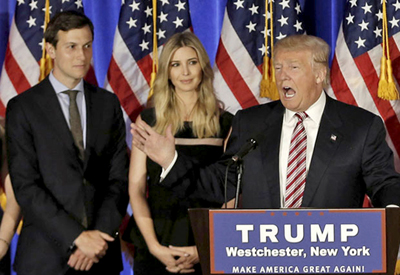
Trump names son-in-law as senior presidential advisor

January 10, 2017

New York, Jan 10: US President-elect Donald Trump announced that his son-in-law Jared Kushner, a property developer and publisher, will serve as senior White House advisor, flouting myriad legal and ethical concerns.

T advisorThe incoming Republican, who has never previously held elected office, said Kushner, who also has no political experience outside his father-in-law's campaign, would serve as "senior advisor to the president."

Kushner, whom Forbes estimates is worth USD 1.8 billion together with his parents and adult brother, will forego his salary while serving in the administration, said a statement from the transition team.

The 35-year-old will work closely with White House chief of staff Reince Priebus and chief strategist Steve Bannon to execute Trump's agenda, it added.

"Jared has been a tremendous asset and trusted advisor throughout the campaign and transition and I am proud to have him in a key leadership role in my administration," Trump announced yesterday.

"He has been incredibly successful, in both business and now politics. He will be an invaluable member of my team as I set and execute an ambitious agenda, putting the American people first," he added.

Priebus called Kushner "a visionary with a rare ability to communicate with and assemble broad coalitions of support" and said his "open mind, adaptability and keen intellect" would be a "great asset" to the team.

Kushner welcomed the appointment as "an honor" and said he was "humbled" by the opportunity to serve.

Comments

shaji
 - 
Tuesday, 10 Jan 2017

Good move by anogther Feku. Next he will appoint his sons as FBI chief, his sister in law as Home secretary, his Father in law as Bank of America chief, his mother in law as home minister etc etc. Good move. Keep going on dear and enjoy your stay as new President

Add new comment

  • Coastaldigest.com reserves the right to delete or block any comments.
  • Coastaldigset.com is not responsible for its readers’ comments.
  • Comments that are abusive, incendiary or irrelevant are strictly prohibited.
  • Please use a genuine email ID and provide your name to avoid reject.
News Network
June 4,2020

Jun 4: A malaria drug President Donald Trump took to try to prevent COVID-19 proved ineffective for that in the first large, high-quality study to test it in people in close contact with someone with the disease.

Results published Wednesday by the New England Journal of Medicine show that hydroxychloroquine was no better than placebo pills at preventing illness from the coronavirus.

The drug did not seem to cause serious harm, though -- about 40% on it had side effects, mostly mild stomach problems.

 “We were disappointed. We would have liked for this to work,” said the study leader, Dr. David Boulware, an infectious disease specialist at the University of Minnesota.

“But our objective was to answer the question and to conduct a high-quality study,” because the evidence on the drug so far has been inconclusive, he said.

Hydroxychloroquine and a similar drug, chloroquine, have been the subject of much debate since Trump started promoting them in March.

Hydroxychloroquine has long been used for malaria, lupus, and rheumatoid arthritis, but no large studies have shown it or chloroquine to be safe or effective for much sicker patients with coronavirus, and some studies have suggested the drugs may do harm.

Trump took a two-week course of hydroxychloroquine, along with zinc and Vitamin D, after two staffers tested positive for COVID-19, and had no ill effects, according to results of his latest physical released by his doctor Wednesday.

Federal regulators have warned against hydroxychloroquine's use except in hospitals and formal studies because of the risk of side effects, especially heart rhythm problems.

Boulware's study involved 821 people in the United States and Canada living with someone diagnosed with COVID-19 or at high risk of getting it because of their job -- doctors, nurses, ambulance workers who had significant exposure to a sick patient while not wearing full protective gear.

They were randomly assigned to get either the nutrient folate as a placebo or hydroxychloroquine for five days, starting within four days of their exposure. Neither they nor others involved in the research knew who was getting which pills.

After 14 days in the study, 12 per cent on the drug developed COVID-19 symptoms versus 14 per cent in the placebo group, but the difference is so small it could have occurred by chance, Boulware said.

“There's basically no effect. It does not prevent infection,” he said of the drug. Even if it were to give some slim advantage, “we'd want a much larger effect” to justify its use and risk of side effects for preventing illness, he said.

Results were no different among a subgroup of participants who were taking zinc or vitamin C, which some people believe might help make hydroxychloroquine more effective or fight the coronavirus.

There are some big caveats: The study enrolled people through the Internet and social media, relying on them to report their own symptoms rather than having them tracked in a formal way by doctors.

Participants were not all tested for the coronavirus but were diagnosed as COVID-19 cases based on symptoms in many cases. And not all took their medicines as directed.

The results “are more provocative than definitive,” and the drug may yet have prevention benefits if tried sooner or in a different way, Dr. Myron Cohen of the University of North Carolina at Chapel Hill wrote in a commentary in the journal.

Others were glad to see a study that had a comparison group and good scientific methods after so many weaker reports on hydroxychloroquine.

“This fits with everything else we've seen so far which suggests that it's not beneficial," said Dr. Peter Bach, director of a health policy center at Memorial Sloan Kettering Cancer Center in New York.

This study was in younger relatively healthy people, but the results “would make me very discouraged about trying to use this in older people” who are most vulnerable to serious illness from the coronavirus, Bach said.

“If it does work, it doesn't work very well.” Dr. Dan Culver, a lung specialist at the Cleveland Clinic, said there's still a chance that giving the drug sooner than four days after someone's exposure to the virus may help prevent illness.

But the study “takes 'home run' off the table” as far as hopes for the drug, he said.

The study was mostly funded by David Baszucki, founder of Roblox, a California-based game software company, and other private donors and the Minnesota university.

Boulware also is leading a study testing hydroxychloroquine for treating COVID-19. The study is finished and results are being analyzed now.

On Tuesday, the journal Lancet posted an “expression of concern” about a study it published earlier this month of nearly 15,000 COVID-19 patients on the malaria drugs that tied their use to a higher risk of dying in the hospital or developing a heartbeat problem.

Scientists have raised serious questions about the database used for that study, and its authors have launched an independent audit.

That work had a big impact: the World Health Organization suspended use of hydroxychloroquine in a study it is leading, and French officials stopped the drug's use in hospitals. On Wednesday, the WHO said experts who reviewed safety information decided that its study could resume.


Comments

Add new comment

  • Coastaldigest.com reserves the right to delete or block any comments.
  • Coastaldigset.com is not responsible for its readers’ comments.
  • Comments that are abusive, incendiary or irrelevant are strictly prohibited.
  • Please use a genuine email ID and provide your name to avoid reject.
News Network
May 15,2020

Washington, May 15: A top US senator has unveiled an 18-point plan, including enhancing military ties with India, to hold the Chinese government accountable for its "lies, deception, and cover-ups" that ultimately led to the global COVID-19 pandemic.

The prominent suggestions are moving manufacturing chain from China and deepening military-strategic ties with India, Vietnam and Taiwan.

"The Chinese government maliciously covered up and enabled a global pandemic that has caused misery for so many Americans. This is the same regime that locks up its own citizens in labour camps, steals America's technology and jobs, and threatens the sovereignty of our allies,” said Senator Thom Tillis, presenting his detailed, 18-point plan on Thursday.

"This is a major wake-up call to the United States and the rest of the free world. My plan of action will hold the Chinese government accountable for lying about COVID-19; sanctioning the Chinese government while protecting America's economy, public health, and national security," he said.

The plan seeking to create a Pacific Deterrence Initiative and immediately approve the military's request for USD 20 billion in funding. It also calls for deepening military ties with regional allies and expand equipment sales to India, Taiwan and Vietnam.

Encourage Japan to rebuild its military and offer Japan and South Korea sales of offensive military equipment, it said.

"Move manufacturing back to the US from China and gradually eliminate our supply chain dependency on China. Stop China from stealing our technology and provide incentives to American companies to regain our technological advantage. Strengthen cybersecurity against Chinese hacks and sabotage," the plan stated.

"Prevent American taxpayer money from being used by the Chinese government to pay off their debt. Implement the US ban on (Chinese technology company) Huawei and coordinate with our allies to implement similar bans,” it added.

The plan seeks restitution from the Chinese government and imposition of sanctions for lying about the virus. It further said China should be sanctioned for their atrocious human rights record.

Senator Tillis' plan urges the Trump Administration to formally request the International Olympic Committee to withdraw the 2022 Winter Olympics from Beijing.

"Stop China's propaganda campaign inside the United States. Treat Chinese government-run media outlets as the propaganda proxies that they are," the plan stated.

Urging the government to investigate the Chinese government's cover-up of the spread of COVID-19, the plan also seeks to investigate America's reliance on China's supply chains and threats to public safety and national security.

"Ensure the independence of the WHO through investigations and reform. Expose and counter China's predatory debt-trap diplomacy targeting developing countries. Increase intelligence sharing on potential pandemics and lead the creation of a watchdog organization to monitor foreign governments' handling of deadly viruses," Tillis said in his suggestions.

The coronavirus, which first emerged in China's Wuhan city in December last, has killed over 3,00,000 people with 4.3 million confirmed cases across the world. More than a quarter of all confirmed COVID-19 cases are from the US.

There has been increasing pressure on the President Trump, in the last several weeks, to take action against China as lawmakers and opinion-makers feel that the COVID-19 spread across the world from Wuhan because of Chinese inaction.

Meanwhile, Senator John Barrasso, in a speech on the Senate floor on Thursday, highlighted the need to update the Foreign Intelligence Surveillance Act (FISA) legislation that was put on hold by the coronavirus pandemic.

"The virus could have been contained had it not been for the Chinese Government's unscrupulous cover-up. China knew the risk months before the rest of the world; yet Chinese communist leaders destroyed key evidence, they under-reported the number of coronavirus cases, and they misled the world about its deadly, rapid spread," he said.

Asserting that the virus should have been contained in Wuhan, he said tens and tens of thousands of Americans and hundreds of thousands of people worldwide have died as a result of China's failure.

Barrasso said the US should encourage its companies to create American and western supply chains. "That way our frontline workers have what they need in the time of crisis," he said.

"Not again, not ever will we be exclusively sourced for critical drugs from China. We should diversify supply and bring home as much of our supply chain as possible," he added.

Congressman Troy Balderson introduced bicameral legislation with Congressman Doug Collins and Senator Lindsey Graham that will hold China accountable for deceptive actions taken by its leaders that led to the spread and subsequent global pandemic.

The COVID-19 Accountability Act authorises president Donald Trump to impose sanctions on China if it fails to cooperate with a full investigation led by the US or its allies into the events that lead to the COVID-19 outbreak.

"The number of Ohioan lives needlessly claimed by this pandemic could have been significantly reduced had China taken appropriate measures to control the virus' spread and disclose its severity," said Balderson.

"The United States can't look the other way when China so recklessly compromised worldwide health and the global economy. China and its Communist Party leadership must be held accountable," he said.

Comments

WHO
 - 
Monday, 18 May 2020

Hahah LOL..


go back to past 20 year...from 2000 to 2020..all your sins are boiling now.


millions of innocent life has been taking by so called AMERICA in middle east.


now come to the point

The great GOD Vs USA

GOD: 4 Million+

USA and allied : 0


throw your nuke weapon to sea...no use

you cant fight God s tiny microorganisms...humans are just a thing.


USA will get 0.5 million death and 10 million infection...20 years of  sin must be given with interest

Add new comment

  • Coastaldigest.com reserves the right to delete or block any comments.
  • Coastaldigset.com is not responsible for its readers’ comments.
  • Comments that are abusive, incendiary or irrelevant are strictly prohibited.
  • Please use a genuine email ID and provide your name to avoid reject.
News Network
March 5,2020

Washington, Feb 5: Experts warned a US government panel last night that India's Muslims face risks of expulsion and persecution under the country’s new Citizenship Amendment Act (CAA) which has triggered major protests.

The hearing held inside Congress was called by the US Commission on International Freedom, which has been denounced by the Indian government as biased.

Ashutosh Varshney, a prominent scholar of sectarian violence in India, told the panel that the law championed by prime minister Narendra Modi's government amounted to a move to narrow the democracy's historically inclusive and secular definition of citizenship.

"The threat is serious, and the implications quite horrendous," said Varshney, a professor at Brown University.

"Something deeply injurious to the Muslim minority can happen once their citizenship rights are taken away," he said.

Varshney warned that the law could ultimately lead to expulsion or detention -- but, even if not, contributes to marginalization.

"It creates an enabling atmosphere for violence once you say that a particular community is not fully Indian or its Indianness in grave doubt," he said.

India's parliament in December passed a law that fast-tracks citizenship for persecuted non-Muslim minorities from neighboring countries.

Responding to criticism at the time from the US commission, which advises but does not set policy, India's External Affairs Ministry said the law does not strip anyone's citizenship and "should be welcomed, not criticized, by those who are genuinely committed to religious freedom."

Fears are particularly acute in Assam, where a citizens' register finalized last year left 1.9 million people, many of them Muslims, facing possible statelessness.

Aman Wadud, a human rights lawyer from Assam who traveled to Washington for the hearing, said that many Indians lacked birth certificates or other documentation to prove citizenship and were only seeking "a dignified life."

The hearing did not exclusively focus on India, with commissioners and witnesses voicing grave concern over Myanmar's refusal to grant citizenship to the Rohingya, the mostly Muslim minority that has faced widespread violence.

Gayle Manchin, the vice chair of the commission, also voiced concern over Bahrain's stripping of citizenship from activists of the Shiite majority as well as a new digital ID system in Kenya that she said risks excluding minorities.

More than 40 people were killed last week in New Delhi in sectarian violence sparked by the citizenship law.

India on Tuesday lodged another protest after the UN human rights chief, Michele Bachelet, sought to join a lawsuit in India that challenges the citizenship law's constitutionality.

Comments

Add new comment

  • Coastaldigest.com reserves the right to delete or block any comments.
  • Coastaldigset.com is not responsible for its readers’ comments.
  • Comments that are abusive, incendiary or irrelevant are strictly prohibited.
  • Please use a genuine email ID and provide your name to avoid reject.