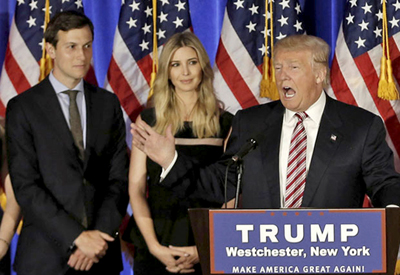
Trump names son-in-law as senior presidential advisor

January 10, 2017

New York, Jan 10: US President-elect Donald Trump announced that his son-in-law Jared Kushner, a property developer and publisher, will serve as senior White House advisor, flouting myriad legal and ethical concerns.

T advisorThe incoming Republican, who has never previously held elected office, said Kushner, who also has no political experience outside his father-in-law's campaign, would serve as "senior advisor to the president."

Kushner, whom Forbes estimates is worth USD 1.8 billion together with his parents and adult brother, will forego his salary while serving in the administration, said a statement from the transition team.

The 35-year-old will work closely with White House chief of staff Reince Priebus and chief strategist Steve Bannon to execute Trump's agenda, it added.

"Jared has been a tremendous asset and trusted advisor throughout the campaign and transition and I am proud to have him in a key leadership role in my administration," Trump announced yesterday.

"He has been incredibly successful, in both business and now politics. He will be an invaluable member of my team as I set and execute an ambitious agenda, putting the American people first," he added.

Priebus called Kushner "a visionary with a rare ability to communicate with and assemble broad coalitions of support" and said his "open mind, adaptability and keen intellect" would be a "great asset" to the team.

Kushner welcomed the appointment as "an honor" and said he was "humbled" by the opportunity to serve.

Comments

shaji
 - 
Tuesday, 10 Jan 2017

Good move by anogther Feku. Next he will appoint his sons as FBI chief, his sister in law as Home secretary, his Father in law as Bank of America chief, his mother in law as home minister etc etc. Good move. Keep going on dear and enjoy your stay as new President

Add new comment

  • Coastaldigest.com reserves the right to delete or block any comments.
  • Coastaldigset.com is not responsible for its readers’ comments.
  • Comments that are abusive, incendiary or irrelevant are strictly prohibited.
  • Please use a genuine email ID and provide your name to avoid reject.
News Network
February 12,2020

Feb 12: China on Wednesday reported another drop in the number of new cases of a viral infection and 97 more deaths, pushing the total dead past 1,100 as postal services worldwide said delivery was being affected by the cancellation of many flights to China.

The National Health Commission said 2,015 new cases had been reported over the last 24 hours, declining for a second day. The total number of cases in mainland China reached 44,653, although many experts say a large number of others infected have gone uncounted.

The additional deaths raised the mainland toll to 1,113. Two people have died elsewhere, one in Hong Kong and one in the Philippines.

In the port city of Tianjin, just southeast of Beijing, a cluster of cases has been traced to a department store in Baodi district. One-third of Tianjin’s 104 confirmed cases are in Baodi, the Xinhua state news agency reported.

A salesperson working in the store’s small home appliance section became the first individual in the cluster to be diagnosed on Jan. 31, Xinhua said. The store was already closed at that point, then disinfected on Feb. 1. Nevertheless, several more diagnoses soon followed.

The next to have their infections confirmed were also salespeople at the store. They had not visited Wuhan recently and, with the exception of one married couple, the patients worked in different sections of the store and did not know one another, according to Xinhua.

Japan’s Health Ministry said that 39 new cases have been confirmed on a cruise ship quarantined at Yokohama, bringing the total to 174 on the Diamond Princess.

The U.S. Postal Service said that it was “experiencing significant difficulties” in dispatching letters, parcels and express mail to China, including Hong Kong and Macau.

Both the U.S. and Singapore Post said in notes to their global counterparts that they are no longer accepting items destined for China, “until sufficient transport capacity becomes available.”

The Chinese mail service, China Post, said it was disinfecting postal offices, processing centers and vehicles to ensure the virus doesn’t spread via the mail and to protect staff.

It said the crisis is also impacting mail that transits China to other destinations including North Korea, Kazakhstan, Kyrgyzstan, Mongolia, Tajikistan, Turkmenistan, Uzbekistan and Vietnam.

The World Health Organization has named the disease caused by the virus as COVID-19, avoiding any animal or geographic designation to avoid stigmatization and to show the illness comes from a new coronavirus discovered in 2019.

The illness was first reported in December and connected to a food market in the central Chinese city of Wuhan, where the outbreak has largely been concentrated.

Zhong Nanshan, a leading Chinese epidemiologist, said that while the virus outbreak in China may peak this month, the situation at the center of the crisis remains more challenging.

“We still need more time of hard working in Wuhan,” he said, describing the isolation of infected patients there a priority.

“We have to stop more people from being infected,” he said. “The problem of human-to-human transmission has not yet been resolved.”

Without enough facilities to handle the number of cases, Wuhan has been building prefabricated hospitals and converting a gym and other large spaces to house patients and try to isolate them from others.

China’s official media reported Tuesday that the top health officials in Hubei province, of which Wuhan is the capital, have been relieved of their duties. No reasons were given, although the province’s initial response was deemed slow and ineffective. Speculation that higher-level officials could be sacked has simmered, but doing so could spark political infighting and be a tacit admission of responsibility.

The virus outbreak has become the latest political challenge for the party and its leader, Xi Jinping, who despite accruing more political power than any Chinese leader since Mao Zedong, has struggled to handle crises on multiple fronts. These include a sharply slowing domestic economy, the trade war with the U.S. and pushback on China’s increasingly aggressive foreign policies.

China is struggling to restart its economy after the annual Lunar New Year holiday was extended to try to curb the spread of the virus. About 60 million people are under virtual quarantine and many others are still working at home.

In Hong Kong, the diagnosis of four people living in an apartment building prompted worried comparisons with the deadly SARS pandemic of 17 years ago.

More than 100 people were evacuated from the building after a 62-year-old woman diagnosed with the virus was found living 10 floors directly below a man who was earlier confirmed with the virus.

Health officials called it a precautionary measure and sought to assuage fears of an epidemic, dismissing similarities to the SARS community outbreak at the Amoy Gardens housing estate in 2003.

Comments

Add new comment

  • Coastaldigest.com reserves the right to delete or block any comments.
  • Coastaldigset.com is not responsible for its readers’ comments.
  • Comments that are abusive, incendiary or irrelevant are strictly prohibited.
  • Please use a genuine email ID and provide your name to avoid reject.
News Network
February 26,2020

Feb 26: Looking out over the world’s largest cricket stadium, the seats jammed with more than 100,000 people, India’s prime minister heaped praise on his American visitor.

“The leadership of President Trump has served humanity,” Prime Minister Narendra Modi said Monday, highlighting Trump’s fight against terrorism and calling his 36-hour visit to India a watershed in India-U.S. relations.

The crowds cheered. Trump beamed.

“The ties between India and the U.S. are no longer just any other partnership,” Modi said. “It is a far greater and closer relationship.”

India, it seems, loves Donald Trump. It seemed obvious from the thousands who turned out to wave as his motorcade snaked through the city of Ahmedabad, and from the tens of thousands who filled the city’s new stadium. It seemed obvious from the hug that Modi gave Trump after he descended from Air Force One, and from the hundreds of billboards proclaiming Trump’s visit.

But it’s not so simple.

Because while Trump is genuinely popular in India, his clamorous and carefully choreographed welcome was also about Asian geopolitics, China’s growing power and a masterful Indian politician who gave his American visitor exactly what he wanted.

Modi “is doing this not necessarily because he loves Trump,” said Tanvi Madan, the director of the India Project at the Brookings Institution in Washington, D.C. “It’s very much about Trump as the leader of the U.S. and recognizing what it is that Trump himself likes.”

Trump likes crowds — big crowds — and the foot soldiers of India’s political parties have long known how to corral enough people to make any politician look popular. In a city like Ahmedabad, the capital of Modi’s home state of Gujarat and the center of his power base, it wouldn’t take much effort to fill a cavernous sports stadium. It was more surprising that a handful of seats remained empty, and that some in the stands had left even before Trump had finished his speech.

For India, good relations with the U.S. are deeply important: They signal that India is a serious global player, an issue that has long been important to New Delhi, and help cement an alliance that both nations see as a counterweight to China’s rise.

“For both countries, their biggest rival is China,” said John Echeverri-Gent, a professor at the University of Virginia whose research often focuses on India. “China is rapidly expanding its presence in the Indian Ocean, which India has long considered its backyard and its exclusive realm for security concerns.”

“It’s very clearly a major concern for both India and the United States,” he said.

Trump isn’t the first U.S. president that Modi has courted. In 2015, then-President Barack Obama was the first American chief guest at India’s Republic Day parade, a powerful symbolic gesture. Obama also got a Modi hug, and the media in both countries were soon writing about the two leaders’ “bromance.”

Trump is popular in India, even if some of that is simply because he’s the U.S. president. A 2019 Pew Research Center poll showed that 56% of Indians had confidence in Trump’s abilities in world affairs, one of only a handful of countries where he has that level of approval. But Obama was also popular: Before he left office, he had 58% approval in world affairs among Indians.

The Pew poll also indicated that Trump’s support was higher among supporters of Modi’s Hindu nationalist party.

That’s not surprising. Both men have fired up their nationalist bases with anti-Muslim rhetoric and government policies, from Trump’s travel bans to Modi’s crackdown in Kashmir, India’s only Muslim-majority state.

And Trump’s Indian support is far from universal. Protests against his trip roiled cities from New Delhi to Hyderabad to the far northeastern city of Gauhati, although those demonstrations were mostly overshadowed by protests over a new Indian citizenship law that Modi backs.

Modi, who is widely popular in India, has faced weeks of protests over the law, which provides fast track naturalization for some foreign-born religious minorities — but not Muslims. While Trump talked about ties with India on Tuesday, Hindus and Muslims fought in violent clashes that left at least 10 people dead over two days.

In some ways, Modi and Trump are powerful echoes of each other.

They have overlapping political styles. Both are populists who see themselves as brash, rule-breaking outsiders who disdain their countries’ traditional elites. Both are seen by their critics as having authoritarian leanings. Both surround themselves with officials who rarely question their decisions.

But are they friends?

Trump says yes. “Really, we feel very strongly about each other,” he said at a New Delhi press briefing.

But many observers aren’t so sure.

“The question is how much of this is real chemistry, as opposed to what I’d call planned chemistry” orchestrated for diplomatic reasons, said Madan. “It’s so hard to know if you’re not in the room.”

Certainly, Modi understands America’s importance to India. While the two countries continue to bicker about trade issues, the prime minister organized a welcome that impressed even India’s news media, which have watched countless choreographed mass political rallies.

“There is no other country for whose leader India would hold such an event, and for which an Indian prime minister would lavish such rhetoric,” the Hindustan Times said in an editorial.

“The spectacle and the sound were worth a thousand agreements.”

Comments

Add new comment

  • Coastaldigest.com reserves the right to delete or block any comments.
  • Coastaldigset.com is not responsible for its readers’ comments.
  • Comments that are abusive, incendiary or irrelevant are strictly prohibited.
  • Please use a genuine email ID and provide your name to avoid reject.
Agencies
July 28,2020

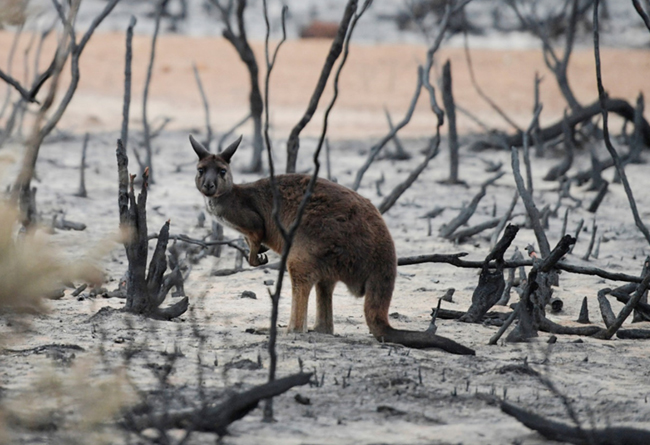
Sydney, Jul 28: Nearly 3 billion koalas, kangaroos and other native Australian animals were killed or displaced by bushfires in 2019 and 2020, a study by the World Wide Fund for Nature (WWF) said on Tuesday, triple the group's earlier estimates.

Some 143 million mammals, 2.46 billion reptiles, 180 million birds and 51 million frogs were impacted by the country's worst bushfires in decades, the WWF said.

When the fires were still blazing, the WWF estimated the number of affected animals at 1.25 billion. The fires destroyed more than 11 million hectares (37 million acres) across the Australian southeast, equal to about half the area of the United Kingdom.

"This ranks as one of the worst wildlife disasters in modern history," said WWF-Australia Chief Executive Officer Dermot O'Gorman in a statement.

The project leader Lily Van Eeden, from the University of Sydney, said the research was the first continent-wide analysis of animals impacted by the bushfires, and "other nations can build upon this research to improve understanding of bushfire impacts everywhere".

The total number included animals which were displaced because of destroyed habitats and now faced lack of food and shelter or the prospect of moving to habitat that was already occupied.

The main reason for raising the number of animal casualties was that researchers had now assessed the total affected area, rather than focusing on the most affected states, they said.

After years of drought made the Australian bush unusually dry, the country battled one of its worst bushfire seasons ever from September 2019 to March 2020, resulting in 34 human deaths and nearly 3,000 homes lost.

Comments

Add new comment

  • Coastaldigest.com reserves the right to delete or block any comments.
  • Coastaldigset.com is not responsible for its readers’ comments.
  • Comments that are abusive, incendiary or irrelevant are strictly prohibited.
  • Please use a genuine email ID and provide your name to avoid reject.