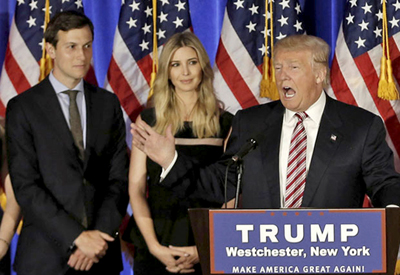
Trump names son-in-law as senior presidential advisor

January 10, 2017

New York, Jan 10: US President-elect Donald Trump announced that his son-in-law Jared Kushner, a property developer and publisher, will serve as senior White House advisor, flouting myriad legal and ethical concerns.

T advisorThe incoming Republican, who has never previously held elected office, said Kushner, who also has no political experience outside his father-in-law's campaign, would serve as "senior advisor to the president."

Kushner, whom Forbes estimates is worth USD 1.8 billion together with his parents and adult brother, will forego his salary while serving in the administration, said a statement from the transition team.

The 35-year-old will work closely with White House chief of staff Reince Priebus and chief strategist Steve Bannon to execute Trump's agenda, it added.

"Jared has been a tremendous asset and trusted advisor throughout the campaign and transition and I am proud to have him in a key leadership role in my administration," Trump announced yesterday.

"He has been incredibly successful, in both business and now politics. He will be an invaluable member of my team as I set and execute an ambitious agenda, putting the American people first," he added.

Priebus called Kushner "a visionary with a rare ability to communicate with and assemble broad coalitions of support" and said his "open mind, adaptability and keen intellect" would be a "great asset" to the team.

Kushner welcomed the appointment as "an honor" and said he was "humbled" by the opportunity to serve.

Comments

shaji
 - 
Tuesday, 10 Jan 2017

Good move by anogther Feku. Next he will appoint his sons as FBI chief, his sister in law as Home secretary, his Father in law as Bank of America chief, his mother in law as home minister etc etc. Good move. Keep going on dear and enjoy your stay as new President

Add new comment

  • Coastaldigest.com reserves the right to delete or block any comments.
  • Coastaldigset.com is not responsible for its readers’ comments.
  • Comments that are abusive, incendiary or irrelevant are strictly prohibited.
  • Please use a genuine email ID and provide your name to avoid reject.
Agencies
May 31,2020

Minneapolis, May 31: The full Minnesota National Guard was activated for the first time since World War Two after four nights of civil unrest that has spread to other U.S. cities following the death of George Floyd, a black man shown on video gasping for breath as a white Minneapolis policeman knelt on his neck.

Minnesota Governor Tim Walz said the deployment was necessary because outside agitators were using protests over Monday’s death of George Floyd to sow chaos and that he expected Saturday night’s demonstrations to be the fiercest so far.

From Minneapolis to several other major cities including New York, Atlanta and Washington, protesters clashed with police late on Friday in a rising tide of anger over the treatment of minorities by law enforcement.

“We are under assault,” Walz, a first-term governor elected from Minnesota’s Democratic-Farmer-Labor Party, told a briefing on Saturday. “Order needs to be restored. ... We will use our full strength of goodness and righteousness to make sure this ends.”

He said he believed a “tightly controlled” group of outsiders, including white supremacists and drug cartel members, were instigating some of the violence in Minnesota’s largest city, but he did not give specific evidence of this when asked by reporters.

As many as 80% of those arrested were from outside the state, Walz said. But detention records show just eight non-Minnesota residents have been booked into the Hennepin County Jail since Tuesday, and it was unclear whether all of them were arrested in connection with the Minneapolis unrest.

The Republican Trump administration suggested civil disturbances were being orchestrated from the political left.

“In many places, it appears the violence is planned, organized and driven by anarchic and left extremist groups - far-left extremist groups ... many of whom travel from outside the state to promote violence,” U.S. Attorney William Barr said in a statement.

In an extraordinary move, the Pentagon said it put military units on a four-hour alert to be ready if requested by Walz to help keep the peace.

Activists staged another round of protests on Saturday in at least a dozen major U.S. cities coast to coast, including Seattle, Los Angeles, Chicago, Cleveland, Dallas, Atlanta, New York and Atlanta.

In the nation’s capital, hundreds of demonstrators assembled near the Justice Department headquarters, then marched toward the U.S. Capitol, chanting, “Black lives matter,” and “I can’t breathe,” a rallying cry echoing Floyd’s dying words.

Many later ended up near the White House, where they faced off with shield-carrying police, some mounted on horseback.

The streets of Minneapolis were largely quiet during daylight on Saturday, though several National Guard armoured personnel carriers were seen rolling through town.

On Friday, in defiance of a newly imposed curfew, Minneapolis protesters took to the streets for a fourth night - albeit in smaller numbers than before - despite the announcement hours earlier of murder charges filed against Derek Chauvin, the policeman seen in video footage kneeling on Floyd’s neck.

Three other officers fired from the police department with Chauvin on Tuesday are also under criminal investigation in the case, prosecutors said.

The video of Floyd’s arrest - captured by an onlooker’s cellphone as he repeatedly groaned, “please, I can’t breathe” before becoming motionless - triggered an outpouring of rage that civil rights activists said has long simmered in Minneapolis and cities across the country over persistent racial bias in the U.S. criminal justice system.

‘PAINS ME SO MUCH’

The mood was sombre on Saturday in the Minneapolis neighbourhood of Lyndale, where dozens of people surveyed the damage while sweeping up broken glass and debris.

“It pains me so much,” said Luke Kallstrom, 27, a financial analyst, standing in the threshold of a fire-gutted post office. “This does not honour the man who was wrongfully taken away from us.”

Some of Friday’s most chaotic scenes were in the New York City borough of Brooklyn, where police armed with batons and pepper spray made more than 200 arrests in sometimes violent clashes. Several officers were injured, police said.

In Washington, President Donald Trump said on Saturday that if protesters who gathered the night before in Lafayette Square, across from the White House, had breached the fence, “they would have been greeted with the most vicious dogs, and most ominous weapons, I have ever seen.”

CHAOS IN ATLANTA

In Atlanta, Bernice King, the youngest daughter of slain civil rights icon Martin Luther King Jr., urged people to go home on Friday night after more than 1,000 protesters marched to the state capitol and blocked traffic on an interstate highway.

The demonstration turned violent at points. Fires burned near the CNN Center, the network’s headquarters, and windows were smashed at its lobby. Several vehicles were torched, including at least one police car.

Rapper Killer Mike, in an impassioned speech flanked by the city’s mayor and police chief, also implored angry residents to stay indoors and to mobilize to win at the ballot box.

“But it is not time to burn down your own home.”

Floyd, a Houston native who had worked security for nightclubs, was arrested on suspicion of trying to pass counterfeit money at a store to buy cigarettes on Monday evening. Police said he was unarmed. An employee who called for help had told a police dispatcher that the suspect appeared to be intoxicated.

In a striking coincidence, Floyd and Chauvin had both worked security at the same Latin nightclub in Minneapolis, though it was unlikely they ever interacted, former owner Maya Santamaria, who sold the El Nuevo Rodeo club in January, told Reuters.

Santamaria said Floyd worked inside the club on certain nights, supporting other staff with security. She said Chauvin, who worked outside the club as an off-duty cop for 16 years, had a reputation for roughing up customers, but she considered him responsible and a friend.


Comments

Add new comment

  • Coastaldigest.com reserves the right to delete or block any comments.
  • Coastaldigset.com is not responsible for its readers’ comments.
  • Comments that are abusive, incendiary or irrelevant are strictly prohibited.
  • Please use a genuine email ID and provide your name to avoid reject.
News Network
February 24,2020

Beijing, Feb 24: The lockdown of Guo Jing's neighbourhood in Wuhan -- the city at the heart of China's new coronavirus epidemic -- came suddenly and without warning.

Unable to go out, the 29-year-old is now sealed inside her compound where she has to depend on online group-buying services to get food.

"Living for at least another month isn't an issue," Guo told news agency, explaining that she had her own stash of pickled vegetables and salted eggs.

But what scares her most is the lack of control -- first, the entire city was sealed off, and then residents were limited to exiting their compound once every three days.

Now even that has been taken away.

Guo is among some 11 million residents in Wuhan, a city in central Hubei province that has been under effective quarantine since January 23 as Chinese authorities race to contain the epidemic.

Since then, its people have faced a number of tightening controls over daily life as the death toll from the virus swelled to over 2,500 in China alone.

But the new rules this month barring residents from leaving their neighbourhoods are the most restrictive yet -- and for some, threaten their livelihoods.

"I still don't know where to buy things once we've finished eating what we have at home," said Pan Hongsheng, who lives with his wife and two children.

Some neighbourhoods have organised group-buying services, where supermarkets deliver orders in bulk.

But in Pan's community, "no one cares".

"The three-year-old doesn't even have any milk powder left," Pan told news agency, adding that he has been unable to send medicine to his in-laws -- both in their eighties -- as they live in a different area.

"I feel like a refugee."

The "closed management of neighbourhoods is bound to bring some inconvenience to the lives of the people", Qian Yuankun, vice secretary of Hubei's Communist Party committee, said at a press briefing last week.

Authorities on Monday allowed healthy non-residents of the city to leave if they never had contact with patients, but restrictions remained on those who live in Wuhan.

Demand for group-buying food delivery services has rocketed with the new restrictions, with supermarkets and neighbourhood committees scrambling to fill orders.

Most group-buying services operate through Chinese messaging app WeChat, which has ad-hoc chat groups for meat, vegetables, milk -- even "hot dry noodles", a famous Wuhan dish.

More sophisticated shops and compounds have their own mini-app inside WeChat, where residents can choose packages priced by weight before orders are sent in bulk to grocery stores.

In Guo's neighbourhood, for instance, a 6.5-kilogramme (14.3-pound) set of five vegetables, including potatoes and baby cabbage, costs 50 yuan ($7.11).

"You have no way to choose what you like to eat," Guo said. "You cannot have personal preferences anymore."

The group-buying model is also more difficult for smaller communities to adopt, as supermarkets have minimum order requirements for delivery.

"To be honest, there's nothing we can do," said Yang Nan, manager of Lao Cun Zhang supermarket, which requires a minimum of 30 orders.

"We only have four cars," she said, explaining that the store did not have the staff to handle smaller orders.

Another supermarket told AFP it capped its daily delivery load to 1,000 orders per day.

"Hiring staff is difficult," said Wang Xiuwen, who works at the store's logistics division, adding that they are wary about hiring too many outsiders for fear of infection.

Closing off communities has split the city into silos, with different neighbourhoods rolling out controls of varying intensity.

In some compounds, residents have easier access to food -- albeit a smaller selection than normal -- and one woman said her family pays delivery drivers to run grocery errands.

Her compound has not been sealed off either, the 24-year-old told AFP under condition of anonymity, though they are limited to one person leaving at a time.

Some districts have implemented their own rules, such as prohibiting supermarkets from selling to individuals, forcing neighbourhoods to buy in bulk or not at all.

"In the neighbourhood where I live, the reality is really terrible," said David Dai, who is based on the outskirts of Wuhan.

Though his apartment complex has organised group-buying, Dai said residents were unhappy with price and quality.

"A lot of tomatoes, a lot of onions -- they were already rotten," he told , estimating over a third of the food had to be thrown away.

His family must "totally depend" on themselves, added the 49-year-old, who has resorted to saving and drying turnip skins to add nutrients to future meals.

The uncertainty of not knowing when the controls will be lifted is also frustrating, said Ma Chen, a man in his 30s who lives alone.

"I have no way of knowing how much (food) I should buy."

Comments

Add new comment

  • Coastaldigest.com reserves the right to delete or block any comments.
  • Coastaldigset.com is not responsible for its readers’ comments.
  • Comments that are abusive, incendiary or irrelevant are strictly prohibited.
  • Please use a genuine email ID and provide your name to avoid reject.
Agencies
January 25,2020

Pentagon, Jan 25: Thirty-four US troops had been diagnosed with concussions and traumatic brain injury (TBI) as a result of the January 8 Iranian missile attack on two military bases in Iraq housing American soldiers, the Pentagon said.

"Eight service members who were previously transported to Germany have been brought to the US, they would continue to receive treatment in the US either at Walter Reed or their home bases," Pentagon spokesman Jonathan Hoffman told the media on Friday.

Hoffman said that nine service members were still undergoing treatment in Germany, and the rest of the 17 injured troops have already returned to duty in Iraq, reports Xinhua news agency.

Lat week, the US military had said that 11 service members were treated for concussion symptoms due to the missile attacks.

Hoffman noted that the symptoms "are late developing and manifested over a period of time".

In retaliation for the killing of Iranian Major General Qasem Soleimani in an American drone attack on January 3 in Baghdad, Tehran launched over 13 ballistic missiles on the two military bases in Anbar and near the city of Erbil.

US military initially said that no casualty was reported from the Iranian attack. President Donald Trump then downplayed the seriousness of those injures.

"I heard that they had headaches and a couple of other things, but I would say and I can report that it's not very serious," Trump told reporters on Wednesday at a press conference in Davos, Switzerland.

More than 5,000 US troops are deployed in Iraq to support the country's forces in the battle against Islamic State militants.

Comments

Add new comment

  • Coastaldigest.com reserves the right to delete or block any comments.
  • Coastaldigset.com is not responsible for its readers’ comments.
  • Comments that are abusive, incendiary or irrelevant are strictly prohibited.
  • Please use a genuine email ID and provide your name to avoid reject.