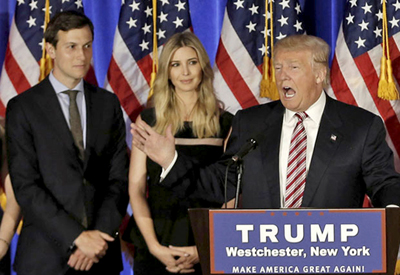
Trump names son-in-law as senior presidential advisor

January 10, 2017

New York, Jan 10: US President-elect Donald Trump announced that his son-in-law Jared Kushner, a property developer and publisher, will serve as senior White House advisor, flouting myriad legal and ethical concerns.

T advisorThe incoming Republican, who has never previously held elected office, said Kushner, who also has no political experience outside his father-in-law's campaign, would serve as "senior advisor to the president."

Kushner, whom Forbes estimates is worth USD 1.8 billion together with his parents and adult brother, will forego his salary while serving in the administration, said a statement from the transition team.

The 35-year-old will work closely with White House chief of staff Reince Priebus and chief strategist Steve Bannon to execute Trump's agenda, it added.

"Jared has been a tremendous asset and trusted advisor throughout the campaign and transition and I am proud to have him in a key leadership role in my administration," Trump announced yesterday.

"He has been incredibly successful, in both business and now politics. He will be an invaluable member of my team as I set and execute an ambitious agenda, putting the American people first," he added.

Priebus called Kushner "a visionary with a rare ability to communicate with and assemble broad coalitions of support" and said his "open mind, adaptability and keen intellect" would be a "great asset" to the team.

Kushner welcomed the appointment as "an honor" and said he was "humbled" by the opportunity to serve.

Comments

shaji
 - 
Tuesday, 10 Jan 2017

Good move by anogther Feku. Next he will appoint his sons as FBI chief, his sister in law as Home secretary, his Father in law as Bank of America chief, his mother in law as home minister etc etc. Good move. Keep going on dear and enjoy your stay as new President

Add new comment

  • Coastaldigest.com reserves the right to delete or block any comments.
  • Coastaldigset.com is not responsible for its readers’ comments.
  • Comments that are abusive, incendiary or irrelevant are strictly prohibited.
  • Please use a genuine email ID and provide your name to avoid reject.
News Network
March 12,2020

Geneva, Mar 12: For the global economy, virus repercussions were profound, with increasing concerns of wealth- and job-wrecking recessions. U.S. stocks wiped out more than all the gains from a huge rally a day earlier as Wall Street continued to reel.

The Dow Jones Industrial Average dropped 1,464 points, bringing it 20% below its record set last month and putting it in what Wall Street calls a “bear market.” The broader S&P 500 is just 1 percentage point away from falling into bear territory and bringing to an end one of the greatest runs in Wall Street’s history.

WHO officials said they thought long and hard about labeling the crisis a pandemic — defined as sustained outbreaks in multiple regions of the world.

The risk of employing the term, Ryan said, is “if people use it as an excuse to give up.” But the benefit is “potentially of galvanizing the world to fight.”

Underscoring the mounting challenge: soaring numbers in the U.S. and Europe’s status as the new epicenter of the pandemic. While Italy exceeds 12,000 cases and the United States has topped 1,300, China reported a record low of just 15 new cases Thursday and three-fourths of its infected patients have recovered.

China’s totals of 80,793 cases and 3,169 deaths are a shrinking portion of the world’s more than 126,000 infections and 4,600 deaths.

“If you want to be blunt, Europe is the new China,” said Robert Redfield, the head of the U.S. Centers for Disease Control and Prevention.

With 12,462 cases and 827 deaths, Italy said all shops and businesses except pharmacies and grocery stores would be closed beginning Thursday and designated billions in financial relief to cushion economic shocks in its latest efforts to adjust to the fast-evolving crisis that silenced the usually bustling heart of the Catholic faith, St. Peter’s Square.

Comments

Add new comment

  • Coastaldigest.com reserves the right to delete or block any comments.
  • Coastaldigset.com is not responsible for its readers’ comments.
  • Comments that are abusive, incendiary or irrelevant are strictly prohibited.
  • Please use a genuine email ID and provide your name to avoid reject.
News Network
February 22,2020

Johannesburg, Feb 22: To meet shortage of skilled nursing staff, private hospitals in South Africa are recruiting senior Indian nurses for their good work ethics and ability to become efficient trainers for the local staff, according to a media report.

A report at a 2018 jobs summit indicated that the country had a shortage of more than 47,000 nurses.

The shortage of the skilled nursing staff has been attributed to several factors, including preference of highly qualified nurses to emigrate or take up contract employment in countries such as the UK, the United Aarb Emirates, Saudi Arabia or New Zealand for want of higher salaries, a report in the weekly Business Times said.

Mediclinic, one of South Africa's largest private hospital groups, confirmed that it is recruiting 150 nurses from India this year.

“To supplement our training, as an internal strategy, we will continue to recruit senior registered nurses from India,” a Mediclinic spokesperson told the Business Times.

Mediclinic started recruiting nurses from India in 2005 but could not provide details about how many among the more than 8,800 nurses it employs at its hospitals are from India.

Another company, Life Healthcare SA, said it employed 135 Indian nurses between 2008 and 2014.

Top managements at the hospital groups lauded senior Indian nurses as being very efficient trainers for local staff.

“But we find that many of them prefer coming here on short-term contracts due to family commitments," a hospital executive said on the basis of anonymity.

The official said that the few who apply for long-term positions are usually young newly-qualified nurses, which is not the group in demand.

“They work hard, with a patient-oriented work ethic, and do not have the nine-to-five approach of many local nurses, especially those who are unionised," the official said.

“We would be very happy to take in more nursing staff from India," the official added.

Comments

Add new comment

  • Coastaldigest.com reserves the right to delete or block any comments.
  • Coastaldigset.com is not responsible for its readers’ comments.
  • Comments that are abusive, incendiary or irrelevant are strictly prohibited.
  • Please use a genuine email ID and provide your name to avoid reject.
News Network
July 1,2020

Jul 1: Hong Kong police moved swiftly on Wednesday against protesters gearing up for the first rally since the introduction of sweeping security legislation, making their first arrest under it and warning of punishment for pro-independence material.

Beijing on Tuesday unveiled the details of the much-anticipated law after weeks of uncertainty, pushing China's freest city and one of the world's most glittering financial hubs onto a more authoritarian path.

As hundreds of protesters gathered downtown for an annual rally marking the 23rd anniversary of the former British colony's handover to China, riot police used pepper spray to arrest at least two people, while one metro station closed.

Police, who earlier banned the rally, cited the law for the first time in confronting protesters and they also made their first arrest under it - a man holding a flag advocating independence.

"You are displaying flags or banners/chanting slogans/or conducting yourselves with an intent such as secession or subversion, which may constitute offences under the ... national security law," police said in a message displayed on a purple banner.

The law will punish crimes of secession, subversion, terrorism and collusion with foreign forces with up to life in prison, heralding a more authoritarian era for the Asian financial hub.

China's parliament adopted it in response to months of pro-democracy protests last year triggered by fears that Beijing was stifling the city's freedoms, guaranteed by a "one country, two systems" formula agreed when it returned to Chinese rule.

Authorities in Beijing and Hong Kong have repeatedly said the legislation is aimed at a few "troublemakers" and will not affect rights and freedoms, nor investor interests.

But critics fear it will crush the freedoms that are seen as key to Hong Kong's success as a financial centre.

"With the release of the full detail of the law, it should be clear to those in any doubt that this is not the Hong Kong they grew up in," said Hasnain Malik, head of equity research, Tellimer in Dubai.

"The difference is that U.S. and China relations are far worse and this could be used as a pretext to impede the role of Hong Kong as a finance hub."

In Beijing, Zhang Xiaoming, executive deputy director of Beijing's Hong Kong and Macau Affairs Office, told reporters suspects arrested by Beijing's new security office in Hong Kong could be tried on the mainland.

He said the mainland's national security office abided by Chinese law and that Hong Kong's legal system could not be expected to implement the laws of the mainland. Article 55 of the law states that Beijing's national security office in Hong Kong could exercise jurisdiction over "complex" or "serious" cases.

Mainland security agencies will also be based in Hong Kong officially for the first time, with powers that go beyond city laws.

"The law is a birthday gift to (Hong Kong) and will show its precious value in the future," Zhang said, adding the law would not be applied retroactively.

On July 1 last year, hundreds of protesters stormed and vandalised the city's legislature to protest against a now-scrapped bill that would have allowed extraditions to mainland China.

Those protests evolved into calls for greater democracy, paralysing parts of the city and paving the way for Beijing's imposition of the law this week.

'INEVITABLE'

Speaking at a flag-raising ceremony to mark the handover anniversary, the city's Beijing-backed leader, Carrie Lam, said the law was the most important development since the city's return to Chinese rule.

"It is also an inevitable and prompt decision to restore stability," Lam said at the same harbour-front venue where 23 years ago the last colonial governor, Chris Patten, a staunch critic of the security law, tearfully handed back Hong Kong to Chinese rule.

Some pro-Beijing officials and political commentators say the law is aimed at sealing Hong Kong's "second return" to the motherland after the first failed to bring residents to heel.

Luo Huining, the head of Beijing's top representative office in Hong Kong, said at the ceremony the law was a "common aspiration" of Hong Kong citizens.

Critics denounced the lack of transparency surrounding the details of the legislation until it was unveiled. It came into force at 11 p.m. (1500 GMT) on Tuesday.

Some pro-democracy activists gave up membership of their groups just before the law came into force, though calling for the campaign for democracy to go on offshore.

"I saw this morning there are celebrations for Hong Kong's handover, but to me it is a funeral, a funeral for 'one country two systems'," said democracy lawmaker Kwok Ka-ki.


Comments

Add new comment

  • Coastaldigest.com reserves the right to delete or block any comments.
  • Coastaldigset.com is not responsible for its readers’ comments.
  • Comments that are abusive, incendiary or irrelevant are strictly prohibited.
  • Please use a genuine email ID and provide your name to avoid reject.