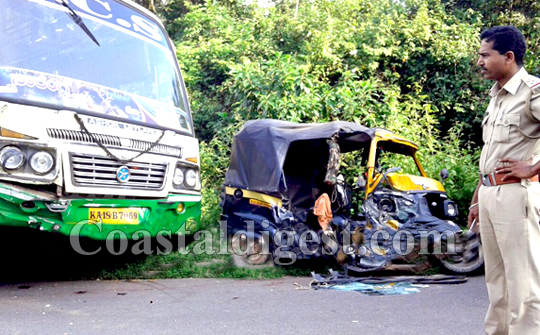
Two brothers killed as speeding bus rams into auto-rickshaw in Karkala

[email protected] (CD Network)
October 3, 2016

Udupi, Oct 3: Two brothers aged 26 and 30 years lost their lives when a speeding bus rammed into their auto-rickshaw at Shivapura near Hebri village in Karkala taluk of Udupi district.

acc

Police said that younger brother Guruprasad (26) was riding the ill-fated auto rickshaw while elder brother Vasant was sitting on passenger seat.

The tragedy occurred on Sunday near a bridge when the two brothers were heading to Hebri for some work from Shivapura.

The driver of the Udupi-bound private bus lost control over his vehicle and rammed into the three-wheeler, the police said.

While Guruprasad died on the spot, Vasant breathed his lost at a private hospital in Manipal. A case has been registered at Hebri police station.

Comments

Prakash Shetty
 - 
Tuesday, 4 Oct 2016

I surprise why the driver not fled the spot leaving the vehicle after the accident, always we read as a common sentence

Add new comment

  • Coastaldigest.com reserves the right to delete or block any comments.
  • Coastaldigset.com is not responsible for its readers’ comments.
  • Comments that are abusive, incendiary or irrelevant are strictly prohibited.
  • Please use a genuine email ID and provide your name to avoid reject.
News Network
April 21,2020

Wayanad, Apr 21: Panic gripped residents of Mananthavady and Mepaddi regions of the district after several cats in the region were found dead.

A group of people approached authorities after which the Animal Husbandry Department tested samples from the carcasses and found that the cat deaths were caused by Feline Parvovirus, which does not transmit to humans.

Speaking to ANI, Dr D Ramachandran, Chief Veterinary Officer, Wayanad said that Feline Parvovirus affects cats and vaccines are available to protect cats and keep the virus at bay.

"There were incidents of cat deaths in Mananthavady and Meppadi region of Wayanad district creating panic among the local residents. The officials of the Animal Husbandry department visited the spots for epidemiological investigations. The samples were collected and sent to the State Institute of Animal Diseases, which confirmed that the deaths were due to Feline Parvovirus. There is no need to worry as this virus does not spread to humans," he said.

A cat owner in Meppadi said that within a span of two-three days, over 13 cats had died in the region.

"We are afraid of these sudden cat deaths amidst coronavirus outbreak. We have informed the Health Department and Animal Husbandry department. Officials came here and collected the samples," she said.

Comments

Add new comment

  • Coastaldigest.com reserves the right to delete or block any comments.
  • Coastaldigset.com is not responsible for its readers’ comments.
  • Comments that are abusive, incendiary or irrelevant are strictly prohibited.
  • Please use a genuine email ID and provide your name to avoid reject.
News Network
February 6,2020

Shivamogga, Feb 6: A youth, who allegedly uploaded pornography and inappropriate videos of children on social media, was arrested by the district CEN police after a tip-off from the CyberTipline.

The accused is a resident of Sorab taluk and is said to be below 18 years. He uploaded the objectionable content during April and May last year. He was traced based on the IP address of his computer and the mobile call records shared by the investigating agencies.

He was arrested in January under the provisions of the Information Technology Act 2000 and sent to judicial custody, said police sources.

Comments

Add new comment

  • Coastaldigest.com reserves the right to delete or block any comments.
  • Coastaldigset.com is not responsible for its readers’ comments.
  • Comments that are abusive, incendiary or irrelevant are strictly prohibited.
  • Please use a genuine email ID and provide your name to avoid reject.
Agencies
May 8,2020

Washington D.C., May 8: The prime time for brain development in a child's life is the first year, where the infant spends most of the time asleep. It is the time when neural connections form and sensory memories are encoded.

However, when sleep is disrupted, as occurs more often among children with autism, brain development may be affected, too.

New research led by the University of Washington finds that sleep problems in a baby's first 12 months may not only precede an autism diagnosis but also may be associated with altered growth trajectory in a key part of the brain, the hippocampus.

The study, which was published in the American Journal of Psychiatry, researchers report that in a sample of more than 400 taken of 6- to 12-month-old infants, those who were later diagnosed with autism were more likely to have had difficulty falling asleep.

It also states that this sleep difficulty was associated with altered growth trajectories in the hippocampus.

"The hippocampus is critical for learning and memory, and changes in the size of the hippocampus have been associated with poor sleep in adults and older children.

As many as 80 per cent of the children with autism spectrum disorder have sleep problems," said Annette Estes, director of the UW Autism Center and senior author of the study.

"In our clinical experience, parents have a lot of concerns about their children's sleep, and in our work on early autism intervention, we observed that sleep problems were holding children and families back," added Estes, who is also a UW professor of speech and hearing sciences.

"It could be that altered sleep is part-and-parcel of autism for some children. One clue is that behavioural interventions to improve sleep don't work for all children with autism, even when their parents are doing everything just right. This suggests that there may be a biological component to sleep problems for some children with autism," said Estes.

To consider links among sleep, brain development, and autism, researchers at the IBIS Network looked at MRI scans of 432 infants, surveyed parents about sleep patterns, and measured cognitive functioning using a standardized assessment.

At the outset of the study, infants were classified according to their risk for developing autism: Those who were at higher risk of developing autism -- about two-thirds of the study sample -- had an older sibling who had already been diagnosed.

Infant siblings of children with autism have a 20 per cent chance of developing autism spectrum disorder -- a much higher risk than children in the general population.

In the current study, 127 of the 432 infants were identified as "low risk" at the time the MRI scans were taken because they had no family history of autism.

They later evaluated all the participants at 24 months of age to determine whether they had developed autism. Of the roughly 300 children originally considered "high familial risk," 71 were diagnosed with autism spectrum disorder at that age.

Problems with sleep were more common among the infants later diagnosed with an autism spectrum disorder, as were larger hippocampi. No other subcortical brain structures were affected, including the amygdala, which is responsible for certain emotions and aspects of memory, or the thalamus, a signal transmitter from the spinal cord to the cerebral cortex.

The authors note that while parents reported more sleep difficulties among infants who developed autism compared to those who did not, the differences were very subtle and only observed when looking at group averages across hundreds of infants.

Sleep patterns in the first years of life change rapidly as infants transition from sleeping around the clock to a more adult-like sleep/wake cycle. Until further research is completed, Estes said, it is not possible to interpret challenges with sleep as an early sign of increased risk for autism.


Comments

Add new comment

  • Coastaldigest.com reserves the right to delete or block any comments.
  • Coastaldigset.com is not responsible for its readers’ comments.
  • Comments that are abusive, incendiary or irrelevant are strictly prohibited.
  • Please use a genuine email ID and provide your name to avoid reject.