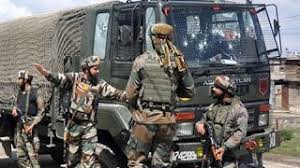
Two jawans killed as militants attack Army convoy in J-K

June 3, 2017

Srinagar, Jun 3: Two jawans were killed and four others injured when militants attacked an Army convoy on the Srinagar-Jammu national highway in south Kashmir's Kulgam district today.J-K

The militants attacked the convoy near Lower Munda toll post in Qazigund area of the district, 100 km from here, injuring six army personnel, an army official said.

He said the injured were evacuated to Army's 92 base hospital here where two jawans succumbed to their injuries.

The other four are being treated, the official said.

He said a hunt is underway to nab the attackers.

Comments

Add new comment

  • Coastaldigest.com reserves the right to delete or block any comments.
  • Coastaldigset.com is not responsible for its readers’ comments.
  • Comments that are abusive, incendiary or irrelevant are strictly prohibited.
  • Please use a genuine email ID and provide your name to avoid reject.
News Network
March 29,2020

New Delhi, Mar 29: The battle against coronavirus is a tough one and it required harsh decisions to keep India safe, said Prime Minister Narendra Modi in his first Mann Ki Baat after the 21-day lockdown was imposed in the wake of COVID-19 outbreak.
"The battle against COVID-19 is a tough one and it did require such harsh decisions. It is important to keep the people of India safe. A disease must be dealt with at the very beginning as delay makes it incurable," said Prime Minister Modi.
He said that as the coronavirus has put the entire world in lockdown, so "India is doing the same."
"It is a challenge before everyone, science and knowledge, poor and rich, powerful and weak. It is neither restricted to a nation nor region or particular weather. This virus is bent upon killing human beings, eliminating them. Hence all of us, the entire humanity, must unite and resolve to eliminate it," he added.
Addressing the 63rd edition of his monthly radio programme 'Mann Ki Baat', the Prime Minister had sought forgiveness from all countrymen, and especially the poor, for the nationwide lockdown in the country in the view of the novel coronavirus.
During his address to the nation on March 24, the Prime Minister had announced a 21-day nationwide lockdown to contain the spread of the deadly virus. 

Comments

Add new comment

  • Coastaldigest.com reserves the right to delete or block any comments.
  • Coastaldigset.com is not responsible for its readers’ comments.
  • Comments that are abusive, incendiary or irrelevant are strictly prohibited.
  • Please use a genuine email ID and provide your name to avoid reject.
News Network
May 19,2020

New Delhi, May 19: In a fresh blow to saffronite journalist Arnab Goswami, the Supreme Court of India today rejected his plea seeking transfer of the investigation of a case, filed against him for defaming Congress interim president Sonia Gandhi, to the CBI. The court also refused to quash the FIRs filed against him.

Goswami, editor-in-chief of Republic TV, has been booked in connection with a TV show on the gathering of migrants outside Bandra railway station on April 14. This apart, multiple FIRs have been filed against him for his show on Palghar lynching. In that show, he had posed certain questions on the incident to Congress President Sonia Gandhi, following which Congress workers lodged complaints against him in various states.

Extending Goswami’s interim protection from arrest by three weeks, the Supreme Court said, “Right of a journalist under 19 1 (a) higher…Free citizens can’t exist if news media can’t speak.”

During the earlier hearing, Senior Advocate Harish Salve, appearing for Goswami, had urged the court to transfer the probe to an agency like CBI. He said the “nature of the” second FIR against Goswami over a show on the migrant gathering outside Bandra station on April 14 “shows that it’s arm-twisting tactic”. 

“They are trying to stifle an unpleasant voice. This is a political party targeting a journalist. All complainants are members of one political party. They have a problem with the government. They want to teach this journalist a lesson,” he added.

Objecting to Salve’s plea to transfer the case to the CBI, Maharashtra government counsel, Senior Advocate Kapil Sibal, had said, “CBI investigation will go into your hands”. 

Sibal denied that Goswami was being harassed and said he was only asked relevant questions. He said Goswami should “stop this communal violence and communal mongering”.

Comments

Add new comment

  • Coastaldigest.com reserves the right to delete or block any comments.
  • Coastaldigset.com is not responsible for its readers’ comments.
  • Comments that are abusive, incendiary or irrelevant are strictly prohibited.
  • Please use a genuine email ID and provide your name to avoid reject.
Agencies
June 15,2020

New Delhi, Jun 15: Average temperature of India experienced a rise of 0.7 degree Celsius, along with decline in rainfall, significant increase in frequency of very severe cyclonic storms and droughts in over a decade due to human activities, the Ministry of Earth Sciences in its research report said.

The contentions were made in a report issued by the ministry on the impact of climate change. It will be published by Union Minister Harsh Vardhan on June 19.

According to the report, "Since the middle of the twentieth century, India witnessed rise in temperature; decrease in monsoon; rise in extreme temperature and rainfall, droughts, and sea levels; and increase intensity of severe cyclones.

The report, prepared by researchers of the Centre for Climate Change Research, a cell under The Ministry's Indian Institute of Tropical Meteorology, Pune, further stated that there is compelling scientific evidence that human activities have influenced these changes in regional climate.

India's average temperature has risen by around 0.7 degrees Celsius during 1901-2018, it said, adding that the rise is largely on account of GHG-induced warming and partially offset by forcing due to anthropogenic aerosols.

It states that the average temperature over India is projected to rise by 4.4 degrees Celsius, while the intensity of heat waves is likely to increase by 3-4 times by the end of the century.

In the 30-year period between 1986 and 2015, temperatures of the warmest day and the coldest night of the year have risen by about 0.63 degrees Celsius and 0.4 degree Celsius.

According to the report, by the end of the century, the temperatures of the warmest day and the coldest night are projected to rise by approximately 4.7 degrees Celsius and 5.5 degrees Celsius, respectively.

Alarmingly, sea surface temperature of the tropical Indian Ocean has also risen by one degrees Celsius on average during 1951-2015.

"The frequency of very severe cyclonic storms during the post-monsoon season has increased significantly (+1 event per decade) during the last two decades (2000-2018)," it added.

This came in the backdrop of Cyclone 'Amphan' and 'Nisarga' which made landfalls on May 20 and June 3 and killed several people, flattened villages, and destroyed farms.

"This is the first-ever climate change assessment report for India. This report will be very useful for policy makers, researchers, social scientists, economists, and students," said M. Rajeevan, secretary, the Ministry of Earth Sciences.

Besides this, the report also highlighted various other unnerving data on climate change in the country. Both the frequency and extent of droughts have increased significantly during 1951-2016.

The overall decrease of seasonal "summer monsoon rainfall" during the last 6-7 decades has led to an increased propensity for droughts over India.

"In particular, areas over central India, southwest coast, southern peninsula and north-eastern India have experienced more than 2 droughts per decade, on average, during this period. The area affected by drought has also increased by 1.3 per cent per decade over the same period."

The Hindu Kush Himalayas (HKH) also experienced a temperature rise of about 1.3 degree Celsius during 1951-2014.

Several areas of the Himalayas have experienced a declining trend in snowfall and also retreat of glaciers in recent decades. By the end of the twenty-first century, its annual mean surface temperature is projected to increase by about 5.2 degree Celsius.

The summer monsoon precipitation from June to September over India has also declined by around 6 per cent from 1951 to 2015, with notable decreases over the Indo-Gangetic Plains and the Western Ghats, the report further states.


Comments

Add new comment

  • Coastaldigest.com reserves the right to delete or block any comments.
  • Coastaldigset.com is not responsible for its readers’ comments.
  • Comments that are abusive, incendiary or irrelevant are strictly prohibited.
  • Please use a genuine email ID and provide your name to avoid reject.