Two sisters, 3-yr-old child die after being run over by train engine at Manjeshwar

coastaldigest.com news network
January 31, 2018

Manjeshwar, Jan 31: In a gut-wrenching tragedy, three members of a family were crushed to death by the engine of a train while crossing railway tracks near Manjeshwar railway station on Wednesday morning.

The victims have been identified as Aamina (45), her sister Ayesha (42) and latter’s three-year-old son Tameem.

According to sources, the trio were knocked down by the engine of a train moving towards Mangaluru. According to reports, they failed to notice the speeding engine as another train had just passed on the adjacent tracks. 

All of them breathed their last on the spot. The bodies were shifted to Mangalpady CHC for post-mortem. A case has been registered by Manjeshwar police.

Comments

Mohanakrishnan C
 - 
Saturday, 3 Feb 2018

The NH 66 is very close to station here and the town is on opposite side. A limited height subway linking NH 66 and west side of Manjeshwar Railway station is a must for pedestrians. Foot Over Bridge will be of no use as it is difficult for people to climb the stairs especially for elders and women with kids on tow. Authorities should wake up. There is just a pathway connecting east and west sides of the station. If any train is staioned on the tracks waiting for signal or crossing people tend to cross under the waggons.

Hari
 - 
Wednesday, 31 Jan 2018

Its like suicide only. I saw many people doing the same for getting out from railway station.

Mohammed SS
 - 
Wednesday, 31 Jan 2018

Very Sad Rip to the departed souls, urgently we need bullet train to take more lifes

Ganesh
 - 
Wednesday, 31 Jan 2018

People trying for easy way by risking their life. RIP

Add new comment

  • Coastaldigest.com reserves the right to delete or block any comments.
  • Coastaldigset.com is not responsible for its readers’ comments.
  • Comments that are abusive, incendiary or irrelevant are strictly prohibited.
  • Please use a genuine email ID and provide your name to avoid reject.
News Network
February 23,2020

Bengaluru, Feb 23: The sleuths of Custom Department have seized ephedrine worth Rs 5 Crore in courier terminal of Air Cargo complex in Kempegowda International Airport (KIA), the department said on Sunday.

Customs Joint Commissioner M J Chethan, in a statement, said that Central Intelligence Unit, Air Cargo Complex, scanned the package while verifying export consignments and found concealment of some powder. 5.04 kg of Ephedrine worth Rs 5 crore was packed in polythene pouches and concealed between cardboard layers of wedding invitation cards.

Detailed examination of the Wedding cards revealed banned drugs hidden between 43 wedding invitation cards in the package that also contained a few clothes.

Comments

Add new comment

  • Coastaldigest.com reserves the right to delete or block any comments.
  • Coastaldigset.com is not responsible for its readers’ comments.
  • Comments that are abusive, incendiary or irrelevant are strictly prohibited.
  • Please use a genuine email ID and provide your name to avoid reject.
News Network
June 26,2020

Bengaluru, Jun 26: The National Restaurant Association of India (NRAI) on Thursday came up with a Standard Operating Procedure (SOP) for restaurants whereby among other physical distancing norms, it has suggested a 2-metre gap between tables.

Formulated in partnership with Releski, a Bengaluru based skill-tech company, the SoP suggests that in case of back-to-back seating, people sitting with their backs towards each other will have their seats divided by 'Plexiglass' divider raised up to 2 meters from the ground.

"In a typical restaurant, the improvised seating plan should have a minimum distance of 2 metres between tables. The distance of 2 metres (6 feet) between tables should measure from one edge of the table to the other table's edge," it said.

In case of loose or free seating such as in banquet style or food court style seating, a minimum 2 meters of distance should be maintained between tables.

The guidelines noted that, to encourage physical distancing, restaurants have to sacrifice their seating capacity, to promote health and safety, and also to gain trust from their patrons.

"In order to perform this, divide your restaurants under different sectors. Pull out your restaurant's floor plan and colour code different sections red and yellow. Red sections are potential areas where maximum footfall or traffic is observed. Yellow sections are areas where the footfalls are average," it said.

All the red sections are encircled or bordered by placing barricades or Q manager and will open at specific points to access the yellow section and all the opening points will have hand sanitisers and sprays, and every guest who walks from red zones to yellow zones will sanitise himself/herself to reduce the chances of contamination.

For air conditioning, the guidelines of CPWD shall be followed which inter alia emphasises that the temperature setting of all air conditioning devices should be in the range of 24-30 degree Celsius, relative humidity should be in the range of 40- 65 per cent, intake of fresh air should be as much as possible and cross ventilation should be adequate, the guidelines suggested.

The industry body has also suggested appointment of a COVID-free Ambassador who would operate as the Chief Health Officer within the restaurant team, preferably from the management team in each shift.

The ambassador's would put the new daily work routines into practice, to monitor compliance with good practice and to lead the preventative measures, adapt to health & safety recommendations and requirements of the restaurant and oversee the implementation of the norms.

Anurag Katriar, President of NRAI and CEO & Executive Director of deGustibus Hospitality, said: "Every restaurant cutting across formats is facing the harsh reality of subdued to shut business volumes in the present and the uncertainty of business environment in the future. One thing is certain that hygiene and safety will be a key differentiator in the post-pandemic restaurant operations."


Comments

Add new comment

  • Coastaldigest.com reserves the right to delete or block any comments.
  • Coastaldigset.com is not responsible for its readers’ comments.
  • Comments that are abusive, incendiary or irrelevant are strictly prohibited.
  • Please use a genuine email ID and provide your name to avoid reject.
coastaldigest.com news network
August 8,2020

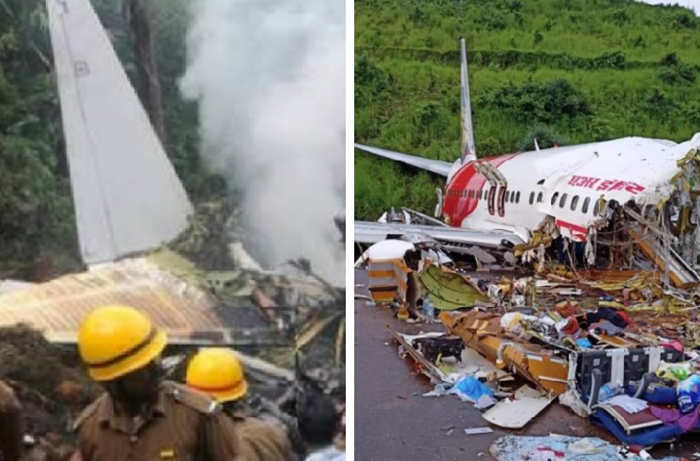
Mangaluru, Aug 8: As visuals of the Air India Express flight crash at Kozhikode international airport emerge, one cannot help but be reminded of an eerily similar and unfortunate accident that occurred a decade ago. The August 7, 2020 tragedy brought back memories of the 2010 crash.

It was on May 22, 2010 that an Air India Express Boeing 737-800 flight from Dubai to Mangaluru over shot the runway while landing at Bajpe airport and fell into a cliff. Of the 160 passengers and 6 crew members on board, 158 were killed (all crew members and 152 passengers) and only 8 survived.

Even back then, the plane had split into two. The crash has been termed as one of India's worst aviation disasters.

The final conversations between Air traffic control (ATC) and the pilot prior to the landing showed no indication of any distress.

Like the Mangaluru accident, Karipur crash too happened when the flight was attempting to land.

The captain of the aircraft which crashed at Mangaluru, Z Glucia, was an experienced pilot with 10,000 hours of flying experience and had 19 landings at the Mangalore airport. Co-pilot S S Ahluwalia, with 3,000 hours of flying experience had as many as 66 landings at this airport. Both the pilot and co-pilot were among the victims.

An investigation into the accident later found that the cause of the accident was the captain’s failure to discontinue an ‘unstabilised approach’ and his persistence to continue with the landing, despite three calls from the First Officer to ‘go-around’.

Comments

Add new comment

  • Coastaldigest.com reserves the right to delete or block any comments.
  • Coastaldigset.com is not responsible for its readers’ comments.
  • Comments that are abusive, incendiary or irrelevant are strictly prohibited.
  • Please use a genuine email ID and provide your name to avoid reject.