


UAE announces ministers for state ministers for happiness, tolerance, youth

February 11, 2016

Dubai, Feb 11: It sounds a bit New Age, but the United Arab Emirates has just appointed state ministers for happiness, tolerance and youth.
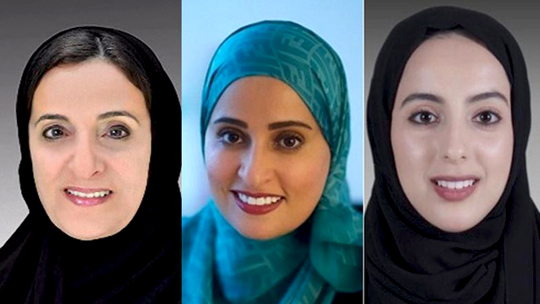
ministers

Minister of Tolerance Sheikha Lubna Al-Qassimi, Minister of Happiness Ohood Al-Roumi, Minister for Youth Affairs Shama Al-Mazroui

Sheikh Mohammed bin Rashid al-Maktoum, the UAE prime minister who is also the ruler of Dubai, announced the new lineup on Wednesday via his official Twitter account.

It is apparently part of a move to show the government is offering more than simply providing basic services for its citizens.

"Happiness in our nation is not a wish .. but there will be plans, projects and programs and indicators .. and it will be part of the work of all our ministries .. and a part of our way of life," Sheikh Mohammed tweeted.

The job went to Ohood Al Roumi, who will continue her existing role as director-general of the prime minister’s office. She was one of seven women named to posts in the new 29-member Cabinet.

"The new cabinet focuses on the future, youth, happiness, developing education and combating climate change," tweeted the 66-year-old prime minister, who is also the Emirati vice president and ruler of Dubai.

Sheikha Lubna al-Qassimi, the former development and international cooperation minister, was made state minister for tolerance.

Twenty-two year old, Western-educated Shama al-Mazroui was made state minister for youth affairs.

The United Arab Emirates, which has one of the highest levels of GDP per capita in the Arab world, is seen as a haven of stability in a region beset by turmoil and where public devotion to the rulers is high and little dissent is tolerated.

It is home to the glitzy emirate of Dubai, which transformed from a desert backwater to a global financial hub, where thousands of Arab expatriates flock to seek professional and entpreneurial opportunities not available in as much supply in other unstable Arab countries.

Sheikh Mohammed had announced earlier this week plans to outsource most government tasks to the private sector and cuts to the number of ministries.

The announcement came as energy-rich Gulf Arab states have been hit by low oil prices, encouraging them to streamline institutions and attract more foreign investment.

The cabinet lineup left the same figures in the critical portfolios of finance, economy, energy, defence and foreign affairs.

"The new lineup is a new stage whose headline is the future ... the youth ... happiness ... developing education ... and dealing with climate change to protect our environment," Sheikh Mohammed said.

Comments

preetha
 - 
Saturday, 13 Feb 2016

A good move to have a minister for happiness, which is lacking in this world, only if we are happy we can radiate happiness to others .
A good move
stay blessed

Add new comment

  • Coastaldigest.com reserves the right to delete or block any comments.
  • Coastaldigset.com is not responsible for its readers’ comments.
  • Comments that are abusive, incendiary or irrelevant are strictly prohibited.
  • Please use a genuine email ID and provide your name to avoid reject.
News Network
June 4,2020

Bengaluru, Jun 4: Karnataka opposition leader Siddaramaiah created a flutter on Wednesday saying many disgruntled BJP leaders had met him.

"Many disgruntled BJP lawmakers have met me and, of course, expressed their displeasure," tweeted Siddaramaiah.

Congress leader Siddaramaiah''s statements assume significance as recently several reports emerged highlighting some north Karnataka legislators meeting over dinner to put pressure on Chief Minister B.S. Yediyurappa to expand the cabinet and offer them ministerial roles.

North Karnataka leaders such as Umesh V. Katti, Chitradurga MLA G. H. Thippareddy and Vijayapura MLA Basanagouda Patil Yatnal and others met over dinner.

However, the Chief Minister said he was too busy to even look at the dissidence because he is occupied with development work of the state and fighting Covid.

Siddaramaiah, the former chief minister, alleged that Yediyurappa''s son Vijayendra is functioning as a non-constitutional chief minister.

"This is true in the BJP. That dissent will continue. We are not responsible if the government collapses," he pointed out.

The Congress leader said Karnataka has stooped to the level of not being in a position to even pay salaries to its employees.

"The state was the first in economic discipline during our government. Now the government has no money to pay salaries to government employees. Not only the state but the entire country is financially bankrupt," he said.

Comments

Add new comment

  • Coastaldigest.com reserves the right to delete or block any comments.
  • Coastaldigset.com is not responsible for its readers’ comments.
  • Comments that are abusive, incendiary or irrelevant are strictly prohibited.
  • Please use a genuine email ID and provide your name to avoid reject.
News Network
March 24,2020

Mangaluru, Mar 24: Seven people were arrested on Tuesday for violating prohibitory orders imposed under Section 144 of CrPC in Mangaluru during the lockdown in Karnataka, Commissioner of Police PS Harsha said.

Chief Minister BS Yediyurappa on Monday had announced a complete lockdown in the state till April 1.
"In the wake of the coronavirus outbreak, the entire state will be locked down from 12 am of March 23 to April 1. People are requested to strictly follow it to contain the coronavirus spread," he said.
Earlier, the state government had ordered the suspending of all public and private transport services.
According to the data compiled by the Indian Council of Medical Research (ICMR), the total number of the infection-related death toll in the country rose to nine on Tuesday, while the total number of active cases reached 482.

Comments

Add new comment

  • Coastaldigest.com reserves the right to delete or block any comments.
  • Coastaldigset.com is not responsible for its readers’ comments.
  • Comments that are abusive, incendiary or irrelevant are strictly prohibited.
  • Please use a genuine email ID and provide your name to avoid reject.
Media Release
February 14,2020

Veteran journalist P. Sainath has said that the nation is in a crisis. And this crisis is not limited to just the rural area. It has become a national crisis at various areas such as agriculture, education, economy, job creation etc.

He was delivering the endowment lecture on the topic ‘Indian democracy at the post-liberalization and post-truth era’ at Media Manthan 2020 organized by the PG department of journalism and mass communication at St Aloysius College (Autonomous). 

Mr Sainath said that the many policies adopted in the 90s led to India becoming unusually unequal. Referring to the speech Ambedkar had made at the Constituent Assembly while handing over the draft of the Constitution, Mr Sainath said, “Ambedkar had warned about the weakness of Indian democracy that liberty without equality allows the supremacy of a few over the multitude. Liberty, equality and fraternity must be kept together as we cannot have one without the other.” 

Mr Sainath stated that the agrarian crisis was no longer about the loss of productivity, employment or about farmer suicide; it was a societal, civilizational crisis. Commenting on the lopsided policies such as cow-slaughter ban, he explained how cow slaughter ban had adversely affected many industries due to their interdependency. While Muslims who slaughtered cows were rendered helpless, the cattle traders who were mostly OBCs lost their earnings as the cattle prices crashed. An important industry like Kolhapur sandals industry in Maharashtra went bankrupt as a result of the cow slaughter ban in Maharashtra. He said the policymakers had no idea how the rural industries were interconnected. Demonetisation too devastated the rural economy as 98 percent of rural transactions happen through cash. 

Mr Sainath also spoke about the crisis of inequality which affects the Dalits and the Adivasis far more than anyone else as 90 percent of the rural households take home less than Rs 10,000/- per month. “Women are yet another group whose labour is never counted in the gross domestic product. Women and girls globally do unpaid work which amounts to about 12.5 billion working hours per year. Monetarily speaking, this is worth 10.8 trillion dollars,” Mr Sainath added. 

Speaking about the crisis of jobs Mr Sainath said that major companies were laying off employees just to create more profits for the investors and the adoption of artificial intelligence in the industry would further destroy millions of jobs.

Rector of St Aloysius College Institutions Fr Dionysius Vaz SJ, Principal Dr (Fr) Praveen Martis SJ, HOD of Journalism and Mass Communication department Dr (Fr) Melwyn Pinto SJ were present.

‘Veerappan and Vijay Mallya’s business models are interesting!’

Addressing the gathering during his endowment lecture on Friday, Mr Sainath made an interesting comment on the so called ‘revenue model’. “Whenever I visit IIMs and IITs for lectures on my PARI project, the students there ask me what my revenue model for my project is. I tell them that I do not have a revenue model. In fact, journalism does not begin with a revenue model. Gandhiji, Ambedkar, Bhagat Singh were all great journalists. But they did not have a revenue model,” Mr Sainath said.

On a lighter note, he said that the best revenue model that he liked was that of forest brigand Veerappan and liquor baron Vijay Mallya. “Veerappan ruled the forest for forty years and from the top ministers to the villagers he could dictate terms and liver royally. Similarly, Mallya’s revenue model was to steal the banks and run away abroad and live like a king,” Mr Sainath added.

Journalism is not and can never be a business. It is a calling, he opined. While newspaper can be a business, television can be a business, journalism per se cannot be reduced to a business. “Unfortunately today, journalists are recruited on a contract basis and they have no bargaining power; and there are no unions to fight for their cause. Hence, they are at the mercy of the corporate media houses for their survival and are made to write stories that cannot be called journalism,” Mr Sainath said.

Answering a question as to the pressures he faced as a journalist, he said that external pressures from the government or others could be very well handled. It is the internal pressures from once own media house that journalists find it difficult to manage.


Comments

Add new comment

  • Coastaldigest.com reserves the right to delete or block any comments.
  • Coastaldigset.com is not responsible for its readers’ comments.
  • Comments that are abusive, incendiary or irrelevant are strictly prohibited.
  • Please use a genuine email ID and provide your name to avoid reject.