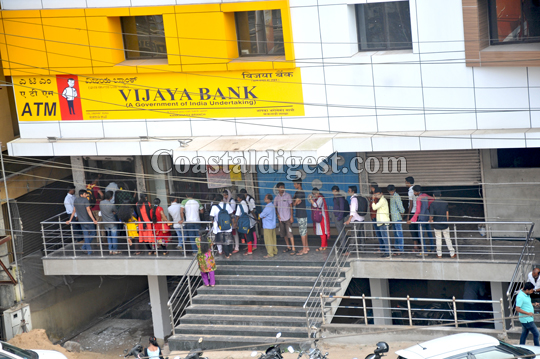
Udupi: 96-year-old dies in note exchange queue before a bank

[email protected] (CD Network | Suresh)
November 12, 2016

Udupi, Nov 12: A 96-year-old man collapsed and died in a queue at a village in Udupi district as cash-strapped common people in the region continued to throng banks and ATM counters for withdrawal of some money to meet their daily expenses on Saturday.

bankqueu

Gopal Shetty (96), a resident of Ajekar village was standing in the before a branch of Corporation bank for exchanging currency. Around 12 noon he collapsed and died on the spot.

It is said that he had only a few notes of Rs 1000 and Rs 500 denomination but waited in queue for a long time.

Though he was rushed to a nearby clinic by some people who saw him collapse, he was declared dead, sources said.

The deceased is the father of Sudhakar Shetty, founder of Jnana Sudha educational institution of Karkala.

Comments

Rikaz
 - 
Saturday, 12 Nov 2016

See, poors will have to suffer, riches have already shifted their amounts 'to foreign countries.....they are safe....poor's had some amount of hard earned money that they will have to lose for unwanted reason....the curse of these people will surely fall on these bloody useless politicians....

I haven't seen any politicians standing in line in front of banks to withdraw money....why why why....have they been given a chance of exchanging their money earlier than the announcement, public needs to know.....this is very bad...

people should teach them nice lesson in next election....

A.Mangalore
 - 
Saturday, 12 Nov 2016

Don't worry let him die . don't disturb our Modiji he is enjoying his Japan trip.

Add new comment

  • Coastaldigest.com reserves the right to delete or block any comments.
  • Coastaldigset.com is not responsible for its readers’ comments.
  • Comments that are abusive, incendiary or irrelevant are strictly prohibited.
  • Please use a genuine email ID and provide your name to avoid reject.
News Network
February 27,2020

Bengaluru, Feb 27: Chief minister BS Yediyurappa has again kindled hope for several ministerial aspirants by suggesting he will expand his council of ministers in April. A dozen senior BJP legislators are aspiring for ministerial berths, but there are only six vacancies in Yediyurappa’s cabinet.

However, Yediyurappa suggested on Tuesday he will fill only three spots, one of which would go to Hukkeri legislator Umesh Katti. With this, lobbying has intensified for the two remaining berths as the expansion exercise is expected soon after the budget session that ends on March 29.

The aspirants include Murugesh Nirani, S Angara, Appachhu Ranjan, SA Ramdas, Aravind Limbavali, Narasimha Nayak and GH Thippareddy besides others.

Yediyurappa, it is being said, is keen on inducting Katti and Limbavali since they are close to him. He will leave the decision on choosing legislators for the remaining two berths to the party’s central leadership.

On more than one occasion in the past, Yediyurappa has publicly stated that his wish is to induct Katti, a former minister, into the cabinet. In fact, the CM had wanted to induct Katti in the previous expansion that took place last month, but dropped the idea at the last minute due to pressure from party bosses.

The CM is also under pressure to induct Athani legislator Mahesh Kumatalli, who was among 17 Congress-JD(S) MLAs who resigned to help the saffron party form the government. Several BJP MLAs and Lingayat seers have been piling pressure on Yediyurappa to make Kumatalli a minister as promised.

Kumatalli was denied a cabinet berth only to accommodate Katti. Both are Lingayats and from Belagavi district. As the Lingayat community already has a lion’s share in cabinet berths, the CM cannot afford to induct both.

Nirani, who has been leaving no stone unturned to secure a spot, reiterated his wish to become minister, but insisted he will not lobby for the post.

Yediyurappa has been upset with Nirani for lobbying for a berth through Panchamasali Mutt seer Vachananand Swami. The former minister was also part of the team of alleged disgruntled MLAs which met Jagadish Shettar at his residence to put pressure on the CM for cabinet berths.

However, while expressing confidence of being made minister when Yediyurappa’s expands his cabinet next, Nirani said, “Yediyurappa is not upset with me. My relationship with him is that of father and son. He knows me and what I am.”

Comments

Add new comment

  • Coastaldigest.com reserves the right to delete or block any comments.
  • Coastaldigset.com is not responsible for its readers’ comments.
  • Comments that are abusive, incendiary or irrelevant are strictly prohibited.
  • Please use a genuine email ID and provide your name to avoid reject.
Agencies
February 20,2020

India ranked 77th on a sustainability index that takes into account per capita carbon emissions and ability of children in a nation to live healthy lives and secures 131st spot on a flourishing ranking that measures the best chance at survival and well-being for children, according to a UN-backed report.

The report was released on Wednesday by a commission of over 40 child and adolescent health experts from around the world. It was commissioned by the World Health Organization (WHO), UN Children's Fund (UNICEF) and The Lancet medical journal.

In the report assessing the capacity of 180 countries to ensure that their youngsters can survive and thrive, India ranks 77th on the Sustainability Index and 131 on the Flourishing Index, it said.

Flourishing is the geometric mean of Surviving and Thriving. For Surviving, the authors selected maternal survival, survival in children younger than 5 years old, suicide, access to maternal and child health services, basic hygiene and sanitation, and lack of extreme poverty.

For Thriving, the domains were educational achievement, growth and nutrition, reproductive freedom, and protection from violence.

Under the Sustainability Index, the authors noted that promoting today's national conditions for children to survive and thrive must not come at the cost of eroding future global conditions for children's ability to flourish.

The Sustainability Index ranks countries on excess carbon emissions compared with the 2030 target. This provides a convenient and available proxy for a country's contribution to sustainability in future.

The report noted that under realistic assumptions about possible trajectories towards sustainable greenhouse gas emissions, models predict that global carbon emissions need to be reduced from 39·7 giga­ tonnes to 22·8 gigatonnes per year by 2030 to maintain even a 66 per cent chance of keeping global warming below 1·5°C.

It said that the world's survival depended on children being able to flourish, but no country is doing enough to give them a sustainable future.

"No country in the world is currently providing the conditions we need to support every child to grow up and have a healthy future," said Anthony Costello, Professor of Global Health and Sustainability at University College London, one of the lead authors of the report.

"Especially, they're under immediate threat from climate change and from commercial marketing, which has grown hugely in the last decade," said Costello – former WHO Director of Mother, Child and Adolescent health.

Norway leads the table for survival, health, education and nutrition rates - followed by South Korea and the Netherlands. Central African Republic, Chad and Somalia come at the bottom.

However, when taking into account per capita CO2 emissions, these top countries trail behind, with Norway 156th, the Republic of Korea 166th and the Netherlands 160th.

Each of the three emits 210 per cent more CO2 per capita than their 2030 target, the data shows, while the US, Australia, and Saudi Arabia are among the 10 worst emitters. The lowest emitters are Burundi, Chad and Somalia.

According to the report, the only countries on track to beat CO2 emission per capita targets by 2030, while also performing fairly – within the top 70 – on child flourishing measures are: Albania, Armenia, Grenada, Jordan, Moldova, Sri Lanka, Tunisia, Uruguay and Vietnam.

"More than 2 billion people live in countries where development is hampered by humanitarian crises, conflicts, and natural disasters, problems increasingly linked with climate change," said Minister Awa Coll-Seck from Senegal, Co-Chair of the commission.

The report also highlights the distinct threat posed to children from harmful marketing.

Evidence suggests that children in some countries see as many as 30,000 advertisements on television alone in a single year, while youth exposure to vaping (e-cigarettes) advertisements increased by more than 250 per cent in the US over two years, reaching more than 24 million young people.

Studies in Australia, Canada, Mexico, New Zealand and the US – among many others – have shown that self-regulation has not hampered commercial ability to advertise to children.

Children's exposure to commercial marketing of junk food and sugary beverages is associated with purchase of unhealthy foods and overweight and obesity, linking predatory marketing to the alarming rise in childhood obesity, it said.

The number of obese children and adolescents increased from 11 million in 1975 to 124 million in 2016 – an 11-fold increase, with dire individual and societal costs, the report said.

To protect children, the authors call for a new global movement driven by and for children.

Specific recommendations include stopping CO2 emissions with the utmost urgency, to ensure children have a future on this planet; placing children and adolescents at the centre of global efforts to achieve sustainable development, the report said.

New policies and investment in all sectors to work towards child health and rights; incorporating children's voices into policy decisions and tightening national regulation of harmful commercial marketing, supported by a new Optional Protocol to the UN Convention on the Rights of the Child, it said.


Comments

Add new comment

  • Coastaldigest.com reserves the right to delete or block any comments.
  • Coastaldigset.com is not responsible for its readers’ comments.
  • Comments that are abusive, incendiary or irrelevant are strictly prohibited.
  • Please use a genuine email ID and provide your name to avoid reject.
News Network
April 23,2020

Bengaluru, Apr 23: The Karnataka government on Wednesday promulgated 'The Karnataka Epidemic Diseases Ordinance 2020' that provides the state with a power to seal borders, restrict essential services and punish those attacking public servants and damaging public property.

The Ordinance comes after violence in Padarayanapura when the police and BBMP officials were attacked while they tried to take some secondary contacts of a deceased COVID-19 patient into quarantine on April 19.

The Ordinance, which was promulgated after the Centre's guidelines in this regard, said, "The offender shall be liable for a penalty of twice the value of public or private property damaged as determined by the Deputy Commissioner after an inquiry."

It further said that if the penalty is not paid by the offender, then the amount shall be recovered under provisions of the Karnataka Land Revenue Act, 1964. The Deputy Commissioner can even attach the property of such offender in due course.

Also, abetment of offence would attract imprisonment of up to two years and a penalty of Rs 10,000 or both.

"No person shall commit or attempt to commit or instigate, incite or otherwise abet the commission of offence to cause loss or damage to any public or private property in any area when restrictions and regulations are in force to contain any epidemic disease," the Ordinance said.

Whoever contravenes such provision shall be punished with imprisonment for a term which shall not be less than six months, but may extend to three years and with fine which may extend to Rs 50,000, it added.

On Wednesday, the Centre brought an Ordinance to end violence against health workers, making it a cognisable and non-bailable offence with imprisonment up to seven years for those found guilty.

"We have brought an Ordinance under which any attack on health workers will be a cognisable and non-bailable offence. In the case of grievous injuries, the accused can be sentenced from six months to seven years. They can be penalised from Rs 1 lakh to Rs 5 lakhs," Union Minister Prakash Javadekar briefed media after Cabinet meeting.

Javadekar said that an amendment will be made to the Epidemic Diseases Act, 1897 and ordinance will be implemented.
This comes amid nationwide lockdown in the wake of COVID-19.

Comments

Add new comment

  • Coastaldigest.com reserves the right to delete or block any comments.
  • Coastaldigset.com is not responsible for its readers’ comments.
  • Comments that are abusive, incendiary or irrelevant are strictly prohibited.
  • Please use a genuine email ID and provide your name to avoid reject.