Udupi: Attacks on minorities, dalits condemned at PFI campaign

[email protected] (CD Network)
September 29, 2016

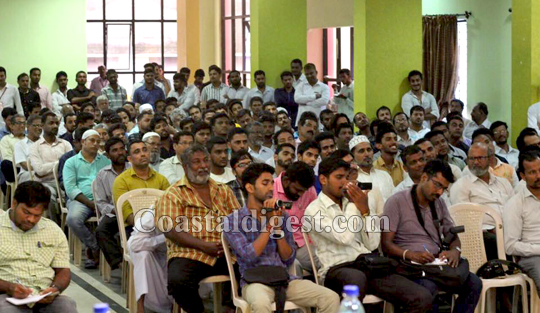
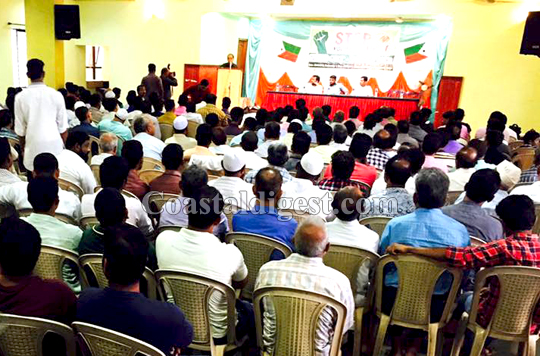
Udupi, Sep 29: Demolition of Babri mosque, Gujarat genocide and attack on churches in Mangaluru and other parts of India are glimpses of hate politics, said Prof Alban Rodrigues, administrator of Dandatheeratha Institutions, Kaup.

pfiudupi 1

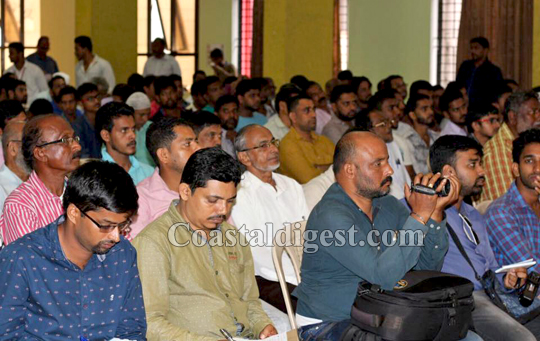
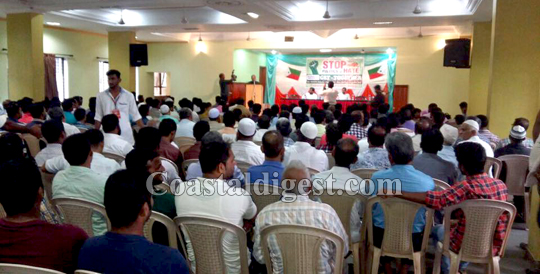
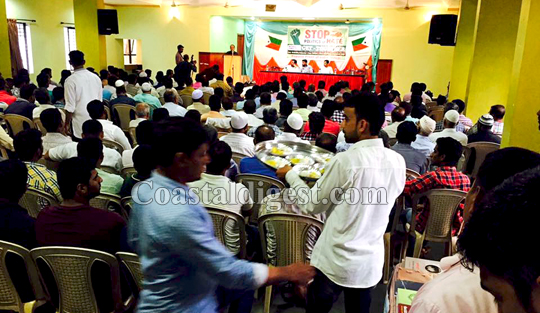
Speaking at the Stop politics of hate' campaign organised by the district unit of the Popular Front of India here on Wednesday, he took on Prime Minister Narendra Modi led government for constant attacks on minorities across the country.

He said that the politics of hate, ultimately leads to communal violence and chaos in the country.

Shafi Bellary, secretary of the State unit of the PFI said that Dalits and minorities were at the receiving end of “majority politics” for the last two years.

Mr. Bellary said all people should accept the fact that India was a diverse multi-religious and multi-cultural country. It has a secular constitution.

The Bharatiya Janata Party-led National Democratic Alliance (NDA) government had got a mere 31 per cent of votes, which meant that a large majority was against it, he said.

Even those who had voted for the NDA had done so because they were fed up of the “corruption” of the previous Congress-led United Progressive Alliance (UPA) government. Hence it could not be concluded that it was a vote for the ideology espoused by the BJP, he said.

pfiudupi 2

pfiudupi 3

pfiudupi 4

pfiudupi 5

pfiudupi 6

Comments

TRUE INDIAN
 - 
Thursday, 29 Sep 2016

PEOPLE ARE EDUCATED. ONLY BJPS AND ITS ALLIANCES ARE UNEDUCATED COWS.

Traveller
 - 
Thursday, 29 Sep 2016

And Majority of those who voted BJP have now come to understand that BJP and cheddis are not their saviours .. They are killers of peace in the society ... anyway people believe when they saw it how Bjp and cheddis governing their people... atleast those who are honest and good at heart should change their position on cheddis and vote those who are really working for the society.

Add new comment

  • Coastaldigest.com reserves the right to delete or block any comments.
  • Coastaldigset.com is not responsible for its readers’ comments.
  • Comments that are abusive, incendiary or irrelevant are strictly prohibited.
  • Please use a genuine email ID and provide your name to avoid reject.
News Network
February 28,2020

Bengaluru, Feb 28: Historian S. Shettar, 85, breathed his last early on February 28 in Bengaluru. He was suffering from respiratory problems and was hospitalised for over a week.

Shettar was known for his multi-disciplinary work, encompassing linguistics, epigraphy, anthropology, the study of religions and art history. He had extensively worked on the Jain practice of ritual death in Karnataka and Asoka edicts. He had studied and compiled early edicts in Kannada and worked extensively on the growth of Kannada language down the ages.

Born in 1935 at Hampasagara, Ballari district, he went on to study at Cambridge University and started his career as a Professor of History at Karnatak University, Dharwad, his alma mater. He later headed the National Museum Institute of the History of Art, Conservation and Museology in 1978 and Indian Council for Historical Research in 1996. He was also a visiting professor at the National Institute of Advanced Studies, Bengaluru.

He was a bilingual historian who wrote in English for most of his career, but started writing in Kannada in later years. In the last two decades, he developed a keen interest in linguistics and wrote multiple books on classical Kannada and Prakrit. His 2007 book “Shangam Tamilagam” is considered a seminal work in the study of the early period of Dravidian languages. It won him Bhasha Samman from Central Sahitya Akademi. He later wrote two works on Halegannada, classical Kannada. His most recent work was “Prakrita Jagadvalaya” in 2018.

Comments

Add new comment

  • Coastaldigest.com reserves the right to delete or block any comments.
  • Coastaldigset.com is not responsible for its readers’ comments.
  • Comments that are abusive, incendiary or irrelevant are strictly prohibited.
  • Please use a genuine email ID and provide your name to avoid reject.
News Network
July 28,2020

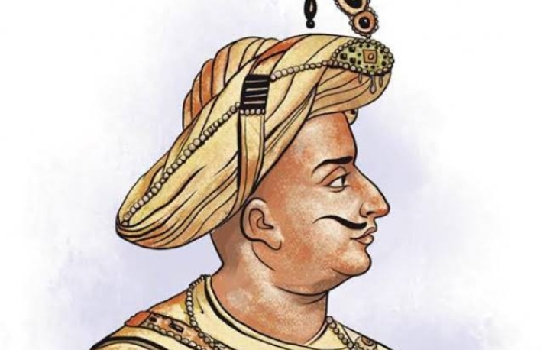
Bengaluru, Jul 28: After the Central Board of Secondary Education (CBSE) reduced the syllabi for Classes 9 to 12 due to COVID-19 pandemic, the Karnataka government has followed the suit. The Department of Public Instruction has omitted the chapters on legendary south Indian rulers Hyder Ali and Tipu Sultan from the textbooks of Class 7 in their attempt to reduce syllabus for state board schools by 30 per cent. 

The department, however, has decided to retain similar chapters on Tipu Sultan in 6th and 10th Classes, though the syllabus in text books for all classes from 1 to 10th has been trimmed. 

The trimmed textbooks uploaded on the website of the Department of State Education Research and Training (DSERT) by Karnataka state Textbook Society revealed removal of chapters on Tipu Sultan for the seventh grade.

Justifying the decision, officials said, "students study similar chapters in Class 6 and more in the 10th grade." Yet another senior official from the Text Book Society said, "Trimming does not mean we have removed half of the syllabus from textbooks. It is only keeping in mind the repetition we have condensed the chapters. In case students study about a particular dynasty in higher grades, then the same had been removed from lower grades."

A few months ago, there was an uproar over dropping of content on Tipu Sultan and MLAs from the ruling BJP also demanded the same and petitioned to the Chief Minister. Even an expert committee led by Prof Baraguru Ramachandrappa suggested to not drop any content on the historic figure. However, the department still decided to drop lessons from one of the classes while keeping the syllabus short for the next 120 active academic days.

Earlier this month, a controversy had erupted over the CBSE's decision to omit topics like federalism, secularism, citizenship, etc while reducing the syllabus for Classes 9 to 12. The education board had issued a detailed clarification later, stating that topics claimed to be dropped "are either being covered by the rationalised syllabus or in the Alternative Academic Calendar of NCERT".

"The rationalisation of syllabus up to 30 per cent has been undertaken by the Board for nearly 190 subjects of class 9 to 12 for the academic session 2020-21 as a one-time measure only. The objective is to reduce the exam stress of students due to the prevailing health emergency situation and prevent learning gaps," it said.

Last week, the Congress in Uttar Pradesh expressed its concern over 'deliberate and systematic' deletions of chapters related to the freedom struggle and the party's role in it from the Class 10-12 syllabi of the Secondary Education Board.


Comments

Add new comment

  • Coastaldigest.com reserves the right to delete or block any comments.
  • Coastaldigset.com is not responsible for its readers’ comments.
  • Comments that are abusive, incendiary or irrelevant are strictly prohibited.
  • Please use a genuine email ID and provide your name to avoid reject.
News Network
March 27,2020

Bengaluru, Mar 27: In a preparatory measure to tackle any exigency in the backdrop of spread of coronavirus, the Karnataka government has asked district administrations to use as quarantine centres the residential schools and hostels that come the under Social Welfare department.

"Wherever necessary, these residential schools and hostels can be converted as quarantine facility without any extra cost by the district administrations," Deputy Chief Minister Govind Karjol said in a statement.

The total number of COVID-19 cases in Karnataka stood at 55, including two deaths and three discharged persons, as on Thursday.

Karjol, who is also the Minister in-charge of Social Welfare department said, in view of holidays for educational institutions, there were no students staying in the residential schools and hostels and hence they can be used for quarantine purpose.

All the residential schools at hostels in districts and taluks are spacious and have all required facilities like rooms, kitchen, toilets, bathrooms, libraries among others, the Minister said adding most of them were located away from densely populated areas.

Comments

Add new comment

  • Coastaldigest.com reserves the right to delete or block any comments.
  • Coastaldigset.com is not responsible for its readers’ comments.
  • Comments that are abusive, incendiary or irrelevant are strictly prohibited.
  • Please use a genuine email ID and provide your name to avoid reject.