Udupi: Bajrang Dal men thrash 2 for transporting buffaloes; arrested

coastaldigest.com news network
July 21, 2017

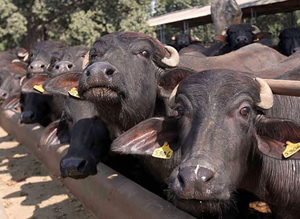
Udupi, Jul 21: Miscreants belonging to Bajrang Dal on Thursday waylaid a vehicle and thrashed two persons for allegedly illegally transporting two buffaloes at Jarigekatte Junction in Mundkur village coming under Karkala Rural Police Station limits in Udupi district.buffaloes

It is learnt that the miscreants stopped a van which was carrying two buffaloes at Jarigekatte Junction at around 8 a.m.. They beat the two persons, Rajesh Mendonca and Sadhu Poojary, who were transporting the two buffaloes in the van.

Meanwhile, Sub-Inspector of Police Karkala Rural Police Station who also got information about this, rushed to the spot and raided the van. Since Rajesh Mendonca had been assaulted, he was taken to hospital for treatment. Meanwhile, Sadhu Poojary had managed to escape.

The police seized the two buffaloes which had been kept tied in the van along with the vehicle. A case had been registered against the victims in the van under sections 8, 9 and 11 of Karnataka Cow Slaughter Prevention Act and Section 379 (theft) of the Indian Penal Code (IPC).

Rajesh Mendonca in his complaint stated that he was transporting the two buffaloes in the van from the house of Sadhu Poojary at Renjal village in Karkala taluk, which were to be given to a person, Chandrahasa Shetty, at Punaroor village near Mulki in Dakshina Kannada district, for rearing them.

But when the van reached Jarigekatte Junction, the two activists, Sandeep and Ramesh, stopped the vehicle.

They beat him and Sadhu Poojary, who was with him, with their hands. He suffered an injury in his head. But in the melee, Sadhu Poojary managed to escape.

A case has been registered under Sections 341 (punishment for wrongful restraint), 324 (voluntarily causing hurt by dangerous weapons or means), 323 (punishment for voluntarily causing hurt) read with Section 34 of Indian Penal Code.

K.T. Balakrishna, Superintendent of Police, said that the police had arrested both Sandeep and Ramesh and produced them before court which granted them bail.

Meanwhile, Rajesh Mendonca, who was later arrested, was produced before court which remanded in judicial custody, he said.

Comments

Wonder Kotian
 - 
Sunday, 23 Jul 2017

Wonderful Ashokappa Better you become Law and Order man to obey the law!!!!!!! but in Dakshina Karnataka, Not only RSS Criminal but also some other poor Humans killed by RSS criminals, Ashoka and Shobakka both side of a Coin, but every Dog has its own day, our greatest, Honourable Minister doing fantastic work around Dakshina Karnataka, Hats of to him.
Jai Hoo Siddanna.

Add new comment

  • Coastaldigest.com reserves the right to delete or block any comments.
  • Coastaldigset.com is not responsible for its readers’ comments.
  • Comments that are abusive, incendiary or irrelevant are strictly prohibited.
  • Please use a genuine email ID and provide your name to avoid reject.
News Network
January 19,2020

Chikkamagaluru, Jan 19: A Chikkamagaluru court on Saturday were sentenced to death two persons convicted of rape and murder 18-year-old girl in 2016.

Pradeep M, 32, and Santhosh, 24, of Vykuntapura in Sringeri taluk raped a 18-year-old girl while she was returning home from college on Februrary 16, 2016.

The crime in which a first year B.Com student who was walking towards her home in a footway was stopped, raped and murdered by the duo. The killers then had dumped her body in a discarded well.

Comments

Add new comment

  • Coastaldigest.com reserves the right to delete or block any comments.
  • Coastaldigset.com is not responsible for its readers’ comments.
  • Comments that are abusive, incendiary or irrelevant are strictly prohibited.
  • Please use a genuine email ID and provide your name to avoid reject.
Ram Puniyani
February 10,2020

Noam Chomsky is one of the leading peace workers in the world. In the wake of America’s attack on Vietnam, he brought out his classic formulation, ‘manufacturing consent’. The phrase explains the state manipulating public opinion to have the public approve of it policies—in this case, the attack of the American state on Vietnam, which was then struggling to free itself from French colonial rule.

In India, we are witness to manufactured hate against religious minorities. This hatred serves to enhance polarisation in society, which undermines India’s democracy and Constitution and promotes support for a Hindu nation. Hate is being manufactured through multiple mechanisms. For example, it manifests in violence against religious minorities. Some recent ghastly expressions of this manufactured hate was the massive communal violence witnessed in Mumbai (1992-93), Gujarat (2002), Kandhamal (2008) and Muzaffarnagar (2013). Its other manifestation was in the form of lynching of those accused of having killed a cow or consumed beef. A parallel phenomenon is the brutal flogging, often to death, of Dalits who deal with animal carcasses or leather.

Yet another form of this was seen when Shambhulal Regar, indoctrinated by the propaganda of Hindu nationalists, burned alive Afrazul Khan and shot the video of the heinous act. For his brutality, he was praised by many. Regar was incited into the act by the propaganda around love jihad. Lately, we have the same phenomenon of manufactured hate taking on even more dastardly proportions as youth related to Hindu nationalist organisations have been caught using pistols, while police authorities look on.

Anurag Thakur, a BJP minster in the central government recently incited a crowd in Delhi to complete his chant of what should happen to ‘traitors of the country...” with a “they should be shot”. Just two days later, a youth brought a pistol to the site of a protest at Jamia Millia Islamia university and shouted “take Azaadi!” and fired it. One bullet hit a student of Jamia. This happened on 30 January, the day Nathuram Godse had shot Mahatma Gandhi in 1948. A few days later, another youth fired near the site of protests against the CAA and NRC at Shaheen Bagh. Soon after, he said that in India, “only Hindus will rule”.

What is very obvious is that the shootings by those associated with Hindu nationalist organisations are the culmination of a long campaign of spreading hate against religious minorities in India in general and against Muslims in particular. The present phase is the outcome of a long and sustained hate campaign, the beginning of which lies in nationalism in the name of religion; Muslim nationalism and Hindu nationalism. This sectarian nationalism picked up the communal view of history and the communal historiography which the British introduced in order to pursue their ‘divide and rule’ policy.

In India what became part of “social common sense” was that Muslim kings had destroyed Hindu temples, that Islam was spread by force, and that it is a foreign religion, and so on. Campaigns, such as the one for a temple dedicated to the Hindu god Rama to be built at the site where the Babri masjid once stood, further deepened the idea of a Muslim as a “temple-destroyer”. Aurangzeb, Tipu Sultan and other Muslim kings were tarnished as the ones who spread Islam by force in the subcontinent. The tragic Partition, which was primarily due to British policies, and was well-supported by communal streams also, was entirely attributed to Muslims. The Kashmir conflict, which is the outcome of regional, ethnic and other historical issues, coupled with the American policy of supporting Pakistan’s ambitions of regional hegemony, (which also fostered the birth of Al-Qaeda), was also attributed to the Muslims.

With recurring incidents of communal violence, these falsehoods went on going deeper into the social thinking. Violence itself led to ghettoisation of Muslims and further broke inter-community social bonds. On the one hand, a ghettoised community is cut off from others and on the other hand the victims come to be presented as culprits. The percolation of this hate through word-of-mouth propaganda, media and re-writing of school curricula, had a strong impact on social attitudes towards the minorities.

In the last couple of decades, the process of manufacturing hate has been intensified by the social media platforms which are being cleverly used by the communal forces. Swati Chaturvedi’s book, I Am a Troll: Inside the Secret World of the BJP’s Digital Army, tells us how the BJP used social media to spread hate. Whatapp University became the source of understanding for large sections of society and hate for the ‘Other’, went up by leaps and bounds. To add on to this process, the phenomenon of fake news was shrewdly deployed to intensify divisiveness.

Currently, the Shaheen Bagh movement is a big uniting force for the country; but it is being demonised as a gathering of ‘anti-nationals’. Another BJP leader has said that these protesters will indulge in crimes like rape. This has intensified the prevalent hate.

While there is a general dominance of hate, the likes of Shambhulal Regar and the Jamia shooter do get taken in by the incitement and act out the violence that is constantly hinted at. The deeper issue involved is the prevalence of hate, misconceptions and biases, which have become the part of social thinking.

These misconceptions are undoing the amity between different religious communities which was built during the freedom movement. They are undoing the fraternity which emerged with the process of India as a nation in the making. The processes which brought these communities together broadly drew from Gandhi, Bhagat Singh and Ambedkar. It is these values which need to be rooted again in the society. The communal forces have resorted to false propaganda against the minorities, and that needs to be undone with sincerity.

Combating those foundational misconceptions which create hatred is a massive task which needs to be taken up by the social organisations and political parties which have faith in the Indian Constitution and values of freedom movement. It needs to be done right away as a priority issue in with a focus on cultivating Indian fraternity yet again.

Comments

Add new comment

  • Coastaldigest.com reserves the right to delete or block any comments.
  • Coastaldigset.com is not responsible for its readers’ comments.
  • Comments that are abusive, incendiary or irrelevant are strictly prohibited.
  • Please use a genuine email ID and provide your name to avoid reject.
News Network
February 12,2020

Mumbai, Feb 12: The Income Tax department's Criminal Investigation wing has identified 2,000 Indian citizens who hold properties in Dubai but had failed to declare it in their IT returns.

In its ongoing crackdown on black money, the agency has identified Indian citizens who purchased properties in Dubai but failed to declare and explain the source of funds used to purchase these properties.

In the past few years, people have used shell companies to route illegal money and buy overseas properties to evade income tax.

However, the tax department has now increased its efforts to track down those involved in major tax evasion cases.

The 2,000 persons and companies identified mainly include businessmen, top professionals, and government officials.

The IT department will initiate action against the accused under the Black Money Act.

Citizens who own properties outside the country but fail to declare the source of funds or income used for the purchase could be prosecuted under the Black Money Act.

Under Section FA (Foreign Assets) of the Income Tax Act, an individual has to declare purchase and ownership of properties, assets, companies owned outside the country while filing the income tax returns annually.

In the recent drive against black money, the IT department identified 2,000 Indian nationals who failed to provide information on the same while filing IT returns.

Of the 2,000 citizens owning properties in Dubai, around 600 could not furnish details regarding purchase details.

Those who haven't been able to explain the source of funds used for the purchase of properties could be prosecuted and their properties can be attached by the agency.

Other than the attachment of the property, they can face a monetary penalty up to 300 per cent of the property value and also face imprisonment under the Black Money Act.

The properties owned by Indians in Dubai raised red flags as this pattern of parking money is used by money launderers, smugglers, underworld gangsters and drug traffickers for making payments.

It is worth mentioning that of the 2,000 citizens identified, most are residing in Mumbai, followed by Kerala and Gujarat.

The clause under section FA (foreign Assets) came into effect in the year 2011-12 and it is mandatory for people owning properties outside India to declare it in their IT returns.

Those identified by IT department could also face action under FEMA (Foreign Exchange Management Act) by the Enforcement Directorate under Section 4.

Recently the Enforcement Directorate (ED) launched a crackdown on black money parked overseas by tracking and identifying immovable assets bought overseas by Indian nationals illegally.

The move is being carried out under rules laid down under Section 4 of FEMA (Foregn Exchange Manipulation Act), 1999. Section 4 of FEMA states that no person resident in India shall acquire, hold, own, possess or transfer any foreign exchange, foreign security or any immovable property situated outside India.

On January 17, the Enforcement Directorate (ED) conducted searches at the residence of a former chief engineer of Brihanmumbai Municipal Corporation (BMC) in connection with an inquiry related to FEMA.

In the raids, the ED officials recovered documents related to the purchase of a property in Dubai in an allegedly illegal manner.

The ex-BMC chief engineer was posted with some of the most crucial wings of the municipal corporation -- the building proposal department and development plan department.

The agency did not disclose the name of the ex-BMC chief engineer but it has been learnt that he had superannuated around seven years ago from the municipal corporation.

ED, in a statement, said incriminating documents with regard to illegal acquisition of a property held in Dubai was recovered during the search operation.

The former BMC chief engineer has stated that he had purchased the property in Dubai at 'Park Island, Bonaire Marsa, Dubai' for Rs 70 lakh in 2012. The property is held jointly in his name, his spouse and son.

The retired BMC officials could not furnish any documents which would help ascertain the value of the property and also could not provide details on how the payments were made to buy the property in Dubai.

The citizens identified by the IT department recently also adopted a similar route to buy property in Delhi. It remains to be seen how the income tax department plans to penalise them.


Comments

Add new comment

  • Coastaldigest.com reserves the right to delete or block any comments.
  • Coastaldigset.com is not responsible for its readers’ comments.
  • Comments that are abusive, incendiary or irrelevant are strictly prohibited.
  • Please use a genuine email ID and provide your name to avoid reject.