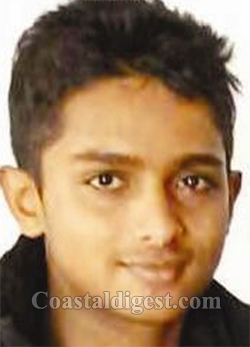
Udupi: Collision of motorbikes claims life of 16-year-old PU student

[email protected] (CD Network)
May 3, 2016

Udupi, May 3: A 16-year-old boy lost his life after a collision between two motorbikes at Ucchila near Padubidri in Udupi district.

zumeeruddinThe victim has been identified as Zameeruddin, a resident of a resident of Belapu Malanguli, here.

He was riding pillion on his friend Shamsuddin's motorbike from Ucchila to Padubidri.

When they reached Mahalakshmi temple near Ucchil an over-speed motorbike coming from the opposite direction rammed into their two-wheeler.

All three people sustained injuries and hospitalized after the accident. However, a day after the tragedy Zameeruddin succumbed to death in a hospital on Monday.

Son of a rickshaw driver father and tailor mother, Zameeruddin was perusing Pre University Course. He had secured a part time job at a shop in Kaup a day before the accident.


Comments

Gowraw
 - 
Tuesday, 3 May 2016

really sad to hear young boy lost his life, Rest in Peace bro.

Add new comment

  • Coastaldigest.com reserves the right to delete or block any comments.
  • Coastaldigset.com is not responsible for its readers’ comments.
  • Comments that are abusive, incendiary or irrelevant are strictly prohibited.
  • Please use a genuine email ID and provide your name to avoid reject.
News Network
April 4,2020

New Delhi, Apr 4: The Supreme Court on Friday urged Karnataka and Kerala to amicably resolve their issues concerning a border blockade that has choked the free flow of vehicles carrying essential items and patients in the midst of the COVID-19 outbreak.

Karnataka, which imposed the blockade, justified that its border was sealed to “combat the spread of the pandemic by preventing the movement of people from the bordering districts of Kerala to Karnataka”.

The State had moved the Supreme Court, challenging a Kerala High Court order on April 1 to open the border. Kerala has countered that patients from the State cannot be denied access to health care. Besides, the blockade has severely affected the supply of essential items, from medicines to food, to Kerala.

On Friday, a Supreme Court Bench of Justices L. Nageswara Rao and Deepak Gupta urged the States to not confront each other in the midst of an unprecedented public health crisis. Instead, it asked the Chief Secretaries of both States to sit with the Union Health Secretary and iron out a solution. Meanwhile, the apex court urged Kerala not to take any precipitative action based on the High Court order.

The court issued notice to Kerala on the appeal filed by Karnataka, represented by advocate Shubhranshu Padhi. It listed the case for further hearing on April 7.

Karnataka, in its appeal against the High Court order, said the blockade was put in place in the interest of public health. The situation regarding Coronavirus was “really dire”, it said. It warned that opening the blockade would cause a law and order issue as its local population wanted the border to remain sealed.

Karnataka argued that Kerala was the “worst-affected” State in the country with nearly 194 coronavirus cases. In this, Kasaragod, adjoining Karnataka, was the “worst affected” district of Kerala with over a 100 positive cases.

MP’s plea

The court also separately considered a writ petition by Kasaragod MP Rajmohan Unnithan for an order to forthwith open the State border.

The parliamentarian, represented by advocates Haris Beeran and Pallavi Pratap, urged the court to issue an ex-parte stay on the operation of the blockade imposed by Karnataka with its border States.

Mr. Unnithan said Karnataka’s blockade was “ill-planned and dangerous” and had led to loss of lives. Two patients from Kerala, in need of urgent medical care, died after their ambulances were denied entry at the border by the Karnataka authorities. 

Comments

Add new comment

  • Coastaldigest.com reserves the right to delete or block any comments.
  • Coastaldigset.com is not responsible for its readers’ comments.
  • Comments that are abusive, incendiary or irrelevant are strictly prohibited.
  • Please use a genuine email ID and provide your name to avoid reject.
News Network
March 21,2020

Bengaluru, Mar 21: Three new COVID-19 cases have been confirmed in Karnataka, taking the total number of infections to 18, the state government said on Saturday.

Earlier in the day, Health Minister B Sriramulu giving details about one positive case said, a 32-year old person from Gauribidanur in Chikkaballapura district, who has returned from Mecca has been confirmed for coronavirus infection.

The person has been admitted in a designated isolated hospital for treatment, he said in a tweet.

Details regarding the other two patients are still awaited.

The mid-day situation update by the government also said a circular has been issued to Health and Family Welfare Department officials and staff at all levels to work even on Sundays and general holidays without fail till March 31 in view of COVID-19.

A total of 48 government hospitals and 35 private hospitals have been identified as first respondent hospitals for the case management of COVID-19 cases, it said.

Mental health counselling is being done for positive COVID-19 cases and suspects in the identified hospitals and quarantined persons at home and hospital.

A total of 4,390 counselling sessions have been held till date, it added.

Sriramulu in a tweet, also said the government as a precautionary measure is planning to install thermal test CC cameras at government offices and certain important places.

Comments

Add new comment

  • Coastaldigest.com reserves the right to delete or block any comments.
  • Coastaldigset.com is not responsible for its readers’ comments.
  • Comments that are abusive, incendiary or irrelevant are strictly prohibited.
  • Please use a genuine email ID and provide your name to avoid reject.
Agencies
May 8,2020

Washington D.C., May 8: The prime time for brain development in a child's life is the first year, where the infant spends most of the time asleep. It is the time when neural connections form and sensory memories are encoded.

However, when sleep is disrupted, as occurs more often among children with autism, brain development may be affected, too.

New research led by the University of Washington finds that sleep problems in a baby's first 12 months may not only precede an autism diagnosis but also may be associated with altered growth trajectory in a key part of the brain, the hippocampus.

The study, which was published in the American Journal of Psychiatry, researchers report that in a sample of more than 400 taken of 6- to 12-month-old infants, those who were later diagnosed with autism were more likely to have had difficulty falling asleep.

It also states that this sleep difficulty was associated with altered growth trajectories in the hippocampus.

"The hippocampus is critical for learning and memory, and changes in the size of the hippocampus have been associated with poor sleep in adults and older children.

As many as 80 per cent of the children with autism spectrum disorder have sleep problems," said Annette Estes, director of the UW Autism Center and senior author of the study.

"In our clinical experience, parents have a lot of concerns about their children's sleep, and in our work on early autism intervention, we observed that sleep problems were holding children and families back," added Estes, who is also a UW professor of speech and hearing sciences.

"It could be that altered sleep is part-and-parcel of autism for some children. One clue is that behavioural interventions to improve sleep don't work for all children with autism, even when their parents are doing everything just right. This suggests that there may be a biological component to sleep problems for some children with autism," said Estes.

To consider links among sleep, brain development, and autism, researchers at the IBIS Network looked at MRI scans of 432 infants, surveyed parents about sleep patterns, and measured cognitive functioning using a standardized assessment.

At the outset of the study, infants were classified according to their risk for developing autism: Those who were at higher risk of developing autism -- about two-thirds of the study sample -- had an older sibling who had already been diagnosed.

Infant siblings of children with autism have a 20 per cent chance of developing autism spectrum disorder -- a much higher risk than children in the general population.

In the current study, 127 of the 432 infants were identified as "low risk" at the time the MRI scans were taken because they had no family history of autism.

They later evaluated all the participants at 24 months of age to determine whether they had developed autism. Of the roughly 300 children originally considered "high familial risk," 71 were diagnosed with autism spectrum disorder at that age.

Problems with sleep were more common among the infants later diagnosed with an autism spectrum disorder, as were larger hippocampi. No other subcortical brain structures were affected, including the amygdala, which is responsible for certain emotions and aspects of memory, or the thalamus, a signal transmitter from the spinal cord to the cerebral cortex.

The authors note that while parents reported more sleep difficulties among infants who developed autism compared to those who did not, the differences were very subtle and only observed when looking at group averages across hundreds of infants.

Sleep patterns in the first years of life change rapidly as infants transition from sleeping around the clock to a more adult-like sleep/wake cycle. Until further research is completed, Estes said, it is not possible to interpret challenges with sleep as an early sign of increased risk for autism.


Comments

Add new comment

  • Coastaldigest.com reserves the right to delete or block any comments.
  • Coastaldigset.com is not responsible for its readers’ comments.
  • Comments that are abusive, incendiary or irrelevant are strictly prohibited.
  • Please use a genuine email ID and provide your name to avoid reject.