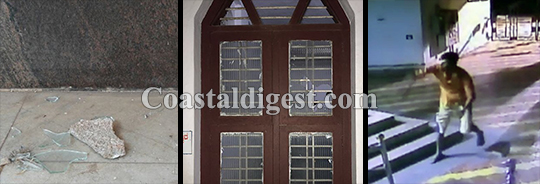
Udupi: Miscreant pelts stones at mosque; crime captured on CCTV

[email protected] (CD Network)
January 29, 2017

Udupi, Jan 29: A trouble monger pelted stones at Noorul Islam mosque at Adi-Udupi near here in the intervening night of Saturday and Sunday.

stone

The incident came to light early on Sunday morning when the muezzin visited the mosque to deliver the azan (prayer call) for Fajr namaz.

Two window panes of the mosque have been broken in the incident. The crime was clearly recorded in the CCTV camera installed outside the mosque.

Police, who watched the footage, said that around midnight a man with orange colour shirt arrived on a motorbike and pelted stones at the mosque. The man's face also has been captured by the CCTV.

Udupi DySP Kumaraswamy DySP, Udupi CPI Naveenchandra, Brahmavar CPI Shrikanth visited the spot. It is said that the same mosque was attacked by the miscreants in a similar way nearly a decade ago.

A case has been registered in Udupi Town Police station and investigations are on. Police have promised to nab the culprit.

Comments

suresh
 - 
Sunday, 29 Jan 2017

Dear Viren don't worry. It is already recoded in CCTV. Police will take care about the person. Your advise is not requested. Better do your work and look into your own things.

SYED
 - 
Sunday, 29 Jan 2017

Mr. Viren, thanks for not saying mentally ill.
The one who pelted stone is identified as saffron terrorist and not mentally ill

Dodanna
 - 
Sunday, 29 Jan 2017

Dear Kotian,

Come in front of SALAFI community there is bravery award for you.

L K Monu Borkala
 - 
Sunday, 29 Jan 2017

All Masjids are belongs to Allah. there is no salafi sunni thableeg jamath Masjid in the world. If one calls it by the name of the group then it may belongs to the group and may not be to Allah and may be name sake. The one who pelts stone to the Masjid will not be a Muslim. either he is Mushrik or Non Beleiver.

Viren Kotian
 - 
Sunday, 29 Jan 2017

If that is a Sunni mosque, the one who pelted stone must be a Salafi.

Add new comment

  • Coastaldigest.com reserves the right to delete or block any comments.
  • Coastaldigset.com is not responsible for its readers’ comments.
  • Comments that are abusive, incendiary or irrelevant are strictly prohibited.
  • Please use a genuine email ID and provide your name to avoid reject.
News Network
February 10,2020

Bengaluru, Feb 10: Two Iranian nationals have been arrested by the Karnataka police for allegedly stealing money from car showrooms by diverting cashiers’ attention in Mangaluru, Udupi and Bengaluru.

The arrested are Saeed Rostami, 26 and his friend Saber Hossein Eghbalzadeh, 35, are both residents of Tehran and in India on tourist visa. They were caught by the sleuths of Bengaluru’s RMC Yard police station.

The accused would approach the cashiers, asking for change for Rs 2000 notes to divert their attention and flee with cash from the showroom. 

The duo landed in New Delhi on January 16. Later, they arrived in coastal Karnataka before reaching Bengaluru on February 1. 

The same day around 4pm, the two visited Trident Automobile Pvt Ltd’s service centre in RMC Yard. They went to cashier Kiran and sought change for Rs 2000. One of them dropped the note and Kiran picked it up for him. Meanwhile, Kiran also noticed there was no change in his cash box and informed the duo accordingly. 

“Kiran later realised Rs 44,000 was missing from the cash box. He verified CCTV footage and found the two visitors stole the money when he bent down to pick up the Rs 2000 note,” a police officer said.

Kiran filed a theft and cheating case against the men. RMC Yard police suggested Kiran circulate the footage at other car showrooms and service centres as they had heard about similar incidents being reported from Udupi, Mangaluru and other places in Bengaluru.

“Sharing of CCTV footage helped us nab the suspects. They visited a showroom near Cauvery junction on Ballari Road on February 6. The staff noticed the duo and realised they were the same guys, who had stolen the money at RMC Yard and informed us,” said police.

Comments

Add new comment

  • Coastaldigest.com reserves the right to delete or block any comments.
  • Coastaldigset.com is not responsible for its readers’ comments.
  • Comments that are abusive, incendiary or irrelevant are strictly prohibited.
  • Please use a genuine email ID and provide your name to avoid reject.
News Network
February 5,2020

Chennai, Feb 5: In order to ensure housing for all, the Madras High Court has proposed ban on non-resident Indians from purchasing houses in India, prohibit speculative sale, and impose 100 per cent extra stamp duty on purchase of second house.

The court on its own impleaded the Union housing and finance ministries as party respondents.

It has directed them to answer a series of questions including as to how many families have basic amenity of housing in India as well as in Tamil Nadu, population and housing ratio in the country and in the state, when 'Housing for All' mission of the central government would be achieved.

"Why the government does not consider imposing such restrictions to control escalation of house prices and to provide a house to every family in the country, a division bench of Justice N Kirubakaran and Justice Abdul Quddhose wondered.

Directing the authorities to inform as to whether the central and state have got special schemes to provide housing for the marginalized and economically weaker sections including SC/ST communities, the bench has also sought the details of the number of families that possess more than one house.

"Why the governments do not restrict families/individuals from purchasing/possessing more than one housing unit/flat/plot till "Housing for all" is achieved?

Why not the government charge 100 per cent more or extra stamp duty to discourage buying more than one house by a family while purchasing second house?

Why not the government conditionally allow the families to purchase more than one house provided the said family pays 100 per cent extra statutory dues like property tax, electricity charges, water and sewerage charges on the second property?" the bench said.

This apart, the court also wanted the authorities to know as to why it should not prohibit the NRIs from purchasing houses in India to bring down the cost of housing.

Justifying its directions, the court said "Lakhs and lakhs of people are living on platforms, roads, and cement pipes, slums, under the trees and on banks of water bodies without proper shelter and basic amenities and safety."

It is true that the Centre had taken a policy decision to provide housing unit to every family.

It should be achieved at the earliest, the court said, adding it could become fruitful when restrictions are put on persons who hold more than one housing units.

The court passed the order while hearing an appeal moved by the Tamil Nadu Housing Board challenging a single judge order against acquisition of about 369 acres of private land in Thudiyalur and Vellakinar areas of Coimbatore for a housing scheme.

Comments

Suresh SS
 - 
Wednesday, 5 Feb 2020

We believed that only Indian Govt. ministers, MP and MLAs has this disease, now it is spreading everywhere even Indian High courts. it is certainly very harmful virus  

Add new comment

  • Coastaldigest.com reserves the right to delete or block any comments.
  • Coastaldigset.com is not responsible for its readers’ comments.
  • Comments that are abusive, incendiary or irrelevant are strictly prohibited.
  • Please use a genuine email ID and provide your name to avoid reject.
Agencies
May 8,2020

Washington D.C., May 8: The prime time for brain development in a child's life is the first year, where the infant spends most of the time asleep. It is the time when neural connections form and sensory memories are encoded.

However, when sleep is disrupted, as occurs more often among children with autism, brain development may be affected, too.

New research led by the University of Washington finds that sleep problems in a baby's first 12 months may not only precede an autism diagnosis but also may be associated with altered growth trajectory in a key part of the brain, the hippocampus.

The study, which was published in the American Journal of Psychiatry, researchers report that in a sample of more than 400 taken of 6- to 12-month-old infants, those who were later diagnosed with autism were more likely to have had difficulty falling asleep.

It also states that this sleep difficulty was associated with altered growth trajectories in the hippocampus.

"The hippocampus is critical for learning and memory, and changes in the size of the hippocampus have been associated with poor sleep in adults and older children.

As many as 80 per cent of the children with autism spectrum disorder have sleep problems," said Annette Estes, director of the UW Autism Center and senior author of the study.

"In our clinical experience, parents have a lot of concerns about their children's sleep, and in our work on early autism intervention, we observed that sleep problems were holding children and families back," added Estes, who is also a UW professor of speech and hearing sciences.

"It could be that altered sleep is part-and-parcel of autism for some children. One clue is that behavioural interventions to improve sleep don't work for all children with autism, even when their parents are doing everything just right. This suggests that there may be a biological component to sleep problems for some children with autism," said Estes.

To consider links among sleep, brain development, and autism, researchers at the IBIS Network looked at MRI scans of 432 infants, surveyed parents about sleep patterns, and measured cognitive functioning using a standardized assessment.

At the outset of the study, infants were classified according to their risk for developing autism: Those who were at higher risk of developing autism -- about two-thirds of the study sample -- had an older sibling who had already been diagnosed.

Infant siblings of children with autism have a 20 per cent chance of developing autism spectrum disorder -- a much higher risk than children in the general population.

In the current study, 127 of the 432 infants were identified as "low risk" at the time the MRI scans were taken because they had no family history of autism.

They later evaluated all the participants at 24 months of age to determine whether they had developed autism. Of the roughly 300 children originally considered "high familial risk," 71 were diagnosed with autism spectrum disorder at that age.

Problems with sleep were more common among the infants later diagnosed with an autism spectrum disorder, as were larger hippocampi. No other subcortical brain structures were affected, including the amygdala, which is responsible for certain emotions and aspects of memory, or the thalamus, a signal transmitter from the spinal cord to the cerebral cortex.

The authors note that while parents reported more sleep difficulties among infants who developed autism compared to those who did not, the differences were very subtle and only observed when looking at group averages across hundreds of infants.

Sleep patterns in the first years of life change rapidly as infants transition from sleeping around the clock to a more adult-like sleep/wake cycle. Until further research is completed, Estes said, it is not possible to interpret challenges with sleep as an early sign of increased risk for autism.


Comments

Add new comment

  • Coastaldigest.com reserves the right to delete or block any comments.
  • Coastaldigset.com is not responsible for its readers’ comments.
  • Comments that are abusive, incendiary or irrelevant are strictly prohibited.
  • Please use a genuine email ID and provide your name to avoid reject.