Udupi: Sri Krishna Leelotsava attracts thousands of devotees

[email protected] (CD Network)
September 6, 2015

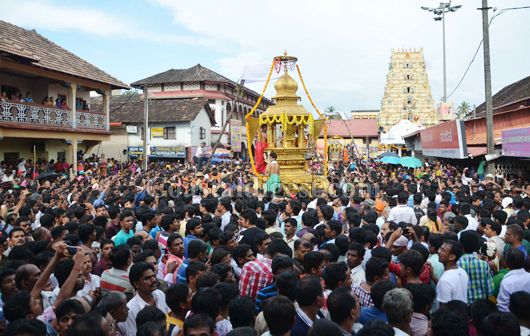
Udupi, Sep 6: Thousands of people took part in the procession of the Sri Krishna Leelotsava, popularly called the Vittal Pindi festival, on Car Street here on Sunday.

Udupi ashtami 1

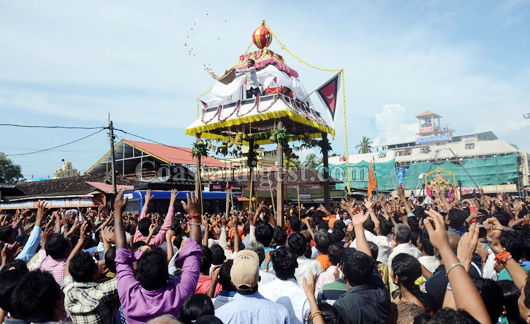
The procession started from the entrance of the Sri Krishna Mutt/Temple at around 3 p.m. Vidyavallabha Tirtha Swami of Paryaya Kaniyur Mutt installed a clay idol, ‘utsava murthy’, of Lord Krishna on the top of the golden chariot.

The idols of Lord Ananteshwara and Lord Chandramouleshwara were placed in the ‘Navaratna Ratha’ ahead of the golden chariot.

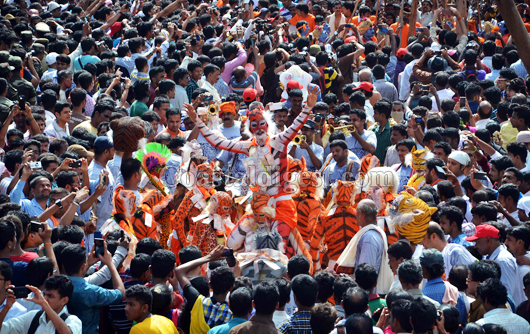
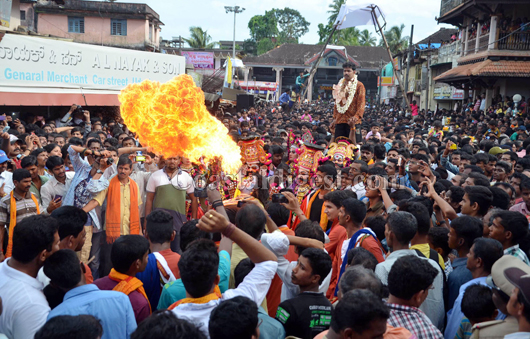
These chariots were pulled around Car Street with traditional drum beaters and ‘Huli Vesha’ dancers accompanying them. Vidyavallabha Tirtha, Vidyasagara Tirtha of Krishnapur Mutt and Lakshmivara Tirtha Swami of Shiroor Mutt walked between the two chariots.

There were a large number of people behind and in front of the chariots.

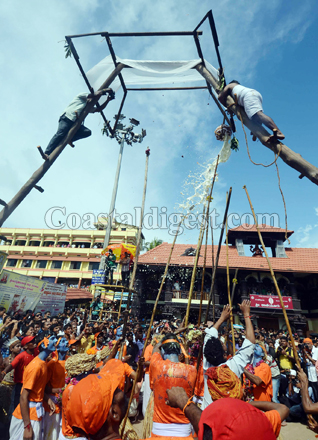
But the main highlight of the festival was mosaru kudike or breaking of earthen pots.

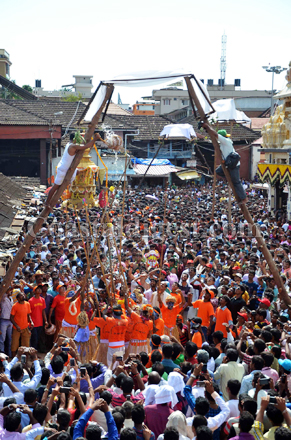
As many as 15 wooden gopuras were constructed around Car Street. As soon as the procession reached a gopura, a person would climb atop it and hang pots containing milk and milk products.

A group of persons dressed in folk costumes would stand below the gopura with long sticks and jostle with one another to break the earthen pots (with the sticks). This process was repeated at all the wooden gopuras.

People applauded them whenever they broke the earthen pots. Mosaru kudike here is different from those arranged at other places, where human pyramids are formed to break earthen pots hung above.

Then, Vidyavallabha Tirtha distributed ladoos and chakkulis at a stage put up near the Ananteshwara Temple Cross Road. Another feature of the festival was the enthusiastic participation of the Huli Vesha groups.

Their vigorous and spirited dancing enlivened the atmosphere.

What caught everyone’s eye was a Huli Vesha dancer dancing on two wooden bars held above the ground by members of his group. Some Yakshagana dancers also displayed their dancing skills during the procession.

After going around the Car Street, the procession culminated at the entrance of the Sri Krishna Mutt/Temple. The clay idol of Lord Krishna was removed from the golden chariot and taken in a golden palanquin and immersed in the Madhwa Sarovara, marking the culmination of the festival.

Udupi ashtami 1

Udupi ashtami 1

Udupi ashtami 1

Udupi ashtami 1

Udupi ashtami 1

Comments

Ashok Eggoni
 - 
Monday, 26 Sep 2016

Thank you coastaldigest for sharing. Indeed it was useful information about Udupi Temple Keep up the work..! Appreciate the time was taken to share the valuable info with the visitors/devotees like us..!

Add new comment

  • Coastaldigest.com reserves the right to delete or block any comments.
  • Coastaldigset.com is not responsible for its readers’ comments.
  • Comments that are abusive, incendiary or irrelevant are strictly prohibited.
  • Please use a genuine email ID and provide your name to avoid reject.
coastaldigest.com news network
May 27,2020

Abu Dhabi-based NMC Healthcare has reportedly received bids to sell its distribution unit and will soon be selling it to different parties.

The development comes over three months after NMC Healthcare’s founder and then-chairman B R Shetty stepped down amid allegations of massive fraud. 

The company, which recently laid off hundreds of workers, is offloading stake in the subsidiary as it is considered non-core and requires substantially high working capital to run the operations. In addition, this stake sale will help the company pay off some of its debt

"There are parties who have strong interest in the distribution business. NMC will be offloading the unit soon and that also to different parties," a source said.

"The company is in the process of exploring options for NMC Trading, the group's distribution business, which it has determined to be non-core and requiring substantial levels of working capital. The process should not materially adversely impact distributors' activities, nor NMC Trading's customers," an NMC Healthcare spokeswoman said.

The UK-court has appointed Alvarez & Marsal as administrator to oversee the operations of the debt-ridden hospital operator. The healthcare firm has been caught in a whirlpool of $6.6 billion debt while its senior former high management team is under investigation for financial irregularities.

The UAE Central Bank has direct local banks to freeze all bank accounts of NMC founder BR Shetty and his family members as well as accounts of those companies where he has a stake. The Central Bank move is subsequent to a criminal complaint filed by Abu Dhabi Commercial Bank, which has the largest exposure to NMC Healthcare, amounting Dh3 billion.

As the company faces financial difficulties, Reuters reported that NMC Health delayed May staff salaries and now expects to complete making payments by the first week of June.

The spokeswoman said: "The company has been in regular dialogue with its creditor constituencies through various creditor committees, including the direct bank lenders to its NMC Trading businesses."

Comments

Add new comment

  • Coastaldigest.com reserves the right to delete or block any comments.
  • Coastaldigset.com is not responsible for its readers’ comments.
  • Comments that are abusive, incendiary or irrelevant are strictly prohibited.
  • Please use a genuine email ID and provide your name to avoid reject.
Ram Puniyani
January 14,2020

In the beginning of January 2020 two very disturbing events were reported from Pakistan. One was the attack on Nankana Sahib, the holy shrine where Sant Guru Nanak was born. While one report said that the place has been desecrated, the other stated that it was a fight between two Muslim groups. Prime Minister of Pakistan Imran Khan condemned the incident and the main accused Imran Chisti was arrested. The matter related to abduction and conversion of a Sikh girl Jagjit Kaur, daughter of Pathi (One who reads Holy Guru Granth Sahib in Gurudwara) of the Gurudwara. In another incident one Sikh youth Ravinder Singh, who was out on shopping for his marriage, was shot dead in Peshawar.

While these condemnable attacks took place on the Sikh minority in Pakistan, BJP was quick enough to jump to state that it is events like this which justify the Citizenship Amendment Act (CAA). Incidentally CAA is the Act which is discriminatory and relates to citizenship with Religion, which is not as per the norms of Indian constitution. There are constant debates and propaganda that population of Hindus has come down drastically in Pakistan and Bangla Desh. Amit Shah, the Home minister stated that in Pakistan the population of Hindus has come down from 23% at the time of partition to 3.7% at present. And in Bangla Desh it has come down from 22% to present 8%.

While not denying the fact that the religious minorities are getting a rough deal in both these countries, the figures which are presented are totally off the mark. These figures don’t take into consideration the painful migrations, which took place at the time of partition and formation of Bangla Desh later. Pakistan census figures tell a different tale. Their first census was held in 1951. As per this census the overall percentage of Non Muslim in Pakistan (East and West together) was 14.2%, of this in West Pakistan (Now Pakistan) it was 3.44 and in Eat Pakistan it was 23.2. In the census held in Pakistan 1998 it became 3.72%. As far as Bangla Desh is concerned the share of Non Muslims has gone down from 23.2 (1951) to 9.6% in 2011.

The largest minority of Pakistan is Ahmadis, (https://minorityrights.org/country/pakistan/) who are close to 4 Million and are not recognised as Muslims in Pakistan. In Bangla Desh the major migrations of Hindus from Bangla Desh took place in the backdrop of Pakistan army’s atrocities in the then East Pakistan.

As far as UN data on refugees in India it went up by 17% between 2016-2019 and largest numbers were from Tibet and Sri Lanka.  (https://www.un.org/en/development/desa/population/migration/publication…)

The state of minorities is in a way the index of strength of democracy. Most South Asian Countries have not been able to sustain democratic values properly. In Pakistan, the Republic began with Jinnah’s classic speech where secularism was to be central credo of Pakistan. This 11th August speech was in a way what the state policy should be, as per which people of all faiths are free to practice their religion. Soon enough the logic of ‘Two Nation theory” and formation of Pakistan, a separate state for Muslim took over. Army stepped in and dictatorship was to reign there intermittently. Democratic elements were suppressed and the worst came when Zia Ul Haq Islamized the state in collusion with Maulanas. The army was already a strong presence in Pakistan. The popular formulation for Pakistan was that it is ruled by three A’s, Army, America and Allah (Mullah).

Bangla Desh had a different trajectory. Its very formation was a nail in the coffin of ‘two nation theory’; that religion can be the basis of a state. Bangla Desh did begin as a secular republic but communal forces and secular forces kept struggling for their dominance and in 1988 it also became Islamic republic. At another level Myanmar, in the grip of military dictatorship, with democratic elements trying to retain their presence is also seeing a hard battle. Democracy or not, the army and Sanghas (Buddhist Sang has) are strong, in Myanmar as well. The most visible result is persecution of Rohingya Muslims.

Similar phenomenon is dominating in Sri Lanka also where Budhhist Sanghas and army have strong say in the political affairs, irrespective of which Government is ruling. Muslim and Christian minorities are a big victim there, while Tamils (Hindus, Christians etc.) suffered the biggest damage as ethnic and religious minorities. India had the best prospect of democracy, pluralism and secularism flourishing here. The secular constitution, the outcome of India’s freedom struggle, the leadership of Gandhi and Nehru did ensure the rooting of democracy and secularism in a strong way.

India so far had best democratic credentials amongst all the south Asian countries. Despite that though the population of minorities rose mainly due to poverty and illiteracy, their overall marginalisation was order of the day, it went on worsening with the rise of communal forces, with communal forces resorting to identity issues, and indulging in propaganda against minorities.

While other South Asian countries should had followed India to focus more on infrastructure and political culture of liberalism, today India is following the footsteps of Pakistan. The retrograde march of India is most visible in the issues which have dominated the political space during last few years. Issues like Ram Temple, Ghar Wapasi, Love Jihad, Beef-Cow are now finding their peak in CAA.

India’s reversal towards a polity with religion’s identity dominating the political scene was nicely presented by the late Pakistani poetess Fahmida Riaz in her poem, Tum bhi Hum Jaise Nikle (You also turned out to be like us). While trying to resist communal forces has been an arduous task, it is becoming more difficult by the day. This phenomenon has been variously called, Fundamentalism, Communalism or religious nationalism among others. Surely it has nothing to do with the religion as practiced by the great Saint and Sufi traditions of India; it resorts mainly to political mobilization by using religion as a tool.


Comments

Ashi
 - 
Tuesday, 14 Jan 2020

If Malaysia implement similar NRC/CAA, India and China are the loser.

Add new comment

  • Coastaldigest.com reserves the right to delete or block any comments.
  • Coastaldigset.com is not responsible for its readers’ comments.
  • Comments that are abusive, incendiary or irrelevant are strictly prohibited.
  • Please use a genuine email ID and provide your name to avoid reject.
News Network
June 18,2020

Bengaluru, Jun 18: Two employees at a plant of Toyota Kirloskar Motor in Karnataka's Bidadi have tested positive for COVID-19, the automobile company said in a statement on Wednesday.

According to the auto major, the two employees had attended work on June 7 and 16 respectively.

"As a first step and through appropriate contact tracing, TKM has started identifying all those employees who may have had primary or secondary contact with the infected employees for necessary treatment and quarantine wherever necessary and is in contact with the local government authorities," the statement said.

Toyota Kirloskar Motors had restarted operations after weeks of nationwide lockdown to prevent the spread of coronavirus on May 26. It said that all necessary precautions were to maintain social distancing and all Central and state government directives were being followed.

"However, despite all such measures, two employees at TKM's Bidadi plant tested positive for COVID-19 on June 16th, 2020. Operations at TKM plant has already been temporarily suspended so that required disinfection can be carried out at the plant," the statement said.

"TKM has extended all necessary support to the infected employees for medical treatment as well as quarantine procedures. The company is in touch with the families of the infected employees so as to support them to handle this situation carefully without further complications," it added.


Comments

Add new comment

  • Coastaldigest.com reserves the right to delete or block any comments.
  • Coastaldigset.com is not responsible for its readers’ comments.
  • Comments that are abusive, incendiary or irrelevant are strictly prohibited.
  • Please use a genuine email ID and provide your name to avoid reject.