Udupi: Yeddyurappa hails Kalladka Bhat; asks CM to drop Ramanath Rai

CD Network
June 24, 2017

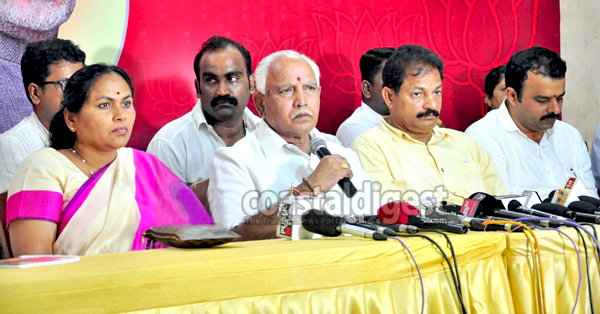
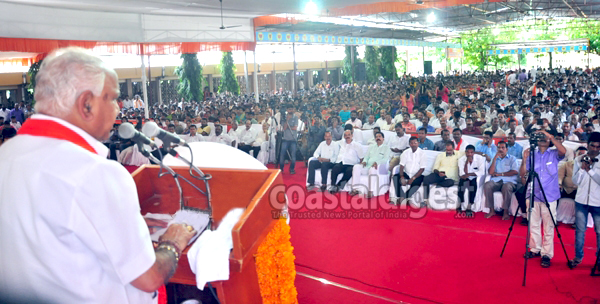
Udupi, Jun 24: Former chief minister and Karnataka BJP chief B S Yeddyurappa has demanded the Chief Minister Siddaramaiah to drop Minister for Forests and Environment B Ramanath Rai for directing a Superintendent of Police of Dakshina Kannada to arrest RSS leader Kalladka Prabhakar Bhat if the latter attempted to disrupt peace in the society.

udupiyeddy1

Addressing presspersons here on Friday, Mr. Yeddyurappa said Mr. Bhat was a sincere person and any attempt to arrest him without rhyme or reason would be illegal. Mr. Rai was indulging in such acts because he wanted to appease a particular community, he said.

Mr. Yeddyurappa said that Mr. Siddaramaiah had not followed protocol by not accompanying President Pranab Mukherjee during the latter’s visit to Sri Krishna Mutt/Temple on June 18. This despite the fact that Vishvesha Tirtha Swami of Pejawar Mutt had requested him to visit the temple.

Mr. Yeddyurappa said that he had allocated Rs. 40 crore to develop Kaginele, the birthplace of Kanakadasa, during his tenure as Chief Minister.

The government had woken up late to the problem of farm loan waiver. A large number of farmers had committed suicide in the State and nearly 25% had repaid their loans in the last four to five months. The State government should bring farmers who had repaid loans under the ambit of the waiver.

The State government had not been able to solve the sand extraction problem in the Coastal districts. Though the Union government was giving priority to the construction of national highways, the lack of sand had affected its development and also the progress of other developmental projects.

There was lot of corruption in the implementation of various works of State government.

The State government should stop accusing the Union government of step-motherly treatment. The Centre had been releasing funds to the State regularly for all Centrally-sponsored schemes, Mr. Yeddyurappa said.

udupiyeddy2

Comments

Karnataka
 - 
Saturday, 24 Jun 2017

koti koti rupay janara hanavannu kaddu jailige hogi banda fraud nachike mana maryade yavudu illa ivanige

SYED
 - 
Saturday, 24 Jun 2017

arrest bhatta and put him behind bars of bellary....

saleemkana
 - 
Saturday, 24 Jun 2017

Choti muh badi bath. What can we expect with Yeddi (Criminal)

Abdul
 - 
Sunday, 25 Jun 2017

No wonder, sangi backed sangi, DK , udupi, madikeri, chikmangalore will witness more n more riots murders coz sangis want power in 2018 election

Add new comment

  • Coastaldigest.com reserves the right to delete or block any comments.
  • Coastaldigset.com is not responsible for its readers’ comments.
  • Comments that are abusive, incendiary or irrelevant are strictly prohibited.
  • Please use a genuine email ID and provide your name to avoid reject.
Indians
May 2,2020

We, the undersigned express our solidarity with Dr Zafarul Islam Khan, renowned scholar, journalist and presently Chairman of the Delhi Minorities Commission.

We strongly condemn the continued media trial and targeting of Dr Zafarul Islam Khan for his Facebook post thanking Kuwait for expressing solidarity with Indian Muslims. In his Facebook post, he mentioned the appalling deterioration of human rights of Indian Muslims who have been targeted by Hindutva bigots. A few politicians with ulterior motives and news channel anchors known for spreading bigotry and Islamophobia have mischievously sought to misinterpret his statement and ridiculously label him as anti-Hindu and anti-India.

He has only reiterated what many citizens of India, public figures, international institutions, various European governments, the United States of America and United Nations human rights mechanisms have repeatedly underlined their concern at the increasing human rights abuse and violations of religious minorities in India.

Dr Zafarul Islam Khan is a man of integrity. He is a scholar who is known to stand up for constitutional freedoms and values.

His work as the Chairman of Delhi Minorities Commission has been warmly applauded by human rights activists and NGOs across different faiths. His timely interventions on problems of minorities in Delhi have made him a respectable figure among not only Muslims but Sikh, Christians, Jains and Parsis. He is a humanist in the truest sense of the word.

The hateful propaganda against Dr Khan is one more illustration as how certain Indians fail to differentiate between Hinduism, a religion and Hindutva which is a supremacist political ideology.

Dr Zafarul Islam Khan is a leading Indian intellectual whose niche area is Islamic studies and Arab world. He enjoys great respect in the Arab and Muslim world for his understanding and knowledge. He is an alumni of the esteemed Jamia Al-Azhar and Manchester University.

Dr Khan is known for taking bold public positions. He was the first Muslim scholar in the world who denounced ISIL, which later became IS or ISIS. He issued a statement opposing the barbaric crimes of ISIL (IS or ISIS) and Boko Haram against minorities. He takes strong stands against extremism of all sorts. That makes him a prominent critic of RSS.

Dr Khan is a scholar ambassador and earned international prestige for the India. Any attack and targeting of him, is actually an insult to Indian constitution and ethos.

We demand the appropriate authorities of the Government of India take strong legal action against those who are distorting Dr Khan’s Facebook post, and spreading vicious false propaganda against him.

Signed by:

Swami Agnivesh

Mohammad Adeeb
Arun Kumar (Prof)

Zafar Jung

Kamal Faruqui

Annie Namala

Kavita Krishnan

Subhash Gatade

Jawed Naqvi

Indu Pratap Singh

Avinash Kumar

Iftikhar Gilani

Anil Chamadia

Xavier Dias

Denzil Fernandes (Dr)

Irfan Engineer

Faisal Khan

John Dayal (Dr)

Mujtaba Farooque

Ravi Nair

Abubakr Sabbaq (Adv)

Gopal Menon

Bilal Khan

Ashok Choudhury

Jaffer Latief Najar

Mujahid Nafis

Aseem Sundan

Poojan Sahil

Ankur Otto

Mariya Salim

Tanweer Alam

Juned Khan

E M Abdul Rahiman

Aditi Dutta

Devika Prasad

Ameeque Jamei

Suhaib Ansari

Gurminder Singh

A C Michael

Neelima Sharma

Aftab Alam (Dr)

Dhruva Narayan

Syed Saif Ur Rahman

Tanweer Fazal (Dr)

Thouseef Madikeri (Dr)

N.D. Jayaprakash

Salahuddin Ansari

Satyajeet Nambiar

Suhail KK

Abu Sufiyan

Sujata Madhok

Tariq Khan

Violin Mathew Benjamin

Shamsul Islam (Prof)

Sreedhar Ramamurthi

Mohd. Shahid (Prof)

Anand Vivek Taneja (Dr)

Kush Kumar Singh (Dr)

Mangla Verma

Vipul Kumar

Waquar Hasan

Braham Prakash

Abdul Rashid Agwan

Fawaz Shaheen

Guman Singh

Mohammed Hafeez Ulla

Kp Sasi

Mushfique Raza Khan

Partha S Banerjee

Gautam Majumdar

S.Q. Masood

Aiman J Khan

M. K. Faizy

Tasleem Rehmani (Dr)

Mohammed Shafi

Lenin Raghuvanshi (Dr)

Malik Motasim Khan

Kripal Singh Mandloi

Labeed Shafi

Qamar Intakhab

Raees Ahmed Siddiqui

Laeeq Ahmed Khan

Anthony Arulraj

Sadiq Zafar

Biju Gopidasan

George Pulikuthiyil

Mohd Abdullah

Mohd Sorab Hussain

Mukunda Kattel

Sandeep Pendse

Paul Newman

Ovais Sultan Khan

Comments

Add new comment

  • Coastaldigest.com reserves the right to delete or block any comments.
  • Coastaldigset.com is not responsible for its readers’ comments.
  • Comments that are abusive, incendiary or irrelevant are strictly prohibited.
  • Please use a genuine email ID and provide your name to avoid reject.
News Network
July 6,2020

Mangaluru, Jul 6: Two fresh deaths in last 24 hours have taken the total number of covid-19 deaths in Dakshina Kannada district to 24.

The deceased are a 52-year-old woman from Ullal and a 52-year-old man from Thokkottu.

The man was suffering from cardovascular disease and pneumonia, sources said.

The woman passed away in Wenlock hospital.

More details are awaited.

Comments

Add new comment

  • Coastaldigest.com reserves the right to delete or block any comments.
  • Coastaldigset.com is not responsible for its readers’ comments.
  • Comments that are abusive, incendiary or irrelevant are strictly prohibited.
  • Please use a genuine email ID and provide your name to avoid reject.
News Network
July 28,2020

Hounde, Jul 28: Coronavirus and its restrictions are pushing already hungry communities over the edge, killing an estimated 10,000 more young children a month as meager farms are cut off from markets and villages are isolated from food and medical aid, the United Nations warned Monday.

In the call to action shared with The Associated Press ahead of publication, four UN agencies warned that growing malnutrition would have long-term consequences, transforming individual tragedies into a generational catastrophe.

Hunger is already stalking Haboue Solange Boue, an infant from Burkina Faso who lost half her former body weight of 5.5 pounds (2.5 kilograms) in just a month. Coronavirus restrictions closed the markets, and her family sold fewer vegetables. Her mother was too malnourished to nurse.

“My child,” Danssanin Lanizou whispered, choking back tears as she unwrapped a blanket to reveal her baby's protruding ribs.

More than 550,000 additional children each month are being struck by what is called wasting, according to the UN — malnutrition that manifests in spindly limbs and distended bellies. Over a year, that's up 6.7 million from last year's total of 47 million. Wasting and stunting can permanently damage children physically and mentally.

“The food security effects of the COVID crisis are going to reflect many years from now,” said Dr. Francesco Branca, the WHO head of nutrition. “There is going to be a societal effect.”

From Latin America to South Asia to sub-Saharan Africa, more poor families than ever are staring down a future without enough food.

In April, World Food Program head David Beasley warned that the coronavirus economy would cause global famines “of biblical proportions” this year. There are different stages of what is known as food insecurity; famine is officially declared when, along with other measures, 30% of the population suffers from wasting.

The World Food Program estimated in February that one Venezuelan in three was already going hungry, as inflation rendered salaries nearly worthless and forced millions to flee abroad. Then the virus arrived.

“Every day we receive a malnourished child,” said Dr. Francisco Nieto, who works in a hospital in the border state of Tachira.

In May, Nieto recalled, after two months of quarantine, 18-month-old twins arrived with bodies bloated from malnutrition. The children's mother was jobless and living with her own mother. She told the doctor she fed them only a simple drink made with boiled bananas.

“Not even a cracker? Some chicken?” he asked.

“Nothing,” the children's grandmother responded. By the time the doctor saw them, it was too late: One boy died eight days later.

The leaders of four international agencies — the World Health Organization, UNICEF, the World Food Program and the Food and Agriculture Organization — have called for at least dollar 2.4 billion immediately to address global hunger.

But even more than lack of money, restrictions on movement have prevented families from seeking treatment, said Victor Aguayo, the head of UNICEF's nutrition program.

“By having schools closed, by having primary health care services disrupted, by having nutritional programs dysfunctional, we are also creating harm,” Aguayo said. He cited as an example the near-global suspension of Vitamin A supplements, which are a crucial way to bolster developing immune systems.

In Afghanistan, movement restrictions prevent families from bringing their malnourished children to hospitals for food and aid just when they need it most. The Indira Gandhi hospital in the capital, Kabul, has seen only three or four malnourished children, said specialist Nematullah Amiri. Last year, there were 10 times as many.

Because the children don't come in, there's no way to know for certain the scale of the problem, but a recent study by Johns Hopkins University indicated an additional 13,000 Afghans younger than 5 could die.

Afghanistan is now in a red zone of hunger, with severe childhood malnutrition spiking from 690,000 in January to 780,000 — a 13% increase, according to UNICEF.

In Yemen, restrictions on movement have blocked aid distribution, along with the stalling of salaries and price hikes. The Arab world's poorest country is suffering further from a fall in remittances and a drop in funding from humanitarian agencies.

Yemen is now on the brink of famine, according to the Famine Early Warning Systems Network, which uses surveys, satellite data and weather mapping to pinpoint places most in need.

Some of the worst hunger still occurs in sub-Saharan Africa. In Sudan, 9.6 million people live from one meal to the next — a 65% increase from the same time last year.

Lockdowns across Sudanese provinces, as around the world, have dried up work and incomes for millions. With inflation hitting 136%, prices for basic goods have more than tripled.

“It has never been easy but now we are starving, eating grass, weeds, just plants from the earth,” said Ibrahim Youssef, director of the Kalma camp for internally displaced people in war-ravaged south Darfur.

Adam Haroun, an official in the Krinding camp in west Darfur, recorded nine deaths linked with malnutrition, otherwise a rare occurrence, over the past two months — five newborns and four older adults, he said.

Before the pandemic and lockdown, the Abdullah family ate three meals a day, sometimes with bread, or they'd add butter to porridge. Now they are down to just one meal of “millet porridge” — water mixed with grain. Zakaria Yehia Abdullah, a farmer now at Krinding, said the hunger is showing “in my children's faces.”

“I don't have the basics I need to survive,” said the 67-year-old, who who hasn't worked the fields since April. “That means the 10 people counting on me can't survive either.”


Comments

Add new comment

  • Coastaldigest.com reserves the right to delete or block any comments.
  • Coastaldigset.com is not responsible for its readers’ comments.
  • Comments that are abusive, incendiary or irrelevant are strictly prohibited.
  • Please use a genuine email ID and provide your name to avoid reject.