



UK banks stop trading Qatari riyals as diplomatic crisis mounts

Arab News
July 1, 2017

London/Dubai, Jul 1: Several British banks said on Friday they had stopped dealing in Qatari riyals, as the diplomatic crisis surrounding the tiny Gulf country disrupted overseas trading of its currency.
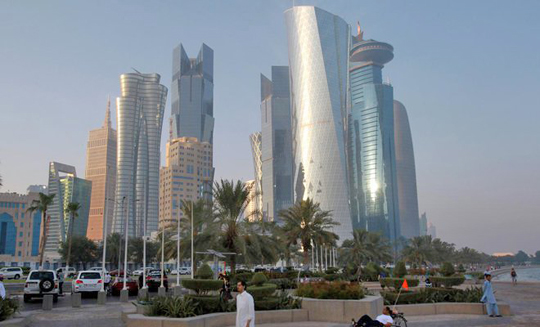
Qataririyals

Saudi Arabia, the United Arab Emirates, Bahrain and Egypt severed diplomatic and travel links with Qatar on June 5, accusing it of supporting terrorism and courting regional foe Iran, in allegations that have ignited a regional crisis between the US allies.

Offshore trade of the riyal has become increasingly volatile and illiquid as a result, raising risks for banks.

Barclays became the latest bank to announce it was no longer trading Qatari riyals for high street customers. The bank was the latest in a list making the same announcement.

A spokeswoman for Britain’s Lloyds Banking Group said a “third-party supplier” which handles its foreign exchange service had ceased trading in Qatar’s riyal as of June 21.

“This currency is no longer available for sale or buy-back across our high street banks including Lloyds Bank, Bank of Scotland and Halifax,” she said.

Tesco Bank said it had halted dealings in the riyal, while Barclays stopped trading riyals for retail customers but continued the service for corporate customers, a source said. Royal Bank of Scotland said it had stopped trading riyals for retail customers.

Banks from the four Arab states that have cut ties with Qatar reduced or halted riyal transactions earlier this month, as have some other countries.

Some big international banks have continued riyal business, however; a spokeswoman for HSBC said on Friday that the bank was still providing riyals for high street customers.

This week the riyal traded between offshore banks as low as 3.81 to the US dollar, its lowest level this decade and more than 4 percent below its peg of 3.64 to the dollar.

Most bankers in the Gulf do not think the peg will break; onshore, the Qatari central bank has continued to provide ample supplies of dollars near 3.6415 under its peg mechanism. The world’s biggest liquefied natural gas exporter has huge reserves with which it could defend its currency.

The Arab states opposing Qatar have set a deadline of around Monday next week — officials have not publicly specified the exact time — for Doha to agree to demands such as shutting television channel Al Jazeera and reducing ties to Iran.

Publicly, Doha has shown little sign of complying, and the four states have said they could impose fresh sanctions if their demands are not met. This threat pushed the cost of insuring Qatari sovereign debt against default to a 16-month high on Friday.

In an effort to reassure markets that the riyal was still widely traded overseas, the Qatari central bank declared in the early hours of Friday that it would guarantee all dealings for customers inside and outside Qatar.

“Qatari riyal’s exchange rate is absolutely stable against the US dollar, and its exchangeability inside and outside Qatar is guaranteed at any time at the official price,” the central bank said, calling reports that some exchange companies had stopped buying the riyal “baseless.”

So far, however, the central bank has not taken the step which bankers say may be necessary to stabilize the offshore currency market: massive dollar-selling intervention.

Some Gulf bankers believe the central bank thinks such radical action is unnecessary; Qatar gets most of its dollar supplies from oil and gas exports, which are controlled by the government, so it does not need to fear offshore trade will suck dollars away from onshore companies which need them.

A source at an investment manager in London, however, said intervention to drive the offshore riyal rate back to 3.64 could be dangerously expensive for the central bank.

“In a month, two months’ time, we would start to see the reserves numbers going down massively, and that could start a panic on the currency.” The alternative to intervention is “the currency grinds down weaker and weaker from here,” he added.

Exchange company Travelex said on Thursday it had resumed purchasing the Qatari riyal globally after a brief suspension “due to business challenges.”

But some exchange houses are demanding increasingly punitive rates because of the risks. Two exchange houses in Dubai told Reuters this week they would buy 1,000 Qatari riyals for only 710 or 720 UAE dirhams – far below the 970 dirhams which they offered before the crisis.

Comments

Add new comment

  • Coastaldigest.com reserves the right to delete or block any comments.
  • Coastaldigset.com is not responsible for its readers’ comments.
  • Comments that are abusive, incendiary or irrelevant are strictly prohibited.
  • Please use a genuine email ID and provide your name to avoid reject.
News Network
July 13,2020

Dubai, July 13: An explosion caused by a gas leak damaged a restaurant, and nearby shops at a residential building in Dubai on Monday morning. 

According to Brigadier Abdul Haleem Al Hashemi, Deputy Director of Al Qusais Police Station, the incident took place at 4am when the restaurant was closed.

No injuries were reported, but two nearby shops, a pharmacy, a salon and three cars were severely damaged.

"Dubai Police patrols were immediately dispatched to the scene and worked with Dubai Civil Defense to evacuate residents of the two-storey building as a precautionary measure," Brig Al Hashimi explained.

Preliminary investigations showed that the blast was caused by a gas leak, the officer said. The Crime Scene Department of the General Department of Forensics and Criminology in Dubai is studying the evidence collected from the site and will be preparing the final report on the accident.

Brig Al Hashimi urged restaurant owners to ensure that all safety and security systems at their outlets are in good condition. Regular maintenance checks should also be conducted on all pipes and gas regulators, especially during the summer season.

Comments

Add new comment

  • Coastaldigest.com reserves the right to delete or block any comments.
  • Coastaldigset.com is not responsible for its readers’ comments.
  • Comments that are abusive, incendiary or irrelevant are strictly prohibited.
  • Please use a genuine email ID and provide your name to avoid reject.
News Network
April 5,2020

Ajman, Apr 5: A bakery worker in Ajman has been detained for spitting in the bread dough as he prepared bread at the bakery, police said.

The General Command of Ajman Police arrested the Asian worker in coordination with Ajman Municipality after investigators suggested that he intentionally spat in the dough while preparing bread at a bakery which is located in Ajman.

Lt. Col. Muhammad Mubarak Al-Ghafli, Director of Al-Jarf Al-Shamel Police Station, said a team from police had immediately gone to arrest the worker after receiving a report from the municipality confirming that the man spat in the bread dough.

Officials said a customer had filmed the Asian as he spat in the dough while preparing the bread at the bakery during the evening.

The customer then filed a complaint to the municipality with the supporting evidence of a video as the worker was doing the buzzer act.

Police said the man was taken for for psychological examination as he's being prepared to be referred to the public prosecution.

Meanwhile, the bakery has been shut down by the municipality for violating food hygiene and public health rules.

Lt. Col. Al-Ghafli has appealed to the public to report persons or any acts that could harm the health and safety of the public.

Comments

Add new comment

  • Coastaldigest.com reserves the right to delete or block any comments.
  • Coastaldigset.com is not responsible for its readers’ comments.
  • Comments that are abusive, incendiary or irrelevant are strictly prohibited.
  • Please use a genuine email ID and provide your name to avoid reject.
News Network
February 5,2020

The Organisation of Islamic Cooperation (OIC) has said it rejects US President  Donald Trump 's recently unveiled Middle East plan.

The 57-member body, which held a summit on Monday  to discuss the plan in Saudi Arabia's Jeddah, said in a statement that it "calls on all member states not to engage with this plan or to cooperate with the US administration in implementing it in any form".

Requested by the Palestinian leadership, the meeting of the body came two days after the Arab League rejected Trump's so-called "deal of the century", saying: "It does not meet the minimum rights and aspirations of Palestinian people."

Addressing a pro-Israel audience at the White House with Israeli Prime Minister Benjamin Netanyahu by his side, Trump on Tuesday described his long-delayed plan for resolving the Israeli-Palestinian conflict as a "win-win solution" for both sides.

The US president said his proposed deal would ensure the establishment of a two-state solution, promising Palestinians a state of their own with a new capital in Abu Dis, a suburb just outside Jerusalem. Trump also said Jerusalem would be the "undivided capital" of Israel. The Palestinians want both occupied East Jerusalem and the West Bank to be part of a future state.

Palestinian leaders, who were absent during the announcement and had rejected the proposal even before its release, denounced the plan as "a new Balfour Declaration" that heavily favoured Israel and would deny them a viable independent state.

The OIC said in a statement on Twitter on Sunday that its "open-ended executive committee meeting" at the level of foreign ministers would "discuss the organisation's position after the US administration announced its peace plan".

With member states from four continents, the OIC is the second-largest intergovernmental organisation in the world after the United Nations, with a collective population reaching more than 1.8 billion.

The majority of its member states are Muslim-majority countries, while others have significant Muslim populations, including several African and South American countries. While the 22 members of the Arab League are also part of the OIC, the organisation has several significant non-Arab member states, including Turkey, Iran and Pakistan. It also has five observer members, including Russia and Thailand.

Iran 'barred'

Meanwhile, Iran on Monday accused its regional rival Saudi Arabia of blocking its officials from attending the OIC meeting.

"The government of Saudi Arabia has prevented the participation of the Iranian delegation in the meeting to examine the 'deal of the century' plan at the headquarters of the Organization of Islamic Cooperation," Fars news agency quoted Abbas Mousavi, spokesman for Iran's foreign ministry, as saying.

Mousavi said Iran - one of the countries to strongly condemn Trump's plan - had filed a complaint with the OIC and accused its regional rival of misusing its position as the host for the organisation's headquarters.

There was no immediate comment from Saudi officials.

Following the unveiling of Trump's plan, the Saudi foreign ministry expressed appreciation for Trump's efforts and support for direct peace negotiations under Washington's auspices, while state media reported that King Salman had called Palestinian President Mahmoud Abbas to reassure him of Riyadh's unwavering commitment to the Palestinian cause.

The announcement of Trump's plan drew mixed responses from Arab states.

Observers said the reaction was indicative of the division among Arab countries and their inability to prioritise the Palestinian people's plight over domestic economic agendas and political calculations in relation to the Trump administration.

Comments

Add new comment

  • Coastaldigest.com reserves the right to delete or block any comments.
  • Coastaldigset.com is not responsible for its readers’ comments.
  • Comments that are abusive, incendiary or irrelevant are strictly prohibited.
  • Please use a genuine email ID and provide your name to avoid reject.