


UK cancels 'Burhan Wani Day' rally in Birmingham City after India protests

Agencies
July 6, 2017

Birmingham, Jul 6: The Birmingham City Council has been forced to withdraw permission granted to the organisers of a rally titled "Burhan Wani Day" to mark the first death anniversary of Hizb-ul-Mujahideen militant/terrorist Burhan Wani here after India lodged a strong protest over the same.burhan
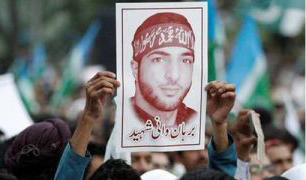
Burhan Wani was killed in an encounter with Indian security forces in the Tral region of Jammu and Kashmir on July 8, 2016.

The United Kingdom has a long memory of terror attacks. For more than 30 years from the early 1970s, the Irish Republican Army (IRA), a paramilitary group, carried out multiple attacks across the UK.

The deadliest were the Birmingham pub bombings of 1974, when 21 were killed. In 1996, the IRA detonated a massive 1500-kilogram (3300-pound) bomb in a Manchester shopping center that injured more than 200 and was not far from this year's terror attack in the Manchester Arena that claimed the lives of 23 adults and children and left 250 injured, 59 of whom were taken to hospital. Twenty three of these 59 had to be classified as critically injured.

For more than a decade, Islamist terrorism has overtaken Irish Republicanism as the key threat for British security services. On July 7 2005, a cell of four British Muslim suicide bombers inspired by al Qaeda detonated devices on the London transit network, killing 52.

Since 2005, successive British governments have warned the public to be on alert for terror attacks, elevating the threat level to "severe", the second highest alert.

The UK's MI5 has thwarted dozens of terrorist plots, mainly involving British-born would-be attackers, the latest of which took place on March 22, 2017 in the vicinity of the Palace of Westminster in London, seat of the British Parliament.

In that incident, the attacker, Khalid Masood, drove a car into pedestrians on the pavement along the south side of Westminster Bridge and Bridge Street, killing four and injuring more than 50 others. After his car crashed into the perimeter fence of the Palace grounds, Masood abandoned it and ran into New Palace Yard where he fatally stabbed an unarmed police officer. He was then shot dead by an armed police officer.

In the case of the "Burhan Wani Day", the Birmingham City Council had initially given permission for the memorial rally to be held on his first death anniversary at Victoria Square on Saturday.

Various posters were being circulated on social media advertising the event. One of them even carried a picture of the slain militant, and said: "We will take back what is ours forcefully. We will not rest until Kashmir is free from Kuffars and hoist the flag of Islamic Ummah."

The Indian Government flagged its concerns with the British Government, which led to the Birmingham City Council cancelling the event.

"We took a booking for a peaceful rally highlighting the human rights abuse in Kashmir. However, we are now aware of concerns raised about the promotional leaflet and, having assessed the material, have not given permission for the use of Victoria Square," a Birmingham Council spokesman was quoted, as saying by the Birmingham Mail.

It was reported that Deputy High Commissioner of India to the UK Dinesh Patnaik lodged a formal complaint with the Foreign and commonwealth Office (FCO), wherein he said that "allowing anti-India elements to flourish here in the name of democracy will not do".

Comments

Add new comment

  • Coastaldigest.com reserves the right to delete or block any comments.
  • Coastaldigset.com is not responsible for its readers’ comments.
  • Comments that are abusive, incendiary or irrelevant are strictly prohibited.
  • Please use a genuine email ID and provide your name to avoid reject.
Agencies
May 31,2020

New Delhi, May 31: The fourth phase of the coronavirus-triggered lockdown, which began on May 18, saw 85,974 COVID-19 cases till 8 am on Sunday, which is nearly half of the total cases reported in the country so far.

Lockdown 4.0, which will end on May 31 midnight, has accounted for 47.20 per cent of the total coronavirus infection cases, number crunching from the Union Health Ministry data reveals.

The lockdown, which was first clamped on March 25 and spanned for 21 days, had registered 10,877 cases, while the second phase of the curbs that began on April 15 and stretched for 19 days till May 3, saw 31,094 cases.

The third phase of the lockdown that was in effect for 14 days ending on May 17, recorded 53,636 cases till 8 am of May 18.

The country had registered 512 coronavirus infection cases till March 24.

India is the ninth worst-hit nation by the COVID-19 pandemic as of now.        

The first case of COVID-19 in India was reported on January 30 from Kerala after a medical student of Wuhan university, who had returned to India, tested  positive for the virus.

India registered its highest single-day spike of COVID-19 cases on Sunday, with 8,380 new infections reported in the last 24 hours, taking the country's tally to 1,82,143, while the death toll rose to 5,164, according to the Union Health Ministry.

The number of active COVID-19 cases stood to 89,995, while 86,983 people have recovered and one patient has migrated, it said.

"Thus, around 47.75 per cent patients have recovered so far," a senior Health Ministry official said.

With the fourth phase of lockdown ending on Sunday, the Home Ministry on Saturday said 'Unlock-1' will be initiated in the country from June 8 under which the nationwide lockdown will be relaxed to a great extent, including opening of shopping malls, restaurants and religious places, even as strict restrictions will remain in place till June 30 in the country's worst-hit areas.

While announcing the extension of the lockdown in containment zones across the country, the Home Ministry said temples, mosques, churches and other religious places and shopping malls will be allowed to open in a phased manner from June 8, while a decision on opening of schools and colleges will be taken in July in consultation with states.

Comments

Add new comment

  • Coastaldigest.com reserves the right to delete or block any comments.
  • Coastaldigset.com is not responsible for its readers’ comments.
  • Comments that are abusive, incendiary or irrelevant are strictly prohibited.
  • Please use a genuine email ID and provide your name to avoid reject.
Agencies
February 10,2020

New Delhi, Fevb 10: Of the countries most at risk of importing coronavirus cases, India ranks 17th, researchers have found on the basis of a mathematical model for the expected global spread of the virus that originated in China's Wuhan area in December 2019.

So far, India has reported three coronavirus positive cases -- all from Kerala.

Among the airports in India, the Indira Gandhi International Airport in New Delhi is most at risk, followed by airports in Mumbai, Kolkata, Bengaluru, Chennai, Hyderabad and Kochi, according to the model.

The new model for predicting global novel coronavirus cases has been developed by researchers from Humboldt University and Robert Koch Institute in Germany.

"The spread of the virus on an international scale is dominated by air travel," said the study.

"Wuhan, the seventh largest city in China with 11 million residents, was the relevant major domestic air transportation hub with many connecting international flights before the city was effectively quarantined on January 23, 2020, and the Wuhan airport was closed. By then the virus had already spread to other Chinese provinces as well as other countries," it added.

The researchers said that it is possible to estimate how likely it is that the virus spreads to other areas by looking at air travel passenger numbers.

"The busier a flight route, the more probable it is that an infected passenger travels this route. Using these probabilistic concepts, we calculate the relative import risk to other airports. When calculating the import risk, we also take into account connecting flights and travel routes that involve multiple destinations," said the study.

The top 10 countries and regions at risk of importing coronavirus cases are: Thailand, Japan, South Korea, Hong Kong, Taiwan, USA, Vietnam, Malaysia, Singapore and Cambodia, according to the model.

While Thailand's national import risk is 2.1%, it is 0.2% for India, found the research.

The foundation of the model is the worldwide air transportation network (WAN) that connects approximately 4,000 airports with more than 25,000 direct connections.

The model accounts for both, the current distribution of confirmed cases in mainland China as well as airport closures that were implemented as a mitigation strategy.

This network theoretic model is based on the concept of effective distance and is an extension of a model introduced in the 2013 paper "The Hidden Geometry of Complex, Network-Driven Contagion Phenomena" published in the journal Science.

The current outbreak of the 2019-nCoV virus started in Wuhan city, Hubei province, China. While the first cases were reported as early as December 8, 2019, the outbreak gained global attention on December 31, 2019, when the World Health Organization was alerted to "several cases of pneumonia" by an unknown virus.

The new virus was soon identified as a novel coronavirus and named 2019-nCOV. It belongs to the family of viruses that include the common cold and viruses such as SARS and MERS. On January 20, 2020, it was confirmed that the coronavirus can be transmitted between humans, greatly increasing the risk of a global spread.

The death toll due to the novel coronavirus outbreak in China has increased to 811 on Sunday, surpassing that of the Severe Acute Respiratory Syndrome (SARS) epidemic in 2003.

Although about 20 countries have confirmed cases, China has accounted for about 99 per cent of those infected. The first foreign victims of the virus both died on Saturday in Wuhan.

Comments

Add new comment

  • Coastaldigest.com reserves the right to delete or block any comments.
  • Coastaldigset.com is not responsible for its readers’ comments.
  • Comments that are abusive, incendiary or irrelevant are strictly prohibited.
  • Please use a genuine email ID and provide your name to avoid reject.
News Network
April 1,2020

Prayagraj,  April 1: Seven Indonesian nationals, one person from Kolkata and one from Kerala who had attended the event at Delhi's Nizamuddin Markaz have been put under quarantine, informed SP (City) Prayagraj, Brijesh Kumar Srivastava on Wednesday.

"Seven Indonesian nationals, one person from Kolkata and one from Kerala, were found at Abdullah mosque here. During the investigation, it was found that they had attended the Markaz gathering in Delhi. These people, along with 28 people who came in contact with them, have been quarantined." he said.

"A case has also been registered against them for not informing the police on reaching here," he added.

Earlier, Delhi Health Minister Satyendar Jain had said that the officials are not certain of the accurate number of people who participated in the event but it is being estimated that 1,500-1,700 people had assembled at the Markaz building.

The religious gathering was held at the Markaz building in Nizamuddin between March 13 and March 15.

The total number of active cases rose to 1466 in the country, while 132 people have been cured and discharged after receiving treatment, as of 9 am.

The number of deaths due to the infection also rose to 38, while one person has migrated.

Comments

Add new comment

  • Coastaldigest.com reserves the right to delete or block any comments.
  • Coastaldigset.com is not responsible for its readers’ comments.
  • Comments that are abusive, incendiary or irrelevant are strictly prohibited.
  • Please use a genuine email ID and provide your name to avoid reject.