


UK cancels 'Burhan Wani Day' rally in Birmingham City after India protests

Agencies
July 6, 2017

Birmingham, Jul 6: The Birmingham City Council has been forced to withdraw permission granted to the organisers of a rally titled "Burhan Wani Day" to mark the first death anniversary of Hizb-ul-Mujahideen militant/terrorist Burhan Wani here after India lodged a strong protest over the same.burhan
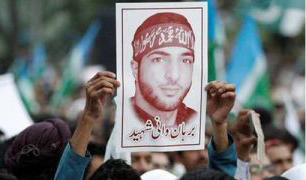
Burhan Wani was killed in an encounter with Indian security forces in the Tral region of Jammu and Kashmir on July 8, 2016.

The United Kingdom has a long memory of terror attacks. For more than 30 years from the early 1970s, the Irish Republican Army (IRA), a paramilitary group, carried out multiple attacks across the UK.

The deadliest were the Birmingham pub bombings of 1974, when 21 were killed. In 1996, the IRA detonated a massive 1500-kilogram (3300-pound) bomb in a Manchester shopping center that injured more than 200 and was not far from this year's terror attack in the Manchester Arena that claimed the lives of 23 adults and children and left 250 injured, 59 of whom were taken to hospital. Twenty three of these 59 had to be classified as critically injured.

For more than a decade, Islamist terrorism has overtaken Irish Republicanism as the key threat for British security services. On July 7 2005, a cell of four British Muslim suicide bombers inspired by al Qaeda detonated devices on the London transit network, killing 52.

Since 2005, successive British governments have warned the public to be on alert for terror attacks, elevating the threat level to "severe", the second highest alert.

The UK's MI5 has thwarted dozens of terrorist plots, mainly involving British-born would-be attackers, the latest of which took place on March 22, 2017 in the vicinity of the Palace of Westminster in London, seat of the British Parliament.

In that incident, the attacker, Khalid Masood, drove a car into pedestrians on the pavement along the south side of Westminster Bridge and Bridge Street, killing four and injuring more than 50 others. After his car crashed into the perimeter fence of the Palace grounds, Masood abandoned it and ran into New Palace Yard where he fatally stabbed an unarmed police officer. He was then shot dead by an armed police officer.

In the case of the "Burhan Wani Day", the Birmingham City Council had initially given permission for the memorial rally to be held on his first death anniversary at Victoria Square on Saturday.

Various posters were being circulated on social media advertising the event. One of them even carried a picture of the slain militant, and said: "We will take back what is ours forcefully. We will not rest until Kashmir is free from Kuffars and hoist the flag of Islamic Ummah."

The Indian Government flagged its concerns with the British Government, which led to the Birmingham City Council cancelling the event.

"We took a booking for a peaceful rally highlighting the human rights abuse in Kashmir. However, we are now aware of concerns raised about the promotional leaflet and, having assessed the material, have not given permission for the use of Victoria Square," a Birmingham Council spokesman was quoted, as saying by the Birmingham Mail.

It was reported that Deputy High Commissioner of India to the UK Dinesh Patnaik lodged a formal complaint with the Foreign and commonwealth Office (FCO), wherein he said that "allowing anti-India elements to flourish here in the name of democracy will not do".

Comments

Add new comment

  • Coastaldigest.com reserves the right to delete or block any comments.
  • Coastaldigset.com is not responsible for its readers’ comments.
  • Comments that are abusive, incendiary or irrelevant are strictly prohibited.
  • Please use a genuine email ID and provide your name to avoid reject.
Agencies
March 15,2020

New Delhi, Mar 15: The new rules for debit and credit cards to increase security and reduce frauds kick in from Monday. In January, the Reserve Bank of India (RBI) had issued new rules to improve user convenience and increase the security of card transactions. These rules will help in curbing the misuse of debit and credit cards.

RBI has directed banks to allow only domestic card transactions at ATMs and PoS terminals in India at the time of issuance/reissuance of card. For international transactions, online transactions, card-not-present transactions and contactless transactions, customers will have to separately set up services on their card.

These rules will be applicable for new cards from March 16. Those with old cards can decide whether to disable any of these features.

As per the existing rules, these services used to come automatically with the card, but now it will start at the request of the customer.

Debit or credit card customers who have not yet done any online transaction, contactless transaction or international transaction with the card, then these services on the card will automatically stop from March 16.

The Reserve Bank has asked all banks to provide mobile banking, net banking option to enable limit and enable and disable service 24 hours a day, seven days a week.

If the customer makes any change in the status of the card, the bank will alert the customer through SMS/email and send the information.

Issuers shall provide to all cardholders facility to switch on/off and set/modify transaction limits (within the overall card limit, if any, set by the issuer) for all types of transactions -- domestic and international, at PoS/ATMs/online transactions/contactless transactions, etc.,

The provisions, however, are not mandatory for prepaid gift cards and those used at mass transit systems.

The latest instructions come in the wake of rising instances of cyber frauds and the huge increase in the use of cards.

Comments

Add new comment

  • Coastaldigest.com reserves the right to delete or block any comments.
  • Coastaldigset.com is not responsible for its readers’ comments.
  • Comments that are abusive, incendiary or irrelevant are strictly prohibited.
  • Please use a genuine email ID and provide your name to avoid reject.
News Network
February 29,2020

New Delhi, Feb 29: India’s economy expanded at its slowest pace in more than six years in the last three months of 2019, with analysts predicting further deceleration as the global Covid 19 coronavirus outbreak stifles growth in Asia’s third-largest economy.

The gross domestic product (GDP) data released yesterday showed government spending, private investment and exports slowing down, while there is a slight upturn in consumer spending and improvement in rural demand lent support.

The quarterly figure of 4.7% growth matched the consensus in a Reuters poll of analysts but was below a revised - and greatly increased - 5.1% rate for the previous quarter.

The central bank has warned that downside risks to global growth have increased as a result of the coronavirus epidemic, the full effects of which are still unfolding.

Prime minister Narendra Modi’s government has taken several steps to bolster economic growth, including a privatisation push and increased state spending, after cutting corporate tax rates last September.

In its annual budget presented this month, the government estimated that annual economic growth in the financial year to March 31 would be 5%, its lowest for last 11 years.

Modi’s government is targeting a slight recovery in growth to 6% for 2020/21, still far below the level needed to generate jobs for millions of young Indians entering the labour market each month.

The annual GDP figure for the September quarter was ramped up from an earlier estimate of 4.5%, while the April-June reading was similarly lifted to 5.6% from 5%, data released by the Ministry of Statistics showed on Friday.

Capital Investment Drop

In the December quarter, private investment grew 5.9%, up from 5.6% in the previous quarter, while government spending rose by 11.8%, against 13.2% in the previous three months.

However, corporate capital investment contracted by 5.2% after a 4.1% decline in the previous quarter, indicating that interest rate cuts by the central bank have failed to encourage new investment. Manufacturing, meanwhile, contracted by 0.2%.

“It appears growth slowdown is not just cyclical but more entrenched with consumption secularly joining the slowdown bandwagon even as the investment story continues to languish,” said Madhavi Arora of Edelweiss Securities in Mumbai.

Many economists said that the government stimulus could take four to six quarters of time before lifting the economy and the impact of those efforts could be outweighed by the global fallout from the coronavirus epidemic that began in China.

“The coronavirus remains the critical risk as India depends on China for both demand and supply of inputs,” said Abheek Barua, chief economist at HDFC Bank.

Indian shares sank on Friday for a sixth session running, capping their worst week in more than a decade. The NSE Nifty 50 index shed 7.3% over the week, while the Sensex dropped 6.8%, the worst weekly declines since the 2008-09 financial crisis.

Separately, India’s infrastructure output rose 2.2% year on year in January, data showed on Friday.

A spike in inflation to a more than 5-1/2 year high of 7.59% in January is expected to make the RBI hold off from further cuts to interest rates for now, while keeping its monetary stance accommodative.

Comments

Add new comment

  • Coastaldigest.com reserves the right to delete or block any comments.
  • Coastaldigset.com is not responsible for its readers’ comments.
  • Comments that are abusive, incendiary or irrelevant are strictly prohibited.
  • Please use a genuine email ID and provide your name to avoid reject.
News Network
June 24,2020

New Delhi, Jun 24: Over 1,500 urban and multi-state cooperative banks will be brought under the supervisory power of the Reserve Bank of India (RBI), said Union Minister Prakash Javadekar on Wednesday.

"Government banks, including 1,482 urban cooperative banks and 58 multi-state cooperative banks, are now being brought under supervisory powers of Reserve Bank of India (RBI); RBI's powers as they apply to scheduled banks will apply for cooperative banks as well," Javadekar said at a press conference, through video conferencing.

"The decision to bring 1,540 cooperative banks under RBI's supervision will give an assurance to more than 8.6 crore depositors in these banks that their money amounting to Rs 4.84 lakh crore will stay safe," he added.

The Minister of Information and Broadcasting further said that the Union Cabinet has approved a scheme "for interest subvention of 2 per cent to Shishu loan category borrowers under Pradhan Mantri Mudra Yojana, outstanding as on March 31, 2020, for one year to eligible borrowers."

The Minister also said that the Union Cabinet has approved the declaration of Kushinagar Airport in Uttar Pradesh as an international airport.

Comments

Add new comment

  • Coastaldigest.com reserves the right to delete or block any comments.
  • Coastaldigset.com is not responsible for its readers’ comments.
  • Comments that are abusive, incendiary or irrelevant are strictly prohibited.
  • Please use a genuine email ID and provide your name to avoid reject.