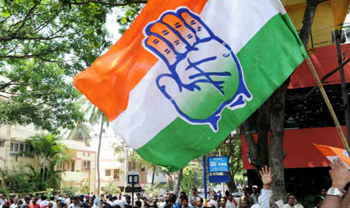
Ullal City Municipal Council bypoll: Congress candidates win both seats

[email protected] (CD Network)
February 15, 2017

Mangaluru, Feb 15: In spite of rigorous pre-poll campaign by Bharatiya Janata Party candidates, the Congress candidates have managed to register huge victories in two wards of Ullal City Municipal Council.

congressThe bypolls were held in Chembugudde and Kallapu wards of the CMC on February 12 and the results were announced today.

Sitting Congress councillor Basil D'Souza retained Chembugudde ward by defeating his closest rival Satish Chembugudde of BJP by a huge margin.

884 out of 1,520 voters had cast their votes in the ward. While D’Soza bagged 600 votes, Satish secured only 149 votes. Harish Shetty of CPM candidate managed to get only 78 votes. Kalandar, an independent candidate, finished fourth by bagging 57 votes.

In Kallapu ward, Congress candidate Usman Kallapu secured 510 votes out of 1005 votes. His closest rival was Dinakar Ullal , an independent candidate, who bagged 240 votes. BJP candidate Chandrahas Pandithouse bagged 226 votes. Ismail Shaffi of JD(S) secured only 29 votes.

Interestingly, women voters outnumbered their male counterparts in both wards.

Comments

SYED
 - 
Thursday, 16 Feb 2017

Mr. Narenanna, This is Anti Nationalists Sanghis infested area so BJP will loose obviously ...hehehehehe

Rikaz
 - 
Wednesday, 15 Feb 2017

BJP has a corrupt president in states....doubtful to win any seats...if he would win his own seat in Karnataka...that will be great job....

Naren kotian
 - 
Wednesday, 15 Feb 2017

this is jihadi infested area so khangrace will win obviously

Add new comment

  • Coastaldigest.com reserves the right to delete or block any comments.
  • Coastaldigset.com is not responsible for its readers’ comments.
  • Comments that are abusive, incendiary or irrelevant are strictly prohibited.
  • Please use a genuine email ID and provide your name to avoid reject.
News Network
March 20,2020

Thiruvananthapuram, Mar 20: One more person tested positive for coronavirus on Thursday, taking the total number of cases to 25, as the Left government announced a Rs 20,000 crore financial package to tide over the present crisis being faced by the southern state in the wake of the virus outbreak.

The multi-crore special package includes Rs 500 crore health package, Rs 2,000 crore loans and free ration.

The man who tested positive had returned from Dubai and hailed from the northern Kasaragod district, Chief Minister Pinarayi Vijayan told reporters after a COVID-19 review meeting.

He said 65 people were hospitalised on Thursday.

"At least 31,173 people are under surveillance, of whom 237 are in observation in hospitals across the state" he said.

Detailing the financial package, Vijayan said loans worth Rs 2,000 crore would be made available to needy families through all-women network 'Kudumbashree' during April-May.

Rural employment guarantee programmes worth Rs 1,000 crore each will be implemented in April-May, he said.

Social security pension of Rs 1,320 crore, to be given in April, would be distributed this month, he said, adding that 50 lakh people are benefited through the pension scheme.

Those belonging to the below poverty line (BPL) and Anthyodaya, who are not receiving social security pension, would be given Rs 1,000 each, for which Rs 100 crore would be earmarked.

Cutting across APL and BPL families, 10 kg free ration would be given and Rs 100 crore would be set apart for the purpose, he said.

A string of 1,000 low-cost hotels, providing food at Rs 20, would be opened across the state next month, the chief minister added.

The 'fitness' charges of autorickshaws and taxis and one month tax of stage and contract carriages would be waived, Vijayan said.

Comments

Add new comment

  • Coastaldigest.com reserves the right to delete or block any comments.
  • Coastaldigset.com is not responsible for its readers’ comments.
  • Comments that are abusive, incendiary or irrelevant are strictly prohibited.
  • Please use a genuine email ID and provide your name to avoid reject.
News Network
April 3,2020

Mangaluru, Apr 3: The Dakshina Kannada district administration’s decision to ban use of private vehicles, excluding permitted categories, from Friday for effective implementation of lockdown, began showing results since morning itself.

Mangaluru City Traffic Police and Dakshina Kannada district police erected several pickets at vantage places on arterial roads to check those moving without a valid reason. Several two-wheelers were seized during the checking while a few car drivers were let off with a strict warning.

Assistant Commissioner of Police (Traffic), M Manjunatha Shetty, who was supervising a picket at Hampankatta, said that movement of private vehicles has drastically reduced in the city.

Comments

Add new comment

  • Coastaldigest.com reserves the right to delete or block any comments.
  • Coastaldigset.com is not responsible for its readers’ comments.
  • Comments that are abusive, incendiary or irrelevant are strictly prohibited.
  • Please use a genuine email ID and provide your name to avoid reject.
Agencies
May 8,2020

Washington D.C., May 8: The prime time for brain development in a child's life is the first year, where the infant spends most of the time asleep. It is the time when neural connections form and sensory memories are encoded.

However, when sleep is disrupted, as occurs more often among children with autism, brain development may be affected, too.

New research led by the University of Washington finds that sleep problems in a baby's first 12 months may not only precede an autism diagnosis but also may be associated with altered growth trajectory in a key part of the brain, the hippocampus.

The study, which was published in the American Journal of Psychiatry, researchers report that in a sample of more than 400 taken of 6- to 12-month-old infants, those who were later diagnosed with autism were more likely to have had difficulty falling asleep.

It also states that this sleep difficulty was associated with altered growth trajectories in the hippocampus.

"The hippocampus is critical for learning and memory, and changes in the size of the hippocampus have been associated with poor sleep in adults and older children.

As many as 80 per cent of the children with autism spectrum disorder have sleep problems," said Annette Estes, director of the UW Autism Center and senior author of the study.

"In our clinical experience, parents have a lot of concerns about their children's sleep, and in our work on early autism intervention, we observed that sleep problems were holding children and families back," added Estes, who is also a UW professor of speech and hearing sciences.

"It could be that altered sleep is part-and-parcel of autism for some children. One clue is that behavioural interventions to improve sleep don't work for all children with autism, even when their parents are doing everything just right. This suggests that there may be a biological component to sleep problems for some children with autism," said Estes.

To consider links among sleep, brain development, and autism, researchers at the IBIS Network looked at MRI scans of 432 infants, surveyed parents about sleep patterns, and measured cognitive functioning using a standardized assessment.

At the outset of the study, infants were classified according to their risk for developing autism: Those who were at higher risk of developing autism -- about two-thirds of the study sample -- had an older sibling who had already been diagnosed.

Infant siblings of children with autism have a 20 per cent chance of developing autism spectrum disorder -- a much higher risk than children in the general population.

In the current study, 127 of the 432 infants were identified as "low risk" at the time the MRI scans were taken because they had no family history of autism.

They later evaluated all the participants at 24 months of age to determine whether they had developed autism. Of the roughly 300 children originally considered "high familial risk," 71 were diagnosed with autism spectrum disorder at that age.

Problems with sleep were more common among the infants later diagnosed with an autism spectrum disorder, as were larger hippocampi. No other subcortical brain structures were affected, including the amygdala, which is responsible for certain emotions and aspects of memory, or the thalamus, a signal transmitter from the spinal cord to the cerebral cortex.

The authors note that while parents reported more sleep difficulties among infants who developed autism compared to those who did not, the differences were very subtle and only observed when looking at group averages across hundreds of infants.

Sleep patterns in the first years of life change rapidly as infants transition from sleeping around the clock to a more adult-like sleep/wake cycle. Until further research is completed, Estes said, it is not possible to interpret challenges with sleep as an early sign of increased risk for autism.


Comments

Add new comment

  • Coastaldigest.com reserves the right to delete or block any comments.
  • Coastaldigset.com is not responsible for its readers’ comments.
  • Comments that are abusive, incendiary or irrelevant are strictly prohibited.
  • Please use a genuine email ID and provide your name to avoid reject.