Ullal Dargah Urs from April 2 to 26, preparation begins

[email protected] (CD Network)
September 10, 2014

Mangalore Press

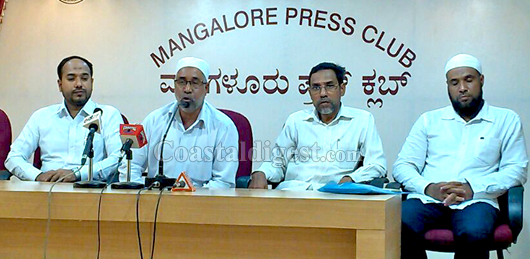
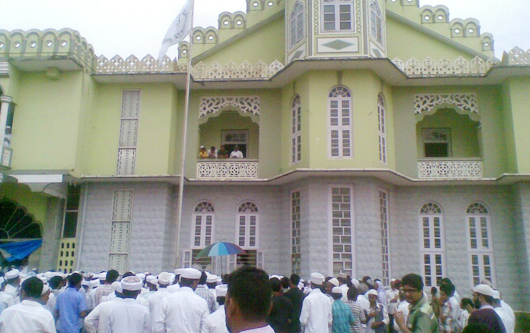
Mangalore, Sep 10: The 20th Urs celebration of the historically famous Dargah Shariff of Hazrat Seyyid Mohammed Shareeful Madani will be held for 25 days from April 2 to April 26, said president of the Dargah U S Hamza.

Announcing this at a press conference here, he said that the historically famous Urs fair was held once every five years at the Dargah Shariff at Ullal. Devotees from all over the state, as well as Kerala, Tamil Nadu, Andhra Pradesh and North India arrive to witness and be a part of the glorious celebrations, he said.

This will be the 20th Urs celebrations to be held at the dargah for the duration of 25 days. The flag hoisting ceremony was held on September 5. The Urs will begin with the monthly Zikr and every night there will be special sermons by noted Ulama scholars, he said.

He said that around 20 to 30 lakh devotees from various parts of the country were expected to participate in the Urs celebrations.

There will be monthly Zikr Majlees programme on the inaugural day, and several programmes during the duration of the Uroos including the valedictory ceremony of the Urs on April 23, he added.

Ullal uroos 5 1

Ullal uroos 5 1

Comments

Appas Majid
 - 
Wednesday, 11 Mar 2020

Coming uroos date?

Add new comment

  • Coastaldigest.com reserves the right to delete or block any comments.
  • Coastaldigset.com is not responsible for its readers’ comments.
  • Comments that are abusive, incendiary or irrelevant are strictly prohibited.
  • Please use a genuine email ID and provide your name to avoid reject.
News Network
May 12,2020

Mangaluru, May 12: Two people hailing from Udupi district tested positive for covid-19 today. The sources of this infection is said to be Mangaluru's First Neuro Hospital.

Fresh bulletin from health and family welfare department revealed that a 52-year-old woman and a 26-year-old man from Karkala in Udupi were tested positive for the deadly coronavirus.

Among them, the woman had undergone treatment at the First Neuro Hospital. She is said to have contracted the infection from P-507 who was also was tested positive  April 27. And the youth was in touch with the woman.

The duo have not visited their home in Karkala for past few days. They were in quarantine and tested positive while being admitted at the same hospital.

With this the total number of COVID-19 cases found in Dakshina Kannada district are 33 now. Three among them have died and 14 have been discharged. Now, the district has 16 active coronavirus cases.

Comments

Add new comment

  • Coastaldigest.com reserves the right to delete or block any comments.
  • Coastaldigset.com is not responsible for its readers’ comments.
  • Comments that are abusive, incendiary or irrelevant are strictly prohibited.
  • Please use a genuine email ID and provide your name to avoid reject.
News Network
January 18,2020

Bengaluru, Jan 18: Amidst the ongoing probe into the multi-billion IMA ponzi scam, another similar scam has come to light in the city wherein around 2500 depositors, most of them Muslims, are fearing that them may lose Rs 350 crore.

Shockingly, Shafiullah, Rafiullah, and Zabiullah, three brothers who run the Baraka Investment Consultant Private Limited, have accused the police of taking over 10 crore rupees bribe from them.

The depositors say that when they recently demanded their investments back from the accused the trio, they allegedly told them that they had paid the Central Crime Branch (CCB) and the RT Nagar police over 10 crores and they could collect that money from the police.

The aggrieved investors alleges that the RT Nagar police have charge-sheeted the three accused only on the complaints of 13 affected depositors who lost precisely Rs 97 lakh and the case is being probed under the Prize Chits and Money Circulation Schemes (Banning) Act, 1978 instead of Karnataka Protection of Interest of Depositors in Financial Institutions Act, 2004 (KPID Act) or the Banning of Unregulated Deposit Schemes Ordinance, 2019 (BUDS) Ordinance.

Aggrieved victims alleged that when the Baraka Investment Consultants had a Registration Certificate of Establishments from Department of Labour issued on November 28, 2017. The CCB took up a suo-motu case against Tellnet Computers on August 16, 2018, after they received complaints from Baraka investors.

Apparently, the CCB knew that Baraka Investment Consultants and Tellnet Computers was one and the same and operating from the same office, but they did not mention the name of Baraka in the case initially for reasons best known to them, said the victims of the Ponzi scheme. A few victims who wished to remain anonymous told BM that a CCB police inspector and one of the accused, Zabiullah, were childhood friends, neighbours and both hailed from Chikkaballapur. This is one of the reasons, they allege, the inspector has protected the accused by downplaying the scam.

The case registered by the CCB states that there are only 500 to 600 depositors who deposited amounts between Rs 50,000 to Rs 1 lakh expecting returns ranging from Rs 5000 to Rs 7000 a month, but in reality there are more than 2500 investors who have deposited amounts ranging from Rs 50,000 to Rs 50 lakh, expecting returns between 12% to 24%, said the victims. Despite this, the CCB was sitting on the case and making no investigations, the victims alleged.

It was later on in May 9, 2019, an FIR was registered by the RT Nagar police when many victims approached the police commissioner and petitioned him. “Even in this case, the accused Zabiullah was not arrested. Zabiullah’s two brothers, Shafiullah and Rafiullah, and his father Abdul Rahman were arrested, but were later granted conditional bails,” one of the victims Mohammed Yahya (42), a software engineer said.

Yahya had invested Rs 10 lakh with Baraka. “Though this case has been charge-sheeted, the police have not made any recoveries or they have not confiscated any properties of the accused,” alleged victim Habibur Rehman (42) who had invested Rs 5 lakh in Baraka. “There is clear-cut evidence that the accused was dealing in foreign exchange using the investors’ money without their knowledge and was offshoring and parking crores and crores in countries like Russia, Dubai, Malaysia, and Singapore. Though the police knew about this, they did nothing to stop it or bring it back,” said Azgar Pasha (44), a businessman who had invested Rs 41 lakh.


Comments

Add new comment

  • Coastaldigest.com reserves the right to delete or block any comments.
  • Coastaldigset.com is not responsible for its readers’ comments.
  • Comments that are abusive, incendiary or irrelevant are strictly prohibited.
  • Please use a genuine email ID and provide your name to avoid reject.
Media Release
February 14,2020

Veteran journalist P. Sainath has said that the nation is in a crisis. And this crisis is not limited to just the rural area. It has become a national crisis at various areas such as agriculture, education, economy, job creation etc.

He was delivering the endowment lecture on the topic ‘Indian democracy at the post-liberalization and post-truth era’ at Media Manthan 2020 organized by the PG department of journalism and mass communication at St Aloysius College (Autonomous). 

Mr Sainath said that the many policies adopted in the 90s led to India becoming unusually unequal. Referring to the speech Ambedkar had made at the Constituent Assembly while handing over the draft of the Constitution, Mr Sainath said, “Ambedkar had warned about the weakness of Indian democracy that liberty without equality allows the supremacy of a few over the multitude. Liberty, equality and fraternity must be kept together as we cannot have one without the other.” 

Mr Sainath stated that the agrarian crisis was no longer about the loss of productivity, employment or about farmer suicide; it was a societal, civilizational crisis. Commenting on the lopsided policies such as cow-slaughter ban, he explained how cow slaughter ban had adversely affected many industries due to their interdependency. While Muslims who slaughtered cows were rendered helpless, the cattle traders who were mostly OBCs lost their earnings as the cattle prices crashed. An important industry like Kolhapur sandals industry in Maharashtra went bankrupt as a result of the cow slaughter ban in Maharashtra. He said the policymakers had no idea how the rural industries were interconnected. Demonetisation too devastated the rural economy as 98 percent of rural transactions happen through cash. 

Mr Sainath also spoke about the crisis of inequality which affects the Dalits and the Adivasis far more than anyone else as 90 percent of the rural households take home less than Rs 10,000/- per month. “Women are yet another group whose labour is never counted in the gross domestic product. Women and girls globally do unpaid work which amounts to about 12.5 billion working hours per year. Monetarily speaking, this is worth 10.8 trillion dollars,” Mr Sainath added. 

Speaking about the crisis of jobs Mr Sainath said that major companies were laying off employees just to create more profits for the investors and the adoption of artificial intelligence in the industry would further destroy millions of jobs.

Rector of St Aloysius College Institutions Fr Dionysius Vaz SJ, Principal Dr (Fr) Praveen Martis SJ, HOD of Journalism and Mass Communication department Dr (Fr) Melwyn Pinto SJ were present.

‘Veerappan and Vijay Mallya’s business models are interesting!’

Addressing the gathering during his endowment lecture on Friday, Mr Sainath made an interesting comment on the so called ‘revenue model’. “Whenever I visit IIMs and IITs for lectures on my PARI project, the students there ask me what my revenue model for my project is. I tell them that I do not have a revenue model. In fact, journalism does not begin with a revenue model. Gandhiji, Ambedkar, Bhagat Singh were all great journalists. But they did not have a revenue model,” Mr Sainath said.

On a lighter note, he said that the best revenue model that he liked was that of forest brigand Veerappan and liquor baron Vijay Mallya. “Veerappan ruled the forest for forty years and from the top ministers to the villagers he could dictate terms and liver royally. Similarly, Mallya’s revenue model was to steal the banks and run away abroad and live like a king,” Mr Sainath added.

Journalism is not and can never be a business. It is a calling, he opined. While newspaper can be a business, television can be a business, journalism per se cannot be reduced to a business. “Unfortunately today, journalists are recruited on a contract basis and they have no bargaining power; and there are no unions to fight for their cause. Hence, they are at the mercy of the corporate media houses for their survival and are made to write stories that cannot be called journalism,” Mr Sainath said.

Answering a question as to the pressures he faced as a journalist, he said that external pressures from the government or others could be very well handled. It is the internal pressures from once own media house that journalists find it difficult to manage.


Comments

Add new comment

  • Coastaldigest.com reserves the right to delete or block any comments.
  • Coastaldigset.com is not responsible for its readers’ comments.
  • Comments that are abusive, incendiary or irrelevant are strictly prohibited.
  • Please use a genuine email ID and provide your name to avoid reject.