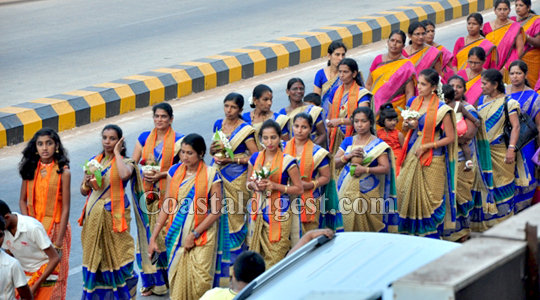
Ullal Muslims offer fruit juice to Hindu devotees during temple festival

[email protected] (CD Network | Photos by Moany Gutty)
January 7, 2017

Mangaluru, Jan 7: Amidst sporadic communal attacks and inflammatory speeches by politicians, the people of Ullal region have once again showed the world that they are the standard-bearers of peace, communal harmony and brotherhood.

ullaluliya 10

On Friday, Muslim brethren in Ullal showed an exemplary gesture that herald the message of communal harmony. While members of the Hindu community were celebrating annual festival at Sri Ullalthi Dharma Arasara Temple, Uliya in Ullal, Muslims in the region welcomed devotees by offering fruit juice. Muslim brethren not only offered soft drinks to Hindu devotees, but also extended festival wishes.

In fact, the occasion was Prathishte - Brahmakalashotsava and Dharma Nadavali Mahotsava of Sri Ullalthi Dharma Arasara Temple, which is one of the prominent Hindu shrines in the region.

The initiatives to offer fruit juice and welcome Hindu devotees to the festival was taken by the management committee of Sayyid Madani Ullal Darga, which is one of the famous Muslim shrine of South India. Minister for food, civil supplies and consumer affairs U T Khader too was behind the initiative as the region comes under his constituency - Mangaluru. Further, Khader also hails from the same place.

The initiative was well-praised by people in general and the police department in particular. Usually, police department is at the receiving end whenever incidents of communal clashes and murders report in Ullal.

Deputy Commissioner of police (crime) M Sanjeev Patil posted the pictures of Muslim brethren distributing fruit juice to Hindu devotees at the temple premises.

"Better days of Hindu - Muslim unity are here. Muslim friends have distributed cold drinks to devotees at Ullalti Amma Temple. A good initiative by Muslim youths in Ullal which needs to be continued," said Patil.


ullaluliya 1

ullaluliya 2

ullaluliya 7

ullaluliya 8

ullaluliya 9

ullaluliya 11

ullaluliya 13

ullaluliya 14

ullaluliya 15

ullaluliya 16

ullaluliya 17

ullaluliya 18

ullaluliya 19

ullaluliya 20

;">ullaluliya 21

ullaluliya 23

Comments

shaji
 - 
Sunday, 8 Jan 2017

Dear Nazeer Ullal, i do not agree with your comments. Please try to be good to others if you are a real Muslim. Islam does not spread hate. Be a model to others and dont let others to have bad image about islam and muslims. In case you cant do anything good, please dont hate anyone who does good job. If you cant appreciate them, please do not hate them.

Rikaz
 - 
Sunday, 8 Jan 2017

WE are human first....religion came afterwards....good gesture people of Ullal.....keep doing...May God bless.....

TWO EARS ATTACHED
 - 
Saturday, 7 Jan 2017

@nasser Ullal

Islam is peace and helping. A man who done bad things. And he had one good habit like feeding dogs. If Allah wills he might go to heaven.

There is no guarantee that a man pray 5 times. And his heart is full of hatred. T

Barkha Dutt
 - 
Saturday, 7 Jan 2017

@NAZEER ULLAL, AL JUBAIL KSA.... like this people should be hanged no rights to stay in india. always front to disturb the peace of society.

Anwar
 - 
Saturday, 7 Jan 2017

Nazeer Ullal,this is also a way of spreading love in society which is missing....Our Prophet had allowed Christians to pray in Masjid e Nabwi in Madina. Please spread love. Humanity is important.

Naren Bhatt
 - 
Saturday, 7 Jan 2017

Ullal people's surgical strike against a terrorist who threatened to set Dakshina Kannada on fire.

Ganesh
 - 
Saturday, 7 Jan 2017

wow two eyes are not enough to see.. that too in ullal.

Harish
 - 
Saturday, 7 Jan 2017

no words to say, just awesome.,

lalitha
 - 
Saturday, 7 Jan 2017

Integrity! good work by good muslims.

Khader
 - 
Saturday, 7 Jan 2017

hatsoff muslim brothers! indeed a great initiate for the happy society.

Rajeshwari
 - 
Saturday, 7 Jan 2017

good job muslim brothers, will unite to make india better.

jayaraj
 - 
Saturday, 7 Jan 2017

wow just wonderful to see this, amazing!!!

Mahesh
 - 
Saturday, 7 Jan 2017

nowhere can be seen like this, this only happens in mangalore.

NAZEER ULLAL
 - 
Saturday, 7 Jan 2017

this is not islam.....instead of serving them, the idol worshippers, let them serve the needy poor people. no where is mr. abdul rasheed haji the president of darga ullal?????

Add new comment

  • Coastaldigest.com reserves the right to delete or block any comments.
  • Coastaldigset.com is not responsible for its readers’ comments.
  • Comments that are abusive, incendiary or irrelevant are strictly prohibited.
  • Please use a genuine email ID and provide your name to avoid reject.
News Network
February 28,2020

Bengaluru, Feb 28: Historian S. Shettar, 85, breathed his last early on February 28 in Bengaluru. He was suffering from respiratory problems and was hospitalised for over a week.

Shettar was known for his multi-disciplinary work, encompassing linguistics, epigraphy, anthropology, the study of religions and art history. He had extensively worked on the Jain practice of ritual death in Karnataka and Asoka edicts. He had studied and compiled early edicts in Kannada and worked extensively on the growth of Kannada language down the ages.

Born in 1935 at Hampasagara, Ballari district, he went on to study at Cambridge University and started his career as a Professor of History at Karnatak University, Dharwad, his alma mater. He later headed the National Museum Institute of the History of Art, Conservation and Museology in 1978 and Indian Council for Historical Research in 1996. He was also a visiting professor at the National Institute of Advanced Studies, Bengaluru.

He was a bilingual historian who wrote in English for most of his career, but started writing in Kannada in later years. In the last two decades, he developed a keen interest in linguistics and wrote multiple books on classical Kannada and Prakrit. His 2007 book “Shangam Tamilagam” is considered a seminal work in the study of the early period of Dravidian languages. It won him Bhasha Samman from Central Sahitya Akademi. He later wrote two works on Halegannada, classical Kannada. His most recent work was “Prakrita Jagadvalaya” in 2018.

Comments

Add new comment

  • Coastaldigest.com reserves the right to delete or block any comments.
  • Coastaldigset.com is not responsible for its readers’ comments.
  • Comments that are abusive, incendiary or irrelevant are strictly prohibited.
  • Please use a genuine email ID and provide your name to avoid reject.
News Network
July 15,2020

Bengaluru, Jul 15: Toyota Kirloskar Motor (TKM) has announced temporary halt of production at its plant in Bidadi, which is on the outskirts of Bengaluru.

“Halting production will be from July 14 (second shift) to July 22 (first shift) and this is in accordance with the directives issued by the Government of Karnataka as well as to support the Govt. in their constant efforts to flatten the curve of the rising Covid-19 positive cases in Karnataka,” a statement from the company said.

Bengaluru Urban and Rural, and other districts are, are under lockdown from 8 pm on July 14 to 5 am on July 22.

“Since the onset of the pandemic, TKM has adopted a very proactive and multi-faceted approach to safeguard the physical as well as the mental well-being of all its stakeholders including customers, its employees, dealer and supplier partners,” the company said.

“The office staff at TKM’s corporate and regional offices, continue to work from home to help mitigate risks. In addition to the safety protocols that are being followed, TKM has provided safety kits containing essential items like sanitisers, 3 ply masks and handwashes to 5000 employees, their family members and their neighbourhoods.

“TKM understands the urgency of the situation. During these difficult times, TKM is taking obligatory actions to contain further spread and will continue to respond in accordance with guidance issued by the Government and its internal standards,” it added.

Comments

Add new comment

  • Coastaldigest.com reserves the right to delete or block any comments.
  • Coastaldigset.com is not responsible for its readers’ comments.
  • Comments that are abusive, incendiary or irrelevant are strictly prohibited.
  • Please use a genuine email ID and provide your name to avoid reject.
News Network
April 2,2020

The current physical distancing guidelines provided by the World Health Organisation (WHO) and by the US Centers for Disease Control and Prevention (CDC) may not be adequate to curb the coronavirus spread, according to a research which says the gas cloud from a cough or sneeze may help virus particles travel up to 8 metres. The research, published in the Journal of the American Medical Association, noted that the the current guidelines issued by the WHO and CDC are based on outdated models from the 1930s of how gas clouds from a cough, sneeze, or exhalation spread.

Study author, MIT associate professor Lydia Bourouiba, warned that droplets of all sizes can travel 23 to 27 feet, or 7-8 metres, carrying the pathogen.

According to Bourouiba, the current guidelines are based on "arbitrary" assumptions of droplet size, "overly simplified", and "may limit the effectiveness of the proposed interventions" against the deadly pandemic.

 She explained that the old guidelines assume droplets to be one of two categories, small or large, taking short-range semi-ballistic trajectories when a person exhales, coughs, or sneezes.

However based on more recent discoveries, the MIT scientist said, sneezes and coughs are made of a puff cloud that carries ambient air, transporting within it clusters of droplets of a wide range of sizes.

Bourouiba warned that this puff cloud, with ambient air entrapped in it, can offer the droplets moisture and warmth that can prevent it from evaporation in the outer environment.

"The locally moist and warm atmosphere within the turbulent gas cloud allows the contained droplets to evade evaporation for much longer than occurs with isolated droplets," she said.

"Under these conditions, the lifetime of a droplet could be considerably extended by a factor of up to 1000, from a fraction of a second to minutes," the researcher explained in the study.

The MIT scientist, who has researched the dynamics of coughs and sneezes for years, added that these droplets settle along the trajectory of a cough or sneeze contaminating surfaces, with their residues staying suspended in the air for hours.

"Even when maximum containment policies were enforced, the rapid international spread of COVID-19 suggests that using arbitrary droplet size cutoffs may not accurately reflect what actually occurs with respiratory emissions, possibly contributing to the ineffectiveness of some procedures used to limit the spread of respiratory disease," Bourouiba wrote in the study

Comments

Add new comment

  • Coastaldigest.com reserves the right to delete or block any comments.
  • Coastaldigset.com is not responsible for its readers’ comments.
  • Comments that are abusive, incendiary or irrelevant are strictly prohibited.
  • Please use a genuine email ID and provide your name to avoid reject.