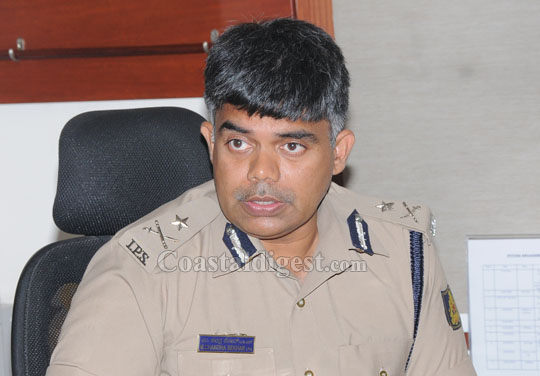
Ullal stabbings: One held, more arrests likely; 'All 5 victims are innocents'

[email protected] (CD Network | Suresh)
April 27, 2016

Mangaluru, Apr 27: After three incidents of stabbing occurred in Ullal and surrounding areas wherein five Muslim youths were injured, police managed to arrest a teenager in connection with the first attack.
commissnr 1

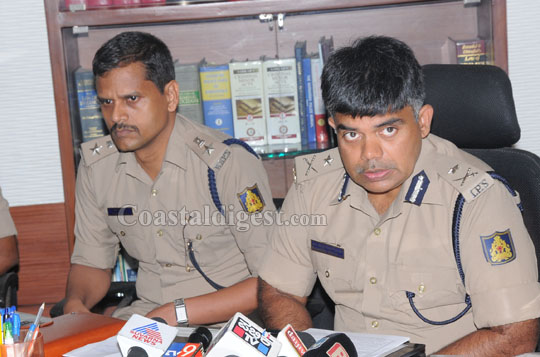
Mangaluru city police commissioner M Chandra Sekhar said that Shivaraj alias Shiva (19), a resident of Kumpala and an electrician by profession, was arrested in connection with the attack on Ibrahim Hassan, who was targeted early on Monday morning, when he was on his way to fishing port in Mangaluru from Ullal.

The top cop of the city said that the police are trying to confirm whether he had involved in two subsequent attacks reported on the same day under the limits of Ullal police station.

Hours after attack on Ibrahim Hassan on Monday a gang of five miscreants had attacked Safwan (24), Saleem (22) and Nizam (22), who work with a catering contractor. Later on Tuesday another youth identified as Safwan (27), a resident of Patla, Kallapu, was allegedly attacked with weapons by about four miscreants when he was coming out of his house.

According to Mr Chandra Sekhar all five victims were innocents without having any criminal background. Raju Kotian, who was hacked to death by a few miscreants a few days ago, was also innocent, he said.

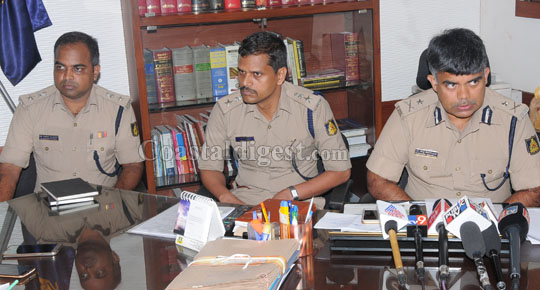
Expressing confidence to nab all the culprits behind the attacks Mr Chandra Sekhar told media persons that a special team had already been formed comprising of ACP Kalyan Shetty, CCB inspector Valentine D'Souza, and inspectors of Konaje and Panambur police stations.

Giving a stern warning to trouble mongers against targeting innocents, he said that the cops will be ruthless towards anti-social elements. “Police have already interrogated around 10 suspects and soon all the accused will be arrested,” he said.

As part of precautionary measures, the commissioner, said that a prohibitory order under Section 144 was imposed in Ullal area between April on April 26 and 27.

He also said that the security was stepped up in Ullal area. “As many as 10 KSRP platoons, 5 ASPs, 8 inspectors, 6 SIs, 10 ASIs besides 260 police personnel were additionally deployed in the area,” he said.

Also Read: Tension grips Ullal after murder bid on four Muslim youths; security tightened
commissnr 1

commissnr 1

Comments

HONEST
 - 
Wednesday, 27 Apr 2016

The MORALS taught in NAGPUR is BLINDING our YOUTH... The HINDU parents should alert their family members about the deception and LIES of the cheddis... More YOUTHs falling and trapping in the name of religion by the cheddis who destroy the family LIFE.

Add new comment

  • Coastaldigest.com reserves the right to delete or block any comments.
  • Coastaldigset.com is not responsible for its readers’ comments.
  • Comments that are abusive, incendiary or irrelevant are strictly prohibited.
  • Please use a genuine email ID and provide your name to avoid reject.
Media Release
February 14,2020

Veteran journalist P. Sainath has said that the nation is in a crisis. And this crisis is not limited to just the rural area. It has become a national crisis at various areas such as agriculture, education, economy, job creation etc.

He was delivering the endowment lecture on the topic ‘Indian democracy at the post-liberalization and post-truth era’ at Media Manthan 2020 organized by the PG department of journalism and mass communication at St Aloysius College (Autonomous). 

Mr Sainath said that the many policies adopted in the 90s led to India becoming unusually unequal. Referring to the speech Ambedkar had made at the Constituent Assembly while handing over the draft of the Constitution, Mr Sainath said, “Ambedkar had warned about the weakness of Indian democracy that liberty without equality allows the supremacy of a few over the multitude. Liberty, equality and fraternity must be kept together as we cannot have one without the other.” 

Mr Sainath stated that the agrarian crisis was no longer about the loss of productivity, employment or about farmer suicide; it was a societal, civilizational crisis. Commenting on the lopsided policies such as cow-slaughter ban, he explained how cow slaughter ban had adversely affected many industries due to their interdependency. While Muslims who slaughtered cows were rendered helpless, the cattle traders who were mostly OBCs lost their earnings as the cattle prices crashed. An important industry like Kolhapur sandals industry in Maharashtra went bankrupt as a result of the cow slaughter ban in Maharashtra. He said the policymakers had no idea how the rural industries were interconnected. Demonetisation too devastated the rural economy as 98 percent of rural transactions happen through cash. 

Mr Sainath also spoke about the crisis of inequality which affects the Dalits and the Adivasis far more than anyone else as 90 percent of the rural households take home less than Rs 10,000/- per month. “Women are yet another group whose labour is never counted in the gross domestic product. Women and girls globally do unpaid work which amounts to about 12.5 billion working hours per year. Monetarily speaking, this is worth 10.8 trillion dollars,” Mr Sainath added. 

Speaking about the crisis of jobs Mr Sainath said that major companies were laying off employees just to create more profits for the investors and the adoption of artificial intelligence in the industry would further destroy millions of jobs.

Rector of St Aloysius College Institutions Fr Dionysius Vaz SJ, Principal Dr (Fr) Praveen Martis SJ, HOD of Journalism and Mass Communication department Dr (Fr) Melwyn Pinto SJ were present.

‘Veerappan and Vijay Mallya’s business models are interesting!’

Addressing the gathering during his endowment lecture on Friday, Mr Sainath made an interesting comment on the so called ‘revenue model’. “Whenever I visit IIMs and IITs for lectures on my PARI project, the students there ask me what my revenue model for my project is. I tell them that I do not have a revenue model. In fact, journalism does not begin with a revenue model. Gandhiji, Ambedkar, Bhagat Singh were all great journalists. But they did not have a revenue model,” Mr Sainath said.

On a lighter note, he said that the best revenue model that he liked was that of forest brigand Veerappan and liquor baron Vijay Mallya. “Veerappan ruled the forest for forty years and from the top ministers to the villagers he could dictate terms and liver royally. Similarly, Mallya’s revenue model was to steal the banks and run away abroad and live like a king,” Mr Sainath added.

Journalism is not and can never be a business. It is a calling, he opined. While newspaper can be a business, television can be a business, journalism per se cannot be reduced to a business. “Unfortunately today, journalists are recruited on a contract basis and they have no bargaining power; and there are no unions to fight for their cause. Hence, they are at the mercy of the corporate media houses for their survival and are made to write stories that cannot be called journalism,” Mr Sainath said.

Answering a question as to the pressures he faced as a journalist, he said that external pressures from the government or others could be very well handled. It is the internal pressures from once own media house that journalists find it difficult to manage.


Comments

Add new comment

  • Coastaldigest.com reserves the right to delete or block any comments.
  • Coastaldigset.com is not responsible for its readers’ comments.
  • Comments that are abusive, incendiary or irrelevant are strictly prohibited.
  • Please use a genuine email ID and provide your name to avoid reject.
News Network
June 3,2020

Bengaluru, Jun 3: Deputy Chief Minister CN Ashwath Narayan on Tuesday invited investors in the Electronics System and Design Manufacturing (ESDM) sector to Karnataka, as the state contributes 64 per cent to the sector's total exports from the nation.

During a video conference organised by Invest India for a few select states with leading ESDM players across the globe, Narayan said, "We are the largest chip design hub and home to 70 per cent of India's chip designers."

Karnataka has introduced industry-friendly policies from the beginning and it continues to be the leader in attracting technology-specific investments, he added.

"Karnataka has an estimated GSDP of almost USD 220 billion. We were the first to come out with IT, BT, ESDM, and AVGC (Animation, Visual Effects, Gaming, and Comics) policies to give a push to the growth of the technology sectors and innovation. We also have vibrant automobiles, agro, aerospace, textile and garment, and heavy engineering industries," Narayan explained.

"We have created sector-specific SEZs for key industries such as IT, biotechnology and engineering, food processing and aerospace,'' he said.

However, the state government is planning ahead as it has initiated talks with other countries.

"We have held multiple consultations with the private sector to seek inputs for returning to business as we ease the COVID-19 lockdown restrictions. We are also initiating dialogue with countries across the globe to understand future plans for their companies in the post COVID era and discuss how the Karnataka government can support that," the Deputy Chief Minister stated.

"Karnataka has attracted cumulative FDI inflows in the state from 2000 to 2019 which were recorded at USD 42.3 billion," he said.

Referring to the Karnataka ESDM policy 2017-2022, Narayan further said, "We aim to stimulate the growth of 2,000 ESDM start-ups during the policy period and create 20 lakh new jobs by 2025.

Comments

Add new comment

  • Coastaldigest.com reserves the right to delete or block any comments.
  • Coastaldigset.com is not responsible for its readers’ comments.
  • Comments that are abusive, incendiary or irrelevant are strictly prohibited.
  • Please use a genuine email ID and provide your name to avoid reject.
News Network
May 8,2020

Mangaluru, May 8: Migrant workers, stranded in Karnataka due to lockdown, staged a protest on Friday at the Central Railway Station here, demanding to be sent back to their respective native places.

The workers demanded the state government to take measures and send them back to their homes.

Maintaining social distancing and covering their faces with masks, the workers were holding placards which read -- "We want to go home Jharkhand, We want justice and we want to go home."

They appealed to the state government to arrange trains and buses to ferry them to their native places and threatened to walk home if denied transport.

Several protests have erupted in different parts of the country, such as Andhra Pradesh and Kerala, as stranded labourers took to the roads demanding to be sent back home.

The Ministry of Home Affairs on May 1 had issued an order to extend the ongoing lockdown by two more weeks from May 4 with some relaxations.

Comments

Add new comment

  • Coastaldigest.com reserves the right to delete or block any comments.
  • Coastaldigset.com is not responsible for its readers’ comments.
  • Comments that are abusive, incendiary or irrelevant are strictly prohibited.
  • Please use a genuine email ID and provide your name to avoid reject.